


Farmers and activists against land expropriation yesterday filed an application with the Ministry of the Interior (MOI) to void permission for Miaoli County Government to take over farmland in Jhunan Township (竹南), saying the county government did not complete all the legally required processes before starting the expropriations.
They also called on the public to join an overnight protest tonight.
The Miaoli County Government is taking over 28 hectares of farmland in Jhunan Township’s Dapu Borough (大埔), a farming village, to make way for the expansion of Jhunan Science Park.
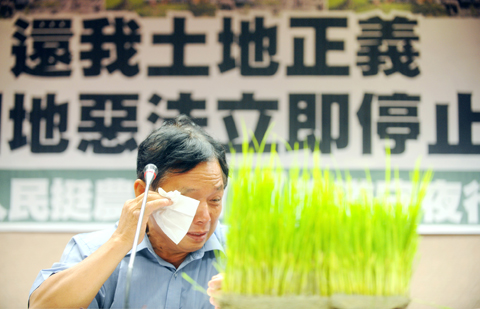
PHOTO: LO PEI-DER, TAIPEI TIMES
Last month, excavators dispatched by the county government forced their way into rice paddies and destroyed rice plants, despite opposition from local farmers.
“Miaoli County Commissioner Liu Cheng-hung [劉政鴻] said the county government was acting according to the law and had completed the legal process to transfer land ownership, but we don’t think so,” Thomas Chan (詹順貴), an attorney and a member of the Taiwan Rural Front, told a press conference yesterday.
“We discovered that the county government’s land expropriation notice was posted nearly half a year before the project was approved by the MOI last year,” Chan said. “That is unlawful.”
Besides farmers from Dapu, residents who are facing a similar situation in Houlong Township (後龍), Miaoli County, Erlin Township (二林), Changhua County, Jhudong (竹東) Township and Jhubei (竹北) City in Hsinchu County and Tucheng City (土城), Taipei County, also stood beside the farmers of Dapu.
National Chengchi University’s Department of Land Economics chairman Hsu Shih-jung (徐世榮) lashed out at the government for overusing its land expropriation powers.
“In many other countries, land expropriation is the last thing that the government wants to do, to take over private land, but in Taiwan it seems to be the No. 1 means of getting land,” Hsu said.
He said that in Europe and North America, as well as in Japan, it would sometimes take more than 10 years for a government to negotiate with landowners on an expropriation.
“In Taiwan, the Miaoli County Government only took months to complete the whole process,” he said.
“Japan is 10 times bigger than Taiwan in terms of land area, but Taiwan has 10 times the number of forced expropriation cases,” Hsu said, calling on the government to revise the Land Expropriation Act (土地徵收法) to offer better protection to landowners.
After the press conference, farmers and activists walked to the MOI to hand over their petition.
The protesters — who numbered fewer than 10 — were stopped by the police before they were able to get into the MOI building, which led to verbal clashes with officers.
“We only wanted to go into the building to hand over the petition, why are you stopping us?” Taiwan Rural Front spokeswoman Tsai Pei-hui (蔡培慧) shouted.
Police officers insisted they could only give their petition to an MOI representative outside the building.
The activists also called on the public to join an overnight protest against forced land expropriations on Ketagalan Boulevard in front of the Presidential Office tonight starting at 6:30pm.

EXCUSES: Beijing is using government and research vessels as a pretext to harass the nation and enter its EEZ, and engage in ‘hegemonic expansion,’ the coast guard said The Coast Guard Administration yesterday said it drove away Chinese oceanographic research vessel Xiang Yang Hong 22 (向陽紅33) from restricted waters after warning it that it was in Taiwan’s exclusive economic zone (EEZ). The Chinese vessel entered restricted waters off the coast of Yilan County’s Suao (蘇澳) at 11:35pm on Thursday, the coast guard said, adding that it dispatched the Lanyu patrol vessel and the boat PP-10077 to shadow the Chinese ship and issue radio warnings ordering it to leave. China has no sovereignty over waters off Taiwan’s east coast, Lanyu’s crew told Xiang Yang Hong 22 over the radio, and demanded

BAIT AND SWITCH: Allowing KMT-run counties to sell to China while the threat of abrupt cancelations hangs overhead is another form of coercion, officials said Beijing is using agricultural purchase offers announced during the Straits Forum to deepen Taiwan’s dependence on the Chinese market, a Taiwanese official said yesterday as they criticized the Taitung County commissioner’s participation in the initiative. During the Straits Forum held in Xiamen on Saturday, Chinese officials announced a sales and purchase agreement for agricultural products from some counties led by the Chinese Nationalist Party (KMT). Taitung County Commissioner Yao Ching-ling (饒慶鈴), who was barred from attending the event in person by the Mainland Affairs Council, participated via video. Under the agreement, China would purchase atemoyas, pomeloes, tea and grouper harvested in Taitung,
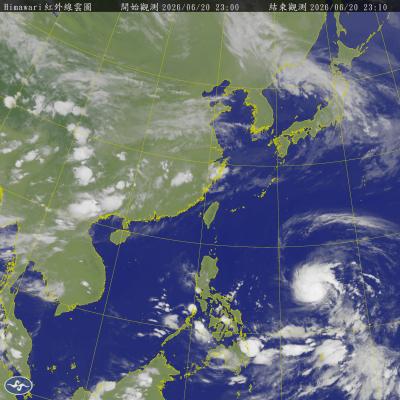
Tropical Storm Mekkhala is forecast to strengthen into a typhoon tomorrow and could come close enough to Taiwan later in the week to prompt a sea warning, the Central Weather Administration (CWA) said yesterday. As of 2 pm, the storm was located 1,870 kilometers southeast of Taiwan's southern tip and moving west- northwest at 23 km per hour. CWA forecaster Cheng Chieh-jen (鄭傑仁) said Mekkhala is expected to continue moving west-northwest through Tuesday under the influence of the Pacific high- pressure system before gradually turning north toward waters east of Taiwan or south of the Ryukyu Islands. The timing and angle of the

Four Taiwanese universities have been ranked among the world's top 200 institutions in the Quacquarelli Symonds (QS) World University Rankings for next year, the highest Taiwan has ever placed in the category, with National Taiwan University (NTU) achieving its best performance at 54th globally and 17th in Asia. The four Taiwanese institutions in the global top 200 are NTU (54th), National Tsing Hua University (142nd), National Yang Ming Chiao Tung University (177th) and National Cheng Kung University (191st), the rankings showed. All four universities achieved their highest-ever global rankings this year, QS data showed. National Cheng Kung University entered the top 200 for


 RSS
RSS