


Lavishly praised by Beijing, bitterly debated in Taipei and calmly accepted in Washington, last week’s landmark trade deal between Taiwan and China is underscoring shifting relations between them and the US.
By slashing tariffs and offering preferential investment terms, the Economic Cooperation Framework Agreement (ECFA) signed on Tuesday may bring Taiwan’s and China’s economies closer and pave the way for a formal end to hostilities.
However, as Beijing and Taipei grow closer — and China’s global clout increases — long-standing US security ties with democratic Taiwan are coming under pressure.
“There are high-ranking people in the US like senior retired military officers, who are speaking out against the relationship,” said military analyst Alexander Huang (黃介正), of Taipei’s Tamkang University. “The US government assures us that they do not reflect official policy, but it is important to take them seriously.”
For the moment, Washington is emphasizing the positive in the triangular relationship. The US State Department applauded the ECFA as an improvement in Taiwan-China relations and hoped the trend would continue.
For President Ma-Ying jeou (馬英九), the trade agreement crowns a two-year effort to build a relationship with long-time rival Beijing. Presidential Office Spokesman Lo Chih-chiang (羅智強) said better relations with China have strengthened Taiwan’s ties with Washington. He points to a recent US$6.4 billion sale of cutting-edge US weaponry.
“During the [former president] Chen Shui-bian (陳水扁) era, the mutual trust between the US and Taiwan was totally gone,” Lo said. “Taiwan’s relations with the US got better only after President Ma Ying-jeou made efforts to improve cross-strait ties, as reflected in the progress in arms procurement.”
However, once Taiwan’s partner in confronting communist-ruled China, Washington now seeks Beijing’s help in confronting global problems — the financial crisis, nuclear proliferation, climate change. That gives Beijing leverage. It has launched a lobbying effort in Washington to squelch the long-standing US security relationship with Taiwan.
Ma’s willingness to court Beijing has caused some to suggest that Taiwan may go the way of Finland, which during the Cold War took positions at odds with the West so as not to anger the neighboring Soviet Union and ensure its survival as an independent country.
Some of Ma’s actions have fed the perception of a pro-Beijing tilt.
In April, he told a television interviewer that “we will never ask Americans to fight for Taiwan,” seemingly undermining Washington’s policy of ambiguity on whether it would aid Taiwan if China attacked.
He has also ordered Taiwan’s armed forces to shift priorities to disaster response and away from defending against a Chinese attack.
Overall military spending has dropped slightly under Ma, to about 2.6 percent of GDP from 3 percent, according to Taiwan military analysts.
From trade ties to defense, Taiwan’s opposition, the Democratic Progressive Party (DPP), says Ma is weakening Taiwanese sovereignty and thereby increasing the chances the democratic island will eventually have to accept China’s rule.
At risk for some US defense planners is US naval supremacy in the Western Pacific. Taiwan sits in the middle of the so-called first island chain that extends from Japan through the Philippines and that some analysts say is a bulwark against China’s eastward maritime expansion toward key Pacific shipping lanes.
Should China and Taiwan grow so close that the nation’s territorial waters would fall under the Chinese naval control, “the ability of the US navy to operate in that area of the Pacific would be constrained,” University of Miami China specialist June Teufel Dreyer said.
Others contend that “Finlandization” would benefit the US.
Bud Cole, a China specialist at the National War College in Washington, said Taiwan’s strategic value is overblown and that its absorption by China would not “significantly weaken the US strategic position in Asia.”
Taiwan-China reconciliation would also give Washington a reason to ditch arms sales to Taiwan and remove a major irritant in ties with Beijing, some said.
In a sign that reasoning is making headway, Senate Intelligence Committee Chairwoman Diane Feinstein last month called the most recent sale “a mistake.” A retired admiral, William Owens, has also called for ending the sales.
Former Pentagon official Thomas Mahnken believes reducing the sales would send the wrong signal to Japan and South Korea, long Washington’s key partners in the Pacific. Still, he said, Washington’s resistance may be waning.
“A key question is, how much longer will American political leaders be willing to take the Chinese pressure that comes with arms sales to Taiwan,” Mahnken said. “I’m really not sure.”
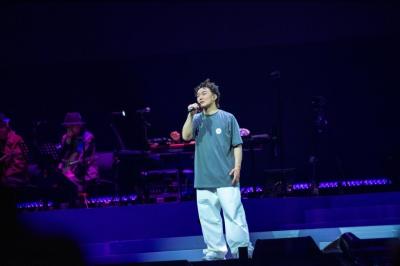
Hong Kong singer Eason Chan’s (陳奕迅) concerts in Kaohsiung this weekend have been postponed after he was diagnosed with Covid-19 this morning, the organizer said today. Chan’s “FEAR and DREAMS” concert which was scheduled to be held in the coming three days at the Kaohsiung Arena would be rescheduled to May 29, 30 and 31, while the three shows scheduled over the next weekend, from May 23 to 25, would be held as usual, Universal Music said in a statement. Ticket holders can apply for a full refund or attend the postponed concerts with the same seating, the organizer said. Refund arrangements would
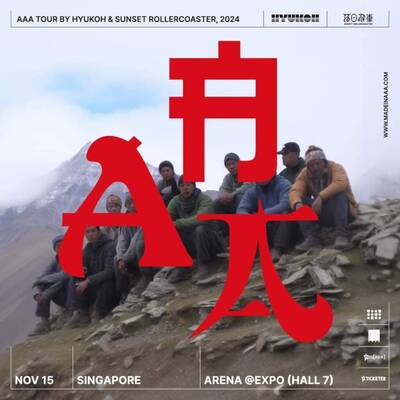
Taiwanese indie band Sunset Rollercoaster and South Korean outfit Hyukoh collectively received the most nominations at this year’s Golden Melody Awards, earning a total of seven nods from the jury on Wednesday. The bands collaborated on their 2024 album AAA, which received nominations for best band, best album producer, best album design and best vocal album recording. “Young Man,” a single from the album, earned nominations for song of the year and best music video, while another track, “Antenna,” also received a best music video nomination. Late Hong Kong-American singer Khalil Fong (方大同) was named the jury award winner for his 2024 album
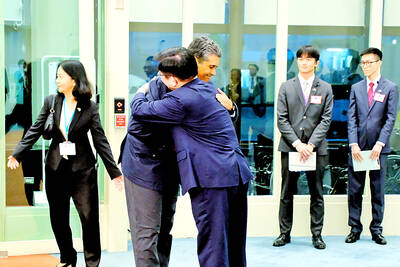
Palauan President Surangel Whipps Jr arrived in Taiwan last night to kick off his first visit to the country since beginning his second term earlier this year. After arriving at Taoyuan International Airport at around 6:30 pm, Whipps and his delegation were welcomed by Minister of Foreign Affairs Lin Chia-lung (林佳龍). Speaking to gathered media, the Palauan leader said he was excited and honored to be back in Taiwan on his first state visit to Taiwan since he was sworn in this January. Among those traveling with Whipps is Minister of State Gustav N. Aitaro, Public Infrastructure
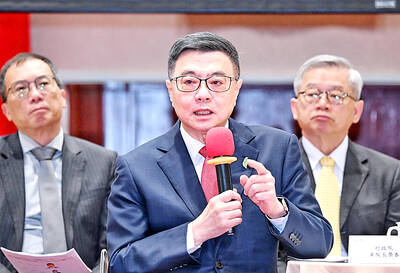
Premier Cho Jung-tai (卓榮泰) on Friday laid out the Cabinet’s updated policy agenda and recapped the government’s achievements ahead of the one-year anniversary of President William Lai’s (賴清德) inauguration. Cho said the government had made progress across a range of areas, including rebuilding Hualien, cracking down on fraud, improving pedestrian safety and promoting economic growth. “I hope the public will not have the impression that the Cabinet only asked the legislature to reconsider a bunch of legal amendments,” Cho said, calling the moves “necessary” to protect constitutional governance and the public’s interest. The Cabinet would work toward achieving its “1+7” plan, he said. The


 RSS
RSS