


Despite a partisan dispute over procedural issues, the Executive Yuan hopes that the legislature will pass the Economic Cooperation Framework Agreement (ECFA) with China by late next month to facilitate its implementation on Jan. 1 next year, an official said yesterday.
The agreement, which was signed on Tuesday in the Chinese city of Chongqing, was approved by the Executive Yuan on Thursday and forwarded immediately to the Legislative Yuan for review.
The legislature is currently in its summer recess, but is planning to begin a one week special legislative session on Wednesday, mainly to deal with the agreement.

PHOTO: LIAO CHEN-HUEI, TAIPEI TIMES
However, there have been concerns that political wrangling might impede the session’s proceedings in light of the differences between the party caucuses on the procedure for reviewing the ECFA.
The Democratic Progressive Party (DPP) caucus said that the agreement should be screened clause-by-clause. However, the Chinese Nationalist Party (KMT) caucus said the legislature did not have the power to unilaterally alter the agreement and could only endorse or reject it in entirety.
An official who spoke on condition of anonymity said there were precedents in which free-trade agreements signed between Taiwan and other countries, such as Guatemala, Nicaragua, El Salvador and Honduras, have been reviewed clause-by-clause in the legislature, although their contents were not changed.
The official urged the legislators to sort out their differences on the issue.
KMT caucus whip Lin Hung-chih (林鴻池) said his caucus hoped inter-party negotiations would be held on the ECFA in the upcoming provisional session.
A second provisional session could be held one month later, when the negotiation deadline has passed, to enact the agreement, Lin said.
Meanwhile, head of the DPP’s policy committee Ker Chien-ming (柯建銘) reiterated his party’s stance that the controversy over the ECFA-screening method must first be resolved in the upcoming provisional session before the legislature can begin screening the agreement.

Taiwanese paleontologists have discovered fossil evidence that pythons up to 4m long inhabited Taiwan during the Pleistocene epoch, reporting their findings in the international scientific journal Historical Biology. National Taiwan University (NTU) Institute of Ecology and Evolutionary Biology associate professor Tsai Cheng-hsiu (蔡政修) led the team that discovered the largest snake fossil ever found in Taiwan. The single trunk vertebra was discovered in Tainan at the Chiting Formation, dated to between 400,000 and 800,000 years ago in the Middle Pleistocene, the paper said. The area also produced Taiwan’s first avian fossil, as well as crocodile, mammoth, saber-toothed cat and rhinoceros fossils, it said. Discoveries

Taiwanese paleontologists have discovered fossil evidence that pythons up to 4m long inhabited Taiwan during the Pleistocene epoch, reporting their findings in the international scientific journal Historical Biology. National Taiwan University (NTU) Institute of Ecology and Evolutionary Biology associate professor Tsai Cheng-hsiu (蔡政修) led the team that discovered the largest snake fossil ever found in Taiwan. A single trunk vertebra was discovered in Tainan at the Chiting Formation, dated to between 800,000 to 400,000 years ago in the Middle Pleistocene, the paper said. The area also produced Taiwan’s first avian fossil, as well as crocodile, mammoth, sabre-toothed cat and rhinoceros fossils, it said. Discoveries

Whether Japan would help defend Taiwan in case of a cross-strait conflict would depend on the US and the extent to which Japan would be allowed to act under the US-Japan Security Treaty, former Japanese minister of defense Satoshi Morimoto said. As China has not given up on the idea of invading Taiwan by force, to what extent Japan could support US military action would hinge on Washington’s intention and its negotiation with Tokyo, Morimoto said in an interview with the Liberty Times (sister paper of the Taipei Times) yesterday. There has to be sufficient mutual recognition of how Japan could provide
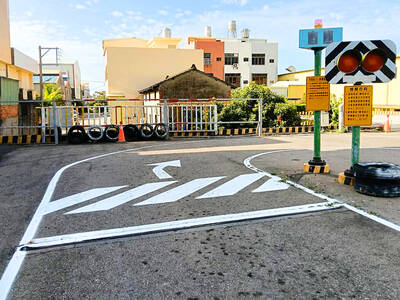
UPDATED TEST: The new rules aim to assess drivers’ awareness of risky behaviors and how they respond under certain circumstances, the Highway Bureau said Driver’s license applicants who fail to yield to pedestrians at intersections or to check blind spots, or omit pointing-and-calling procedures would fail the driving test, the Highway Bureau said yesterday. The change is set to be implemented at the end of the month, and is part of the bureau’s reform of the driving portion of the test, which has been criticized for failing to assess whether drivers can operate vehicles safely. Sedan drivers would be tested regarding yielding to pedestrians and turning their heads to check blind spots, while drivers of large vehicles would be tested on their familiarity with pointing-and-calling


 RSS
RSS