


Taipei Society members yesterday criticized the Referendum Review Committee’s decision to block a referendum proposal submitted by the Taiwan Solidarity Union (TSU) about the government’s plan to sign an economic cooperation framework agreement (ECFA) with China and challenged the committee members to a debate.
“Since I was a child, I have been taught that the government’s power comes from the people and I’ve never been taught that the people need the government’s consent to execute their power,” Taipei Society executive member Hung Yu-hung (洪裕宏) told a press conference in Taipei. “Referendums are a right granted by the Constitution. I wonder when the Referendum Review Committee got the power to deny the people a constitutional right.”
Most of the committee members who voted to block the proposal are college professors, he said.
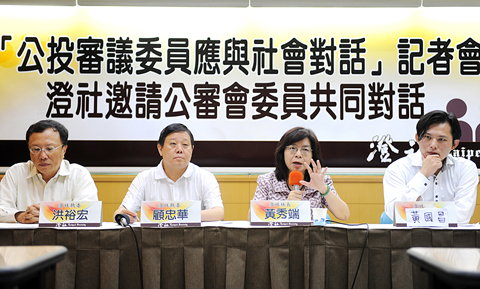
PHOTO: LIAO CHEN-HUEI, TAIPEI TIMES
“I wonder how they will be able to explain that decision to their students or to their fellow academics?” Hung said.
Huang Kuo-chang (黃國昌), a law research fellow at Academia Sinica, said the voice of the people was not being heard.
“They say the [ECFA] referendum proposal turned down last year was submitted by the Democratic Progressive Party [DPP] and this one was submitted by the TSU, but I disagree,” Huang said. “Each referendum proposal was endorsed by more than 100,000 people, on the streets and in markets, who wanted their voices heard.”
“Politicians and political parties were only acting as the public’s agents,” he said.
On June 4, the Referendum Committee voted 12 to four to block a referendum proposal submiited by the TSU that would ask the question: “Do you agree that the government should sign an ECFA with China?”
The committee rejected a similar referendum proposed by the DPP last year.
The Referendum Act (公民投票法) states that a referendum proposal must be endorsed by 0.5 percent of the number of eligible voters in the last presidential election — which would be about 80,000 in this case — in the initial stage. In the second stage, signatures from 5 percent of the number of eligible voters in the last presidential election — approximately 800,000 — must be collected before a referendum vote can be held.
The committee said in its statement that the proposal had been rejected because its wording was “confusing,” since the TSU opposes signing an ECFA and a referendum should only ask voters’ opinion about changing something that has already been done.
“Some [committee] members are worried that the wording of the referendum question may be confusing to voters, but this was not their business,” said another Taipei Society executive member, a sociology professor at National Chengchi University. “Their job is only to check to see if the proposal meets all the criteria as stated in the law and leave the contents to be voted on by the people.”
Taipei Society chairwoman Huang Hsiu-tuan (黃秀端) said that as most committee members were, like the members of the society, academics, they should be rational people and must have had more convincing reasons to block the proposal.
“We have decided to invite all the memebers of the Referendum Review Committee — regardless of whether they voted for or against the proposal — to a debate,” she said. “An invitation to the debate will be delivered to all the members soon.”

Actor Darren Wang (王大陸) was sentenced to six months in prison, commutable to a fine, by the New Taipei District Court today for contravening the Personal Data Protection Act (個人資料保護法) in a case linked to an alleged draft-dodging scheme. Wang allegedly paid NT$3.6 million (US$114,380) to an illegal group to help him evade mandatory military service through falsified medical documents, prosecutors said. He transferred the funds to Chen Chih-ming (陳志明), the alleged mastermind of a draft-evasion ring, although he lost contact with him as he was already in detention on fraud charges, they said. Chen is accused of helping a

SECURITY: Starlink owner Elon Musk has taken pro-Beijing positions, and allowing pro-China companies to control Taiwan’s critical infrastructure is risky, a legislator said Starlink was reluctant to offer services in Taiwan because of the nation’s extremely high penetration rates in 4G and 5G services, the Ministry of Digital Affairs said yesterday. The ministry made the comments at a meeting of the legislature’s Transportation Committee, which reviewed amendments to Article 36 of the Telecommunications Management Act (電信管理法). Article 36 bans foreigners from holding more than 49 percent of shares in public telecommunications networks, while shares foreigners directly and indirectly hold are also capped at 60 percent of the total, unless specified otherwise by law. The amendments, sponsored by Chinese Nationalist Party (KMT) Legislator Ko

UNREASONABLE SURVEILLANCE: A camera targeted on an road by a neighbor captured a man’s habitual unsignaled turn into home, netting him dozens of tickets The Taichung High Administrative Court has canceled all 45 tickets given to a man for failing to use a turn signal while driving, as it considered long-term surveillance of his privacy more problematic than the traffic violations. The man, surnamed Tseng (曾), lives in Changhua County and was reported 45 times within a month for failing to signal while driving when he turned into the alley where his residence is. The reports were filed by his neighbor, who set up security cameras that constantly monitored not only the alley but also the door and yard of Tseng’s house. The surveillance occurred from July

‘SAME OLD TRICK’: Even if Beijing resumes individual travel to Taiwan, it would only benefit Chinese tourism companies, the Economic Democracy Union convener said China’s 10 new “incentives” are “sugar-coated poison,” an official said yesterday, adding that Taiwanese businesses see them clearly for what they are, but that Beijing would inevitably find some local collaborators to try to drums up support. The official, speaking on condition of anonymity, made the remark ahead of a news conference the General Chamber of Commerce is to hold today. The event, titled “Industry Perspectives on China’s Recent Pro-Taiwan Policies,” is expected to include representatives from industry associations — such as those in travel, hotels, food and agriculture — to request the government cooperate with China’s new measures, people familiar with


 RSS
RSS