


A former US national security adviser on Wednesday called for a new “candid dialogue” between the US and China over Taiwan.
Stephen Hadley, national security adviser to former US president George W. Bush during his second term in the White House, said it was his hope that such a dialogue would over time convince Beijing that the solution to the problem of US arms sales to Taiwan was “in China’s own hands.”
Answering questions following a lecture called “The Challenges and Opportunities of US Policy in Asia” at the Heritage Foundation in Washington, Hadley said that China needed to pull back and dismantle the missiles it has aimed at Taiwan.
It would improve relations across the Taiwan Strait and “reassure Taiwan about China’s intentions,” he said.
That in turn, he said, would remove the need for US arms sales.
“Until China understands this is the right course for everyone, the United States needs to stand by Taiwan,” he said.
Hadley was speaking at the 14th annual Lee Byung-chull lecture on international affairs to mark the birth anniversary of the founder of the Samsung group.
“Our historical experience is that nations that share our values are our best partners — because common values beget common interests, and common interests are the basis for making common cause in addressing global challenges,” Hadley said.
One of the great successes of US policy after World War II was to help Japan and South Korea build stable and prosperous societies based on democratic values and free market principles, he said.
“The United States similarly needs to work closely with its other friends and allies — including Australia, the Philippines, New Zealand and Singapore — and continue its close friendship with the people of Taiwan,” he said.
It was no accident, he said, that the spread of freedom and democracy in Asia over the last half of the 20th century was accompanied by nearly unprecedented prosperity and stability.
“South Korea, Japan and Taiwan have led the way,” Hadley said.
While this could be a period of “enormous promise,” it could instead be a period of “peril” in US-China relations, he said.
“There is a growing list of questions in many quarters about how China will use its dramatically increasing economic, military and diplomatic power,” Hadley said.
“China is deploying military capabilities — fighter aircraft, missiles and submarines — that could deny US military forces access to the international waters off China’s coast. At least initially, these capabilities seem designed to give China the option to act militarily against Taiwan without US interference, should it decide to do so, and to give China the potential to exercise exclusive control over the South China Sea,” he said.
Hadley said the US and China needed to increase transparency and resume military cooperation.
“That means military-to-military exchanges, ‘hot lines’ and other mechanisms to avoid confrontation, joint training exercises and joint humanitarian assistance operations in third countries,” he said. “As a further step, China should begin to move back and dismantle the missiles it has deployed adjacent to the Taiwan Strait.”
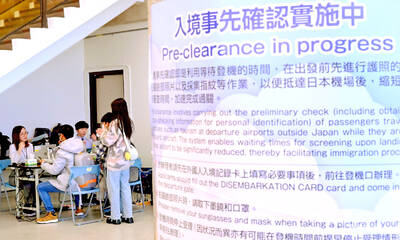
A preclearance service to facilitate entry for people traveling to select airports in Japan would be available from Thursday next week to Feb. 25 at Taiwan Taoyuan International Airport, Taoyuan International Airport Corp (TIAC) said on Tuesday. The service was first made available to Taiwanese travelers throughout the winter vacation of 2024 and during the Lunar New Year holiday. In addition to flights to the Japanese cities of Hakodate, Asahikawa, Akita, Sendai, Niigata, Okayama, Takamatsu, Kumamoto and Kagoshima, the service would be available to travelers to Kobe and Oita. The service can be accessed by passengers of 15 flight routes operated by

GIVE AND TAKE: Blood demand continues to rise each year, while fewer young donors are available due to the nation’s falling birthrate, a doctor said Blood donors can redeem points earned from donations to obtain limited edition Formosan black bear travel mugs, the Kaohsiung Blood Center said yesterday, as it announced a goal of stocking 20,000 units of blood prior to the Lunar New Year. The last month of the lunar year is National Blood Donation Month, when local centers seek to stockpile blood for use during the Lunar New Year holiday. The blood demand in southern Taiwan — including Tainan and Kaohsiung, as well as Chiayi, Pingtung, Penghu and Taitung counties — is about 2,000 units per day, the center said. The donation campaign aims to boost
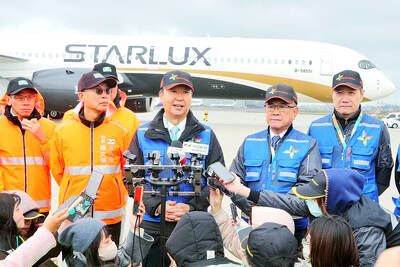
ENHANCING EFFICIENCY: The apron can accommodate 16 airplanes overnight at Taoyuan airport while work on the third runway continues, the transport minister said A new temporary overnight parking apron at Taiwan Taoyuan International Airport is to start operating on Friday next week to boost operational efficiency while the third runway is being constructed, the Ministry of Transportation and Communications said yesterday. The apron — one of the crucial projects in the construction of the third runway — can accommodate 16 aircraft overnight at the nation’s largest international airport, Minister of Transportation and Communications Chen Shih-kai (陳世凱) told reporters while inspecting the new facility yesterday morning. Aside from providing the airport operator with greater flexibility in aircraft parking during the third runway construction,
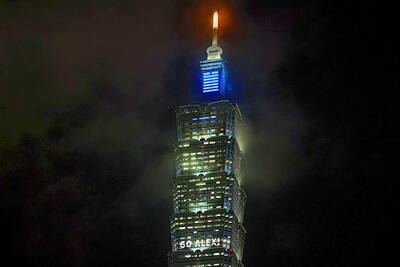
American climber Alex Honnold is to attempt a free climb of Taipei 101 today at 9am, with traffic closures around the skyscraper. To accommodate the climb attempt and filming, the Taipei Department of Transportation said traffic controls would be enforced around the Taipei 101 area. If weather conditions delay the climb, the restrictions would be pushed back to tomorrow. Traffic controls would be in place today from 7am to 11am around the Taipei 101 area, the department said. Songzhi Road would be fully closed in both directions between Songlian Road and Xinyi Road Sec 5, it said, adding that bidirectional traffic controls would


 RSS
RSS