

Biased media reports and national policies are sources of stereotypes leading to wide-spread discrimination against immigrant spouses from Southeast Asia and their children, Chen Yu-wen (陳毓文), a social works professor at National Taiwan University said yesterday.
Chen made her observation while recommending the government stop ethnicity-based welfare policies after conducting research commissioned by the National Science Council (NSC) on whether children of Southeast Asian immigrant spouses learn more slowly and are academically weaker.
Chen studied more than 1,000 children of immigrant spouses — as well as their parents and teachers — in elementary and junior high schools across the country for a period of three years from 2006 to 2008.
“Many people think that Taiwanese who marry Southeast Asians are of lower social and economic status, older or physically challenged. They think immigrant spouses come to Taiwan because they want money,” Chen said at a press conference at the NSC headquarters in Taipei yesterday.
“So they think, naturally, children of these immigrant spouses are not as smart and do not perform as well academically,” Chen added.
However, results from Chen’s research proved otherwise.
“Children of immigrant spouses and children whose both parents are Taiwanese perform at more or less the same level academically, with some children of immigrant spouses showing outstanding academic performance,” Chen said. “Many people say children of immigrant spouses are not good at composition and think it may be because their immigrant parents don’t know Chinese that well. Well, if you think about it, don’t we also complain that children [whose both parents are Taiwanese] are getting worse and worse at composition?”
Chen said that biased media reports and government policies may have helped to maintain such stereotypes.
She said that, when reporting “problems” facing children of immigrant spouses, media outlets often forget to compare them to children whose parents are both Taiwanese.
“Government authorities often single out families with immigrant spouses to create special welfare programs — this is a type of brainwashing that creates the impression that immigrant spouses and their children are not as good, and they are the ones who need help,” Chen told the news conference.
“But the fact is that immigrant spouses and their children are just like everyone else, and there are also non-immigrant spouses and children who need government assistance,” Chen added.
In fact, most teachers told Chen during interviews that because of media reports they often feel more worried about children of immigrant spouses, “but the actual experience often proves otherwise,” she said.
Such negative stereotypes would, in many cases, spark discriminatory remarks from immigrant children’s peers, such as telling them to “go back to Indonesia” or calling them “Filipino servants” or “Thai workers.”
Chen therefore urged the media to refrain from over-generalizations when reporting on immigrant spouses and their children. She also called on the government to develop needs-based welfare programs instead of ethnicity-based ones.
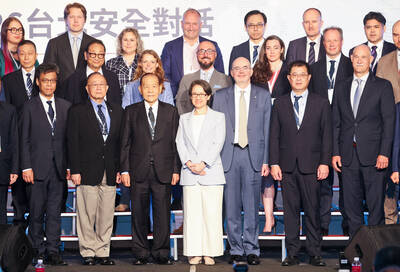
Taiwan’s growing defense preparations might be sending a stronger signal to the US than to Beijing, highlighting the need for Taipei to tailor its deterrence efforts to different audiences, a US security academic said yesterday. Stanford University Freeman Spogli Institute for International Studies fellow Oriana Skylar Mastro made the comment during a Taipei Security Dialogue panel examining lessons Taiwan could draw from the wars in Ukraine and the Middle East. Mastro said she was impressed by Taiwan’s increased defense spending, emphasis on asymmetric capabilities and efforts to prepare society for conflict, but questioned whom those initiatives were influencing. She said when she asked
A total of 400 foreign “high- level” professionals have been naturalized as Republic of China (Taiwan) citizens over the past decade as the government has eased nationality rules to attract talent from a wider range of fields, the Ministry of the Interior said yesterday. The 400th high-level professional, who works in the electronics industry, was approved for ROC citizenship on Aug. 26, the MOI said. The MOI quoted the newly naturalized citizen as saying that Taiwan is a leader in fields such as semiconductors, electronics manufacturing, artificial intelligence development and energy technology. He also said
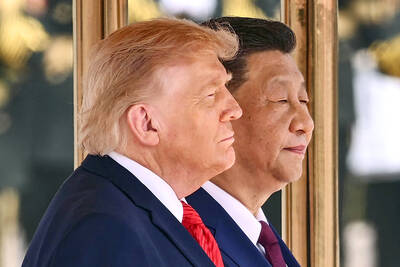
China has warned that it could cancel a planned US-China leaders’ summit if Washington approves new arms sales to Taiwan, a Japanese media outlet quoted sources as saying yesterday. US President Donald Trump, “apparently eager to showcase some diplomatic achievements ahead of November’s midterm congressional elections, places great importance on holding the summit with Chinese President Xi Jinping (習近平),” Japan’s Kyodo News reported. “While preparing for Xi’s upcoming trip, China has restated its position that the Taiwan issue is a ‘red line’ in bilateral relations,” the report said. The report said that when Xi met with Trump in Beijing in May, Xi said
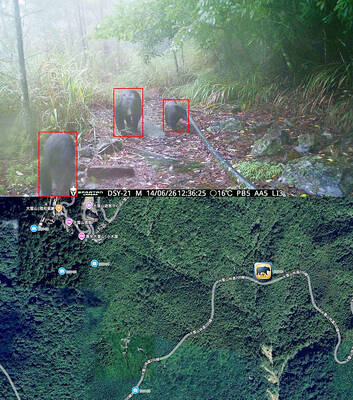
RARE PEEK: The footage released showed one of the bears staying in a cave for as long as 70 days, providing the first record of Formosan black bear’s overwintering The Forestry and Nature Conservation Agency yesterday released tracking records of released Formosan black bears for the first time, showing that they get much closer to human settlements than previously thought. The agency said it had captured two bears, Da Qu-ali (達古阿里) and Aziman (阿里曼), in indigenous villages in Hualien County and began to track them with a camera-mounted satellite collar after releasing them back into the wild. The results confirmed that the bears have moved from deep mountain areas into lowland hills closer to human communities, leading to an increase in human-bear conflicts, it said. The agency has introduced artificial intelligence-assisted early


 RSS
RSS