


Minister of Transportation and Communications Mao Chi-kuo (毛治國) said yesterday that the ministry would closely monitor several geologically sensitive sections along the nation’s freeways and may consider closing some of them if extreme weather conditions created a threat.
“Our preliminary survey showed that 32 dip slopes along National Freeway No. 3 are safe and stable,” he said, “but we also want to hear from the experts, who will give us the results of their evaluations soon.”
Democratic Progressive Party Legislator Yeh Yi-jin (葉宜津), however, questioned the safety of National Freeway No. 3 and urged the Ministry of Transportation and Communications to close the entire freeway for a more detailed inspection.
In response, Mao said that the expert evaluation would be used to determine the safety of the freeway, however, the ministry would apply “necessary regulatory measures” to certain sections if extreme weather such as torrential rain made it unsafe to drive.
Other legislators said Mao’s response could be interpreted as meaning people should not drive whenever there is heavy rain or an earthquake. He said that the ministry would determine where the geologically sensitive sections are and under what conditions those sections of freeway should be closed.
Meanwhile, Mao said that the deadly landslide on National Freeway No. 3 two weeks ago had led the ministry to review other national compensation cases.
Last week, the ministry said that it had begun talking with the families of those who died in the landslide about claiming national compensation for their losses.
He also confirmed that the families of those killed in the collapses of the Fengchiu Tunnel (豐丘明隧道) in 2008 and the Shuangyuan Bridge (雙園大橋) last year may still be compensated by the government.
“We have found new evidence that suggests the government may be at fault,” Mao said. “It is very likely that negotiations over national compensation could resume.”
Mao also said that the Control Yuan had censured the ministry over the Shuangyuan Bridge incident, which triggered another review of the case.

LOUD AND PROUD Taiwan might have taken a drubbing against Australia and Japan, but you might not know it from the enthusiasm and numbers of the fans Taiwan might not be expected to win the World Baseball Classic (WBC) but their fans are making their presence felt in Tokyo, with tens of thousands decked out in the team’s blue, blowing horns and singing songs. Taiwanese fans have packed out the Tokyo Dome for all three of their games so far and even threatened to drown out home team supporters when their team played Japan on Friday. They blew trumpets, chanted for their favorite players and had their own cheerleading squad who dance on a stage during the game. The team struggled to match that exuberance on the field, with
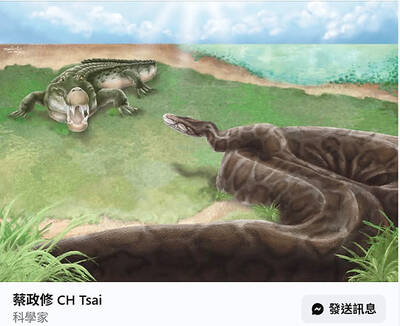
Taiwanese paleontologists have discovered fossil evidence that pythons up to 4m long inhabited Taiwan during the Pleistocene epoch, reporting their findings in the international scientific journal Historical Biology. National Taiwan University (NTU) Institute of Ecology and Evolutionary Biology associate professor Tsai Cheng-hsiu (蔡政修) led the team that discovered the largest snake fossil ever found in Taiwan. The single trunk vertebra was discovered in Tainan at the Chiting Formation, dated to between 400,000 and 800,000 years ago in the Middle Pleistocene, the paper said. The area also produced Taiwan’s first avian fossil, as well as crocodile, mammoth, saber-toothed cat and rhinoceros fossils, it said. Discoveries

Taiwanese paleontologists have discovered fossil evidence that pythons up to 4m long inhabited Taiwan during the Pleistocene epoch, reporting their findings in the international scientific journal Historical Biology. National Taiwan University (NTU) Institute of Ecology and Evolutionary Biology associate professor Tsai Cheng-hsiu (蔡政修) led the team that discovered the largest snake fossil ever found in Taiwan. A single trunk vertebra was discovered in Tainan at the Chiting Formation, dated to between 800,000 to 400,000 years ago in the Middle Pleistocene, the paper said. The area also produced Taiwan’s first avian fossil, as well as crocodile, mammoth, sabre-toothed cat and rhinoceros fossils, it said. Discoveries
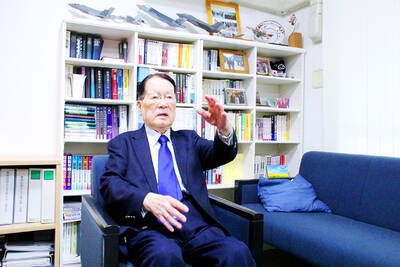
Whether Japan would help defend Taiwan in case of a cross-strait conflict would depend on the US and the extent to which Japan would be allowed to act under the US-Japan Security Treaty, former Japanese minister of defense Satoshi Morimoto said. As China has not given up on the idea of invading Taiwan by force, to what extent Japan could support US military action would hinge on Washington’s intention and its negotiation with Tokyo, Morimoto said in an interview with the Liberty Times (sister paper of the Taipei Times) yesterday. There has to be sufficient mutual recognition of how Japan could provide


 RSS
RSS