


Civil rights leaders in the US are condemning the “inappropriate use of race and ethnicity” in a US lawsuit brought against the Taiwanese-owned PVC and plastic pipe manufacturer JM Eagle.
“Although race and ethnicity have absolutely nothing to do with the case, the plaintiff and his attorneys repeatedly interject gratuitous references to Asian ethnicity,” said Stewart Kwoh, executive director of the Asian Pacific American Legal Center.
“Given the irrelevance of ethnicity and nationality to this case, we are concerned that such information has been included solely to stir racial intolerance,” Kwoh said in an open letter signed by nine Asian, Hispanic, Jewish and African-American civil rights leaders.
The civil rights leaders said they took no position with respect to the merits of the litigation that has been brought by one of JM Eagle’s former employees, which alleges that the company sold nonconforming plastic pipes to government departments.
JM Eagle, one of the world’s leading manufacturers of PVC and plastic pipes, “vigorously denies” the claims.
The company is owned by Walter Wang (王文祥).
“It appears that the plaintiff in the case and his attorneys believe they stand to gain by repeatedly interjecting Asian ethnicity and nationality to describe various entities and individuals, even though ethnicity and nationality have no relevance whatsoever,” Kwoh said.
As an example, he said the legal documents filed in court by the plaintiff alleged that JM Eagle hired “Taiwanese nationals” with “significantly less experience and fewer credentials” to replace the previous managers at some plants.
The documents said that Formosa Plastics Corp — another defendant in the case — “is largely controlled by the Wang family of Taiwan.”
“The ethnicity and nationality of the family that owns Formosa Plastics Corporation, or where they happen to live or come from, has nothing to do with the merits of the complaint. The ethnicity and nationality of the owners of other companies mentioned are never specified,” Kwoh said.
At another point, the documents said the company’s director of production was from Taiwan, although again his nationality “is simply irrelevant to the allegations in the complaint.”
The open letter said that perhaps the most egregious reference in the legal documents filed by the plaintiff and his lawyers stated: “Until approximately 2003, Formosa Plastics Corporation owned and operated a boarding house near its Livingston, New Jersey headquarters to accommodate the large number of Taiwanese employees who could not otherwise afford to live in the greater New York Metropolitan area.”
“This allegation is immaterial to the lawsuit, has no bearing whatsoever on the causes of action alleged and seems designed only to stir anti-immigrant resentment toward a particular ethnic group,” Kwoh said.
The open letter is signed by John Chen, Committee of 100; Craig Ishii, Japanese American Citizens League; Munson Kwok, Chinese American Citizens Alliance; Don Nakanishi, University of California Asian American Studies Center; Connie Rice, Advancement Project; Thomas Saenz, Mexican American Legal Defense and Educational Fund; Amanda Susskind, Anti-Defamation League; Arturo Vargas, National Association of Latino Officials; and Kwoh.
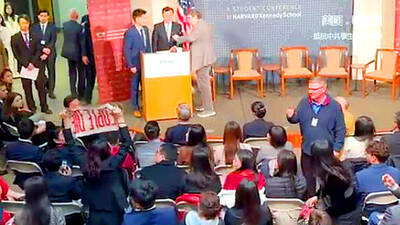
A group of Taiwanese-American and Tibetan-American students at Harvard University on Saturday disrupted Chinese Ambassador to the US Xie Feng’s (謝鋒) speech at the school, accusing him of being responsible for numerous human rights violations. Four students — two Taiwanese Americans and two from Tibet — held up banners inside a conference hall where Xie was delivering a speech at the opening ceremony of the Harvard Kennedy School China Conference 2024. In a video clip provided by the Coalition of Students Resisting the CCP (Chinese Communist Party), Taiwanese-American Cosette Wu (吳亭樺) and Tibetan-American Tsering Yangchen are seen holding banners that together read:

UNAWARE: Many people sit for long hours every day and eat unhealthy foods, putting them at greater risk of developing one of the ‘three highs,’ an expert said More than 30 percent of adults aged 40 or older who underwent a government-funded health exam were unaware they had at least one of the “three highs” — high blood pressure, high blood lipids or high blood sugar, the Health Promotion Administration (HPA) said yesterday. Among adults aged 40 or older who said they did not have any of the “three highs” before taking the health exam, more than 30 percent were found to have at least one of them, Adult Preventive Health Examination Service data from 2022 showed. People with long-term medical conditions such as hypertension or diabetes usually do not
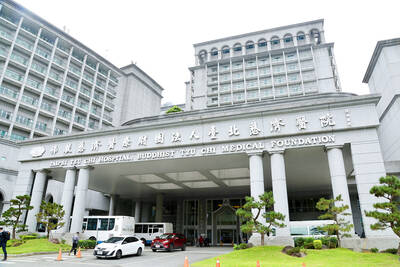
POLICE INVESTIGATING: A man said he quit his job as a nurse at Taipei Tzu Chi Hospital as he had been ‘disgusted’ by the behavior of his colleagues A man yesterday morning wrote online that he had witnessed nurses taking photographs and touching anesthetized patients inappropriately in Taipei Tzu Chi Hospital’s operating theaters. The man surnamed Huang (黃) wrote on the Professional Technology Temple bulletin board that during his six-month stint as a nurse at the hospital, he had seen nurses taking pictures of patients, including of their private parts, after they were anesthetized. Some nurses had also touched patients inappropriately and children were among those photographed, he said. Huang said this “disgusted” him “so much” that “he felt the need to reveal these unethical acts in the operating theater
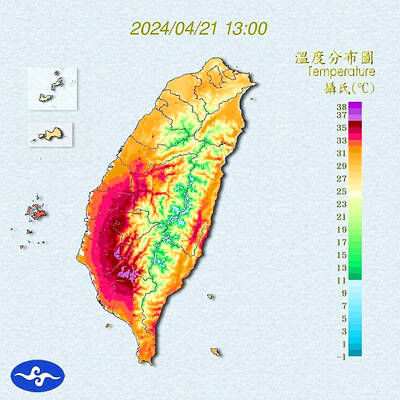
Heat advisories were in effect for nine administrative regions yesterday afternoon as warm southwesterly winds pushed temperatures above 38°C in parts of southern Taiwan, the Central Weather Administration (CWA) said. As of 3:30pm yesterday, Tainan’s Yujing District (玉井) had recorded the day’s highest temperature of 39.7°C, though the measurement will not be included in Taiwan’s official heat records since Yujing is an automatic rather than manually operated weather station, the CWA said. Highs recorded in other areas were 38.7°C in Kaohsiung’s Neimen District (內門), 38.2°C in Chiayi City and 38.1°C in Pingtung’s Sandimen Township (三地門), CWA data showed. The spell of scorching


 RSS
RSS