


Migrant labor activists yesterday protested against a recently proposed plan to abolish the regulation that applies the minimum wage to migrant workers, while Council of Labor Affairs (CLA) Minister Jennifer Wang (王如玄) also expressed opposition to the plan.
The Labor Standards Act (勞動基準法) states that employers are required to employ migrant workers at rates no lower than the minimum wage as it applies to domestic workers.
Two weeks ago, however, Premier Wu Den-yih (吳敦義) said the government was considering removing the requirement for employers to pay foreign workers no less than the minimum wage, which currently stands at NT$17,280 (US$549) per month.
Unhappy with the proposal, the Taiwan International Workers Association (TIWA) yesterday gathered dozens of labor activists and representatives from civic groups in a protest in front of the legislature.
“The goal of decoupling the minimum wage [from migrant labor wages] is to attract Taiwanese capital back, which means allowing wages to converge and letting migrant labor wages drop to the level of Chinese laborers,” TIWA spokesperson Wuo Young-ie (吳永毅) said.
The plan “sacrifices migrant laborers’ rights in order to appeal to Taiwanese businessmen,” he said.
Without the minimum wage, the most vulnerable and disadvantaged workers would no longer have the safety net they need, the labor group said.
The fact that foreign labor would become cheaper would also threaten to take away jobs from domestic workers, the group said.
The proposal would cause labor conditions for both foreign and domestic workers to worsen and it goes against the universal principle of “equal work, equal pay,” the protestors said.
They also urged Wang to stand up to political pressure and resign if the government insisted on going ahead with the proposal.
At the legislature’s Social Welfare and Environmental Hygiene Committee meeting yesterday, Democratic Progressive Party Legislator Huang Sue-ying (黃淑英) grilled Wang on whether she would tender her resignation over the issue.
“Our stance has always been consistent and clear. We are opposed to decoupling foreign labor wages from the minimum wage,” Wang said.
She also vowed to “keep fighting to the final moment” and said she would step down if the plan went into effect.

The military has spotted two Chinese warships operating in waters near Penghu County in the Taiwan Strait and sent its own naval and air forces to monitor the vessels, the Ministry of National Defense (MND) said. Beijing sends warships and warplanes into the waters and skies around Taiwan on an almost daily basis, drawing condemnation from Taipei. While the ministry offers daily updates on the locations of Chinese military aircraft, it only rarely gives details of where Chinese warships are operating, generally only when it detects aircraft carriers, as happened last week. A Chinese destroyer and a frigate entered waters to the southwest

The eastern extension of the Taipei MRT Red Line could begin operations as early as late June, the Taipei Department of Rapid Transit Systems said yesterday. Taipei Rapid Transit Corp said it is considering offering one month of free rides on the new section to mark its opening. Construction progress on the 1.4km extension, which is to run from the current terminal Xiangshan Station to a new eastern terminal, Guangci/Fengtian Temple Station, was 90.6 percent complete by the end of last month, the department said in a report to the Taipei City Council's Transportation Committee. While construction began in October 2016 with an
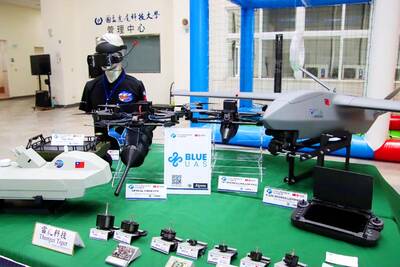
NON-RED SUPPLY: Boosting the nation’s drone industry is becoming increasingly urgent as China’s UAV dominance could become an issue in a crisis, an analyst said Taiwan’s drone exports to Europe grew 41.7-fold from 2024 to last year, with demand from Ukraine’s fight against Russian aggression the most likely driver of growth, a study showed. The Institute for Democracy, Society and Emerging Technology (DSET) in a statement on Wednesday said it found that many of Taiwan’s uncrewed aerial vehicle (UAV) sales were from Poland and the Czech Republic. These countries likely transferred the drones to Ukraine to aid it in its fight against the Russian invasion that started in 2022, it said. Despite the gains, Taiwan is not the dominant drone exporter to these markets, ranking second and fourth

Japanese Prime Minister Sanae Takaichi’s comment last year on Tokyo’s potential reaction to a Taiwan-China conflict has forced Beijing to rewrite its invasion plans, a retired Japanese general said. Takaichi told the Diet on Nov. 7 last year that a Chinese naval blockade or military attack on Taiwan could constitute a “survival-threatening situation” for Japan, potentially allowing Tokyo to exercise its right to collective self-defense. Former Japan Ground Self-Defense Force general Kiyofumi Ogawa said in a recent speech that the remark has been interpreted as meaning Japan could intervene in the early stages of a Taiwan Strait conflict, undermining China’s previous assumptions


 RSS
RSS