


The first televised debate on a proposed economic framework cooperation agreement (ECFA) with China yesterday ended with the two sides still disagreeing on key issues including free trade, sovereignty and the net benefits of the agreement.
However, a poll of the audience showed more people switching to opposing the proposed pact.
The two hour debate featured former Democratic Progressive Party (DPP) legislators Chuang Suo-hang (莊碩漢) and Julian Kuo (郭正亮) against Chinese Nationalist Party (KMT) Legislator Lai Shyh-bao (賴士葆) and Bureau of Foreign Trade Director-General Huang Chih-peng (黃志鵬).
Defending the government's position on the controversial pact, Huang described the pact as vital, saying: “It's a matter of how well we negotiate the agreement, not whether we should negotiate it.”
Inking the pact would “greatly” help Taiwan sign free-trade agreements (FTA) with other countries, Huang said, adding that some trading partners have already indicated that they would be willing to sign an FTA with Taiwan once “cross-strait political tensions diminish.”
“However, I am unable to disclose which countries these are,” he said.
Huang said Taiwan's negotiating team had already informed its Chinese counterparts of the government's intention to push forward with other FTAs.
However, the former DPP lawmakers contended that the government had focused too much on the Chinese negotiations, saying that although the DPP was not against free trade, “globalization does not equal sinification.”
“If Taiwan signs this agreement with China and China continues to sign free-trade agreements with the rest of the world, it would mean that Chinese companies can access the entire world while Taiwanese companies will be limited to just China,” Kuo said.
Criticizing the government for not making progress on any other FTAs, Kuo called on the administration of President Ma Ying-jeou (馬英九) to reject the ECFA if China continued to oppose Taiwan signing agreements with other nations.
Kuo said the two major problems facing Taiwan today continue to be a lack of domestic investment and the relatively high unemployment rate, both of which the ECFA not only fails to address, but would likely exacerbate.
The two sides also sparred on whether the ECFA would undermine Taiwan's sovereignty and increase its dependence on China.
While the KMT representatives said politics and the economy should be viewed separately, the DPP side pointed to comments made by Chinese government officials who have said an ECFA could aid cross-strait unification.
One question posed to participants on the possible impact of an ECFA on Taiwan's sovereignty, asked if they thought a case last year where Chinese government agencies restricted the flow of Chinese tourists to Kaohsiung after the city invited the Dalai Lama to visit was a case of China using economics to pursue political objectives.
Lai said the government would control any potential Chinese interference and also step up monitoring to ensure similar incidents did not take place after the ECFA was signed.
Political analysts were divided on who won the debate, with some saying the government had clarified its position on the issue and others saying they remained unconvinced about the link between the ECFA and the signing of other FTAs.
“Not only did the KMT lose due to President Ma Ying-jeou's rigid stance that the ECFA must be signed, the Bureau of Foreign Trade failed to make itself clear on how an ECFA will lead to other free-trade agreements,” said Hung Tsai-lung (洪財隆), an associate research fellow at the Taiwan Institute of Economic Research.
A poll of audience members before and after the debate showed that the former DPP lawmakers did manage to change the minds of some.
The audience, made up mainly of university students, had originally polled nine to seven in support of the agreement. However, another poll half way through the debate showed support for the agreement had dropped to one in favor and 15 against.
After the conclusion of the debate, 10 audience members said they were now against the agreement with five in support and one undecided.
DPP officials told the Taipei Times that Chuang and Kuo took part in the debate did so of their own accord and without party backing.
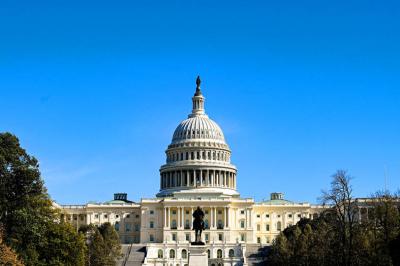
The US House of Representatives yesterday passed the PROTECT Taiwan Act, which stipulates that Washington would exclude China from participating in major global financial organizations if its actions directly threaten Taiwan’s security. The bill, proposed by Republican US Representative Frank Lucas, passed with 395 votes in favor and two against. It stipulates that if China’s actions pose any threat to Taiwan’s security, economic or social systems, the US would, “to the maximum extent practicable,” exclude China from international financial institutions, including the G20, the Bank for International Settlements and the Financial Stability Board. The bill makes it clear that China
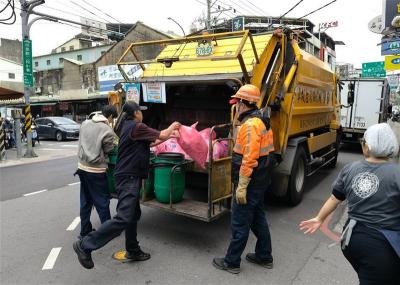
Garbage and recycling schedules are to vary from Saturday through Sunday next week over the Lunar New Year holiday period. The following collection information is from the governments of the six special municipalities. Taipei Regular service: Sunday to Monday next week. No service: Tuesday to Thursday next week. Extra service: Friday next week. Regular service resumes: Saturday next week. New Taipei City Extra service: Sunday. Adjusted collection time: Monday next week — garbage collection is to begin in the morning and end at 6pm. No service: Tuesday to Thursday next week. Regular service resumes: Friday next week. Note: Garbage can be dropped off at 70
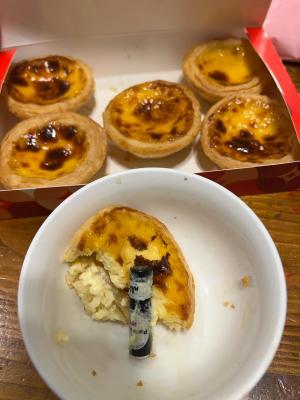
A KFC branch in Kaohsiung may be fined between NT$60,000 and NT$200 million (US$1,907 and US$6.37 million), after a customer yesterday found an entire AAA battery inside an egg tart, the Kaohsiung Department of Health said today. The customer was about to microwave a box of egg tarts they had bought at the fast-food restaurant’s Nanzih (楠梓) branch when they checked the bottom and saw a dark shadow inside one of them, they said in a Threads post. The customer filmed themself taking the egg tart apart to reveal an entire AAA battery inside, which apparently showed signs of damage. Surveillance footage showed
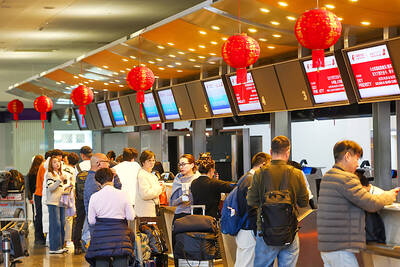
GROUP EFFORT: The number of inbound travelers rose 11 to 12 percent last month, with a significant increase in tourists from Europe and North America, an official said The government aims to attract 9.4 million visitors this year, the Tourism Administration said yesterday, citing last year’s success in diversifying tourist markets. Taiwan last year drew about 8.57 million international arrivals, 72.3 percent of pre-COVID-19 levels. By contrast, the nation had about 18.94 million outbound tourists last year, surpassing the pre-COVID-19 level of 17.1 million. The estimated tourism revenue deficit was about NT$700.9 billion (US$22.22 billion). Taoyuan International Airport Corp expects more than 160,000 passengers to pass through the nation’s largest airport daily during the Lunar New Year holiday, which begins on Saturday. As of Jan. 30, the nation’s average hotel occupancy rate


 RSS
RSS