


The Control Yuan yesterday denied that it was investigating whether the Kaohsiung City Government had funded the city and county chiefs’ invitation of the Dalai Lama to southern Taiwan last year.
“We received a complaint [last year] asking whether local governments misused budgets earmarked for inviting foreign nationals to Taiwan,” Control Yuan Deputy Secretary-General Hsu Hai-chuan (許海泉) told reporters.
However, the Control Yuan referred the complaint to the Ministry of the Interior for an initial investigation because there was no evidence of malfeasance by government agencies or officials, Hsu said, adding that this was standard procedure at the Control Yuan when dealing with public complaints.
“The Control Yuan is not specifically probing the Dalai Lama’s visit,” he said.
ALLEGATIONS
Hsu was responding to allegations by Liang Wen-chieh (梁文傑), former adviser to the Kaohsiung City Government, that he made while addressing a rally in Taipei on Sunday to commemorate the 51st anniversary of the 1959 Tibetan uprising.
Liang said the Control Yuan, the Investigation Bureau and the Kaohsiung Prosecutors’ Office had initiated their own investigations into whether the city government spent public funds to invite the Tibetan spiritual leader.
Seven Democratic Progressive Party city and county chiefs issued a joint invitation to the Dalai Lama in August asking him to visit Taiwan to hold religious services for the victims of Typhoon Morakot.
The ministry confirmed on Sept. 20 that it, as the government authority in charge of religious affairs, received a request from the Control Yuan to determine whether government funds were spent to cover the Dalai Lama’s expenses.
POLITICAL
The probe sparked criticism from the pan-green camp, alleging that the move was politically motivated.
Kaohsiung Mayor Chen Chu (陳菊) said last year that no money from city government coffers was used to sponsor the visit.
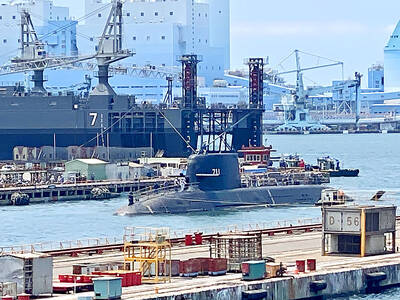
AGING: While Japan has 22 submarines, Taiwan only operates four, two of which were commissioned by the US in 1945 and 1946, and transferred to Taiwan in 1973 Taiwan would need at least 12 submarines to reach modern fleet capabilities, CSBC Corp, Taiwan chairman Chen Cheng-hung (陳政宏) said in an interview broadcast on Friday, citing a US assessment. CSBC is testing the nation’s first indigenous defense submarine, the Hai Kun (海鯤, Narwhal), which is scheduled to be delivered to the navy next month or in July. The Hai Kun has completed torpedo-firing tests and is scheduled to undergo overnight sea trials, Chen said on an SET TV military affairs program. Taiwan would require at least 12 submarines to establish a modern submarine force after assessing the nation’s operational environment and defense

A white king snake that frightened passengers and caused a stir on a Taipei MRT train on Friday evening has been claimed by its owner, who would be fined, Taipei Rapid Transit Corp (TRTC) said yesterday. A person on Threads posted that he thought he was lucky to find an empty row of seats on Friday after boarding a train on the Bannan (Blue) Line, only to spot a white snake with black stripes after sitting down. Startled, he jumped up, he wrote, describing the encounter as “terrifying.” “Taipei’s rat control plan: Release snakes on the metro,” one person wrote in reply, referring

Yangmingshan National Park authorities yesterday urged visitors to respect public spaces and obey the law after a couple was caught on a camera livestream having sex at the park’s Qingtiangang (擎天崗) earlier in the day. The Shilin Police Precinct in Taipei said it has identified a suspect and his vehicle registration number, and would summon him for questioning. The case would be handled in accordance with public indecency charges, it added. The couple entered the park at about 11pm on Thursday and began fooling around by 1am yesterday, the police said, adding that the two were unaware of the park’s all-day live
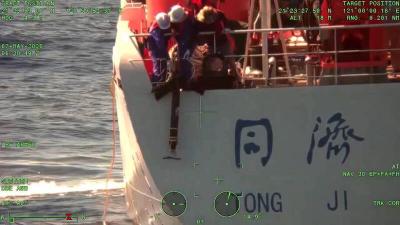
The coast guard today said that it had disrupted "illegal" operations by a Chinese research ship in waters close to the nation and driven it away, part of what Taipei sees a provocative pattern of China's stepped up maritime activities. The coast guard said that it on Thursday last week detected the Chinese ship Tongji (同濟號), which was commissioned only last year, 29 nautical miles (54km) southeast of the southern tip of Taiwan, although just outside restricted waters. The ship was observed lowering ropes into the water, suspected to be the deployment of scientific instruments for "illegal" survey operations, and the coast


 RSS
RSS