


Student groups and rights activists yesterday staged a protest on the National Taiwan University (NTU) campus over the university’s handling of a controversial discussion thread on the popular Bulletin Board System Professional Technology Temple (PTT), which is hosted by the school.
A story published in the Chinese-language Next Magazine on Wednesday says night club employees and drug dealers had managed to become discussion board moderators on PTT.
PTT is run by NTU students or graduates of NTU’s Department of Computer Science and Information Engineering. PTT’s main system, PTT1, hosts about 20,000 discussion boards, while PTT’s second system, PTT2, hosts about 30,000 boards.
The moderators allegedly lured college students and youngsters into taking drugs at night clubs, the story said, adding that some victims ended up with tens of thousands of New Taiwan dollars in credit card debt, with one NTU graduate student forced to halt his schooling after spending NT$300,000 in savings.
After the story broke, NTU deleted related discussions immediately, vowed to strictly screen the identities of board moderators and allowed police onto campus to investigate.
Gender/Sexuality Rights Association Taiwan representative Chiang Chia-wen (江嘉雯) said the school overreacted and accused it of interfering with freedom of speech on the Internet.
“NTU may have created the PTT, but it has grown to be the most popular online discussion forum with millions of registered members, and has built its own culture, which is no longer just [made up of NTU students],” Chiang said. “Out of so many members and discussions, only very few of them may have problems, so it’s not right to impose tight controls on everyone and start checking the identities of users.”
Wang Hao-chung (王顥中), a member of All My Gay, a student-based gay rights group, agreed.
“The NTU said that people are selling drugs on PTT. Well, you don’t close down the entire market just because someone sells something illegally in it,” Wang said.
He said it was misleading to report that students were “lured” into clubs, “because these students are adults, and they have the right to decide what to do and take the consequences.”
In other news, National Central University Department of English professor Josephine Ho (何春蕤) accused NTU of overstepping its bounds as a university, while lauding the protesting students as defenders of the freedom of expression.
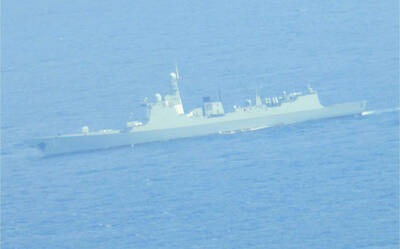
The military has spotted two Chinese warships operating in waters near Penghu County in the Taiwan Strait and sent its own naval and air forces to monitor the vessels, the Ministry of National Defense (MND) said. Beijing sends warships and warplanes into the waters and skies around Taiwan on an almost daily basis, drawing condemnation from Taipei. While the ministry offers daily updates on the locations of Chinese military aircraft, it only rarely gives details of where Chinese warships are operating, generally only when it detects aircraft carriers, as happened last week. A Chinese destroyer and a frigate entered waters to the southwest
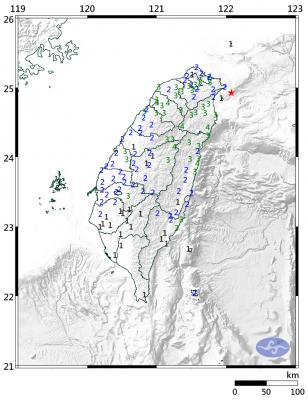
A magnitude 6.1 earthquake struck off the coast of Yilan County at 8:39pm tonight, the Central Weather Administration (CWA) said, with no immediate reports of damage or injuries. The epicenter was 38.7km east-northeast of Yilan County Hall at a focal depth of 98.3km, the CWA’s Seismological Center said. The quake’s maximum intensity, which gauges the actual physical effect of a seismic event, was a level 4 on Taiwan’s 7-tier intensity scale, the center said. That intensity level was recorded in Yilan County’s Nanao Township (南澳), Hsinchu County’s Guansi Township (關西), Nantou County’s Hehuanshan (合歡山) and Hualien County’s Yanliao (鹽寮). An intensity of 3 was
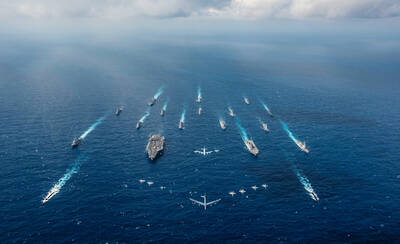
Japanese Prime Minister Sanae Takaichi’s comment last year on Tokyo’s potential reaction to a Taiwan-China conflict has forced Beijing to rewrite its invasion plans, a retired Japanese general said. Takaichi told the Diet on Nov. 7 last year that a Chinese naval blockade or military attack on Taiwan could constitute a “survival-threatening situation” for Japan, potentially allowing Tokyo to exercise its right to collective self-defense. Former Japan Ground Self-Defense Force general Kiyofumi Ogawa said in a recent speech that the remark has been interpreted as meaning Japan could intervene in the early stages of a Taiwan Strait conflict, undermining China’s previous assumptions
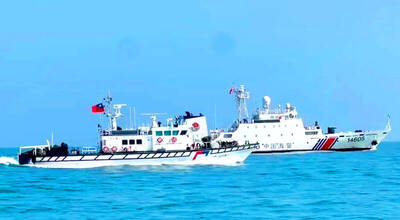
Instead of focusing solely on the threat of a full-scale military invasion, the US and its allies must prepare for a potential Chinese “quarantine” of Taiwan enforced through customs inspections, Stanford University Hoover fellow Eyck Freymann said in a Foreign Affairs article published on Wednesday. China could use various “gray zone” tactics in “reconfiguring the regional and ultimately the global economic order without a war,” said Freymann, who is also a nonresident research fellow at the US Naval War College. China might seize control of Taiwan’s links to the outside world by requiring all flights and ships entering or leaving Taiwan


 RSS
RSS