


The Control Yuan on Wednesday accused the Council of Indigenous Peoples (CIP) of failing to take effective steps to resolve unemployment among Aborigines and demanded that it conduct a thorough review of its job policies.
It said in a censure statement that the unemployment rate for Aborigines in September was 8.69 percent, significantly higher than the national average of 6.04 percent for the same month.
The national average for monthly earnings in 2008 stood at NT$36,357, which was 1.53 times higher than that of employed Aborigines, most of whom worked in low-skilled, labor-intensive jobs, the statement said.
“The council was slack in its duties when it came to tackling the long-term problems facing Aborigines ... offering them limited opportunities to improve their working skills and find employment,” said Tu Shan-liang (杜善良), a Control Yuan member in charge of the case.
The Control Yuan also censured the Bureau of National Health Insurance, saying it failed to combat fraud, scams and abuses in the national health insurance system.
Over the past 11 years, the bureau managed to reclaim NT$2.869 billion (US$89.7 million) in illegal reimbursements by healthcare institutions, which accounted for only 1.71 percent of the NT$167.7 billion the bureau should have gotten back if it had carried out measures meant to remedy shortcomings.
Control Yuan member Cheng Jen-hung (程仁宏) said that, on average, the bureau demanded a return of NT$261 million each year during the period, a trivial amount compared with the about NT$400 billion in insurance payments claimed by healthcare institutions in a year.

LOUD AND PROUD Taiwan might have taken a drubbing against Australia and Japan, but you might not know it from the enthusiasm and numbers of the fans Taiwan might not be expected to win the World Baseball Classic (WBC) but their fans are making their presence felt in Tokyo, with tens of thousands decked out in the team’s blue, blowing horns and singing songs. Taiwanese fans have packed out the Tokyo Dome for all three of their games so far and even threatened to drown out home team supporters when their team played Japan on Friday. They blew trumpets, chanted for their favorite players and had their own cheerleading squad who dance on a stage during the game. The team struggled to match that exuberance on the field, with
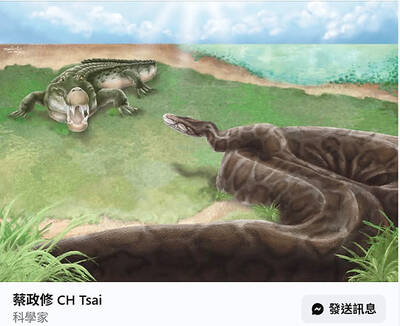
Taiwanese paleontologists have discovered fossil evidence that pythons up to 4m long inhabited Taiwan during the Pleistocene epoch, reporting their findings in the international scientific journal Historical Biology. National Taiwan University (NTU) Institute of Ecology and Evolutionary Biology associate professor Tsai Cheng-hsiu (蔡政修) led the team that discovered the largest snake fossil ever found in Taiwan. The single trunk vertebra was discovered in Tainan at the Chiting Formation, dated to between 400,000 and 800,000 years ago in the Middle Pleistocene, the paper said. The area also produced Taiwan’s first avian fossil, as well as crocodile, mammoth, saber-toothed cat and rhinoceros fossils, it said. Discoveries

Taiwanese paleontologists have discovered fossil evidence that pythons up to 4m long inhabited Taiwan during the Pleistocene epoch, reporting their findings in the international scientific journal Historical Biology. National Taiwan University (NTU) Institute of Ecology and Evolutionary Biology associate professor Tsai Cheng-hsiu (蔡政修) led the team that discovered the largest snake fossil ever found in Taiwan. A single trunk vertebra was discovered in Tainan at the Chiting Formation, dated to between 800,000 to 400,000 years ago in the Middle Pleistocene, the paper said. The area also produced Taiwan’s first avian fossil, as well as crocodile, mammoth, sabre-toothed cat and rhinoceros fossils, it said. Discoveries

Whether Japan would help defend Taiwan in case of a cross-strait conflict would depend on the US and the extent to which Japan would be allowed to act under the US-Japan Security Treaty, former Japanese minister of defense Satoshi Morimoto said. As China has not given up on the idea of invading Taiwan by force, to what extent Japan could support US military action would hinge on Washington’s intention and its negotiation with Tokyo, Morimoto said in an interview with the Liberty Times (sister paper of the Taipei Times) yesterday. There has to be sufficient mutual recognition of how Japan could provide


 RSS
RSS