


Joining four legislative by-election candidates to solicit support yesterday, President Ma Ying-jeou (馬英九), chairman of the Chinese Nationalist Party (KMT), called on the party to unite to win the polls on Feb 27.
“The legislative by-election is a very important battle for the KMT, and we cannot afford to lose this time,” Ma said at KMT headquarters.
The KMT yesterday invited the four by-election candidates — Apollo Chen (陳學聖) of Taoyuan County, Cheng Yung-tang (鄭永堂) of Hsinchu County, Lin Te-jui (林德瑞) of Chiayi County and Wang Ting-sheng (王廷升) of Hualien County — to campaign for the Central Standing Committee meeting yesterday.
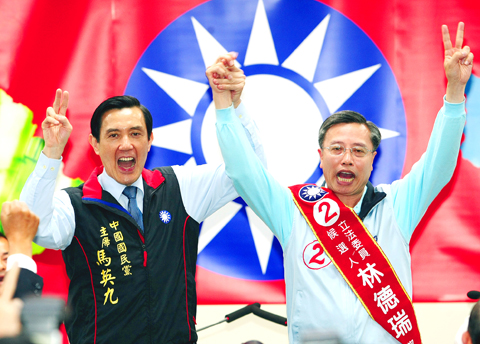
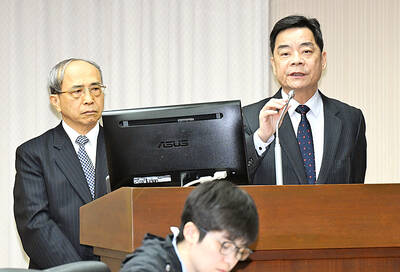
PHOTO: CNA
Ma said the party was facing tough battles in each of the four counties, and urged party members to step up their efforts to campaign for the candidates.
“We must have determination and strive for victory in the by-election,” Ma said.
The KMT lost the previous legislative by-elections to the Democratic Progressive Party (DPP) last month and was seeking to integrate local party factions for the upcoming polls.
Meanwhile, KMT Secretary-General King Pu-tsung (金溥聰) yesterday accompanied Hsinchu County Speaker Chang Pi-ching (張碧琴) as she announced she would drop a lawsuit against Hsinchu County Commissioner Chiu Ching-chun (邱鏡淳) to help party unity.
Chang said Ma and King visited her and Chiu several times to persuade them to drop lawsuits against each other and urged them to join efforts to campaign for the by-election candidates.
“We decided to put party unity ahead of personal issues, and KMT members will join efforts to seek election victory,” Chang said in a press conference.
Chiu agreed to drop a lawsuit against Chang, too, but did not show up at the press conference.
The two filed defamation lawsuits against each other during the Hsinchu County commissioner election last year.By Mo Yan-chih
Staff Reporter
Joining four legislative by-election candidates to solicit support yesterday, President Ma Ying-jeou (馬英九), chairman of the Chinese Nationalist Party (KMT), called on the party to unite to win the polls on Feb 27.
“The legislative by-election is a very important battle for the KMT, and we cannot afford to lose this time,” Ma said at KMT headquarters.
The KMT yesterday invited the four by-election candidates — Apollo Chen (陳學聖) of Taoyuan County, Cheng Yung-tang (鄭永堂) of Hsinchu County, Lin Te-jui (林德瑞) of Chiayi County and Wang Ting-sheng (王廷升) of Hualien County — to campaign for the Central Standing Committee meeting yesterday.
Ma said the party was facing tough battles in each of the four counties, and urged party members to step up their efforts to campaign for the candidates.
“We must have determination and strive for victory in the by-election,” Ma said.
The KMT lost the previous legislative by-elections to the Democratic Progressive Party (DPP) last month and was seeking to integrate local party factions for the upcoming polls.
Meanwhile, KMT Secretary-General King Pu-tsung (金溥聰) yesterday accompanied Hsinchu County Speaker Chang Pi-ching (張碧琴) as she announced she would drop a lawsuit against Hsinchu County Commissioner Chiu Ching-chun (邱鏡淳) to help party unity.
Chang said Ma and King visited her and Chiu several times to persuade them to drop lawsuits against each other and urged them to join efforts to campaign for the by-election candidates.
“We decided to put party unity ahead of personal issues, and KMT members will join efforts to seek election victory,” Chang said in a press conference.
Chiu agreed to drop a lawsuit against Chang, too, but did not show up at the press conference.
The two filed defamation lawsuits against each other during the Hsinchu County commissioner election last year.
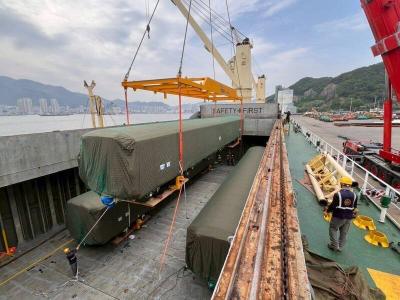
The first of 10 new high-capacity trains purchased from South Korea’s Hyundai Rotem arrived at the Port of Taipei yesterday to meet the demands of an expanding metro network, Taipei Rapid Transit Corp (TRTC) said yesterday. The train completed a three-day, 1,200km voyage from the Port of Masan in South Korea, the company said. Costing NT$590 million (US$18.79 million) each, the new six-carriage trains feature a redesigned interior based on "human-centric" transportation concepts, TRTC said. The design utilizes continuous longitudinal seating to widen the aisles and optimize passenger flow, while also upgrading passenger information displays and driving control systems for a more comfortable
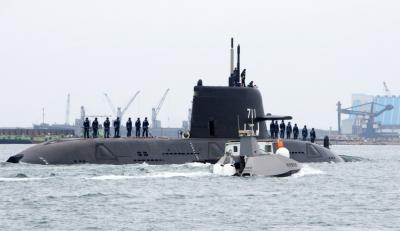
Taiwan's first indigenous defense submarine, the SS-711 Hai Kun (海鯤, or Narwhal), departed for its 13th sea trial at 7am today, marking its seventh submerged test, with delivery to the navy scheduled for July. The outing also marked its first sea deployment since President William Lai (賴清德) boarded the submarine for an inspection on March 19, drawing a crowd of military enthusiasts who gathered to show support. The submarine this morning departed port accompanied by CSBC Corp’s Endeavor Manta (奮進魔鬼魚號) uncrewed surface vessel and a navy M109 assault boat. Amid public interest in key milestones such as torpedo-launching operations and overnight submerged trials,
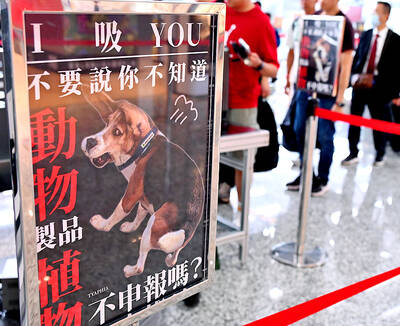
Quarantine awareness posters at Taiwan Taoyuan International Airport have gone viral for their use of wordplay. Issued by the airport branch of the Animal and Plant Health Inspection Agency, the posters feature sniffer dogs making a range of facial expressions, paired with advisory messages built around homophones. “We update the messages for holidays and campaign needs, periodically refreshing materials to attract people’s attention,” quarantine officials said. “The aim is to use the dogs’ appeal to draw focus to quarantine regulations.” A Japanese traveler visiting Taiwan has posted a photo on X of a poster showing a quarantine dog with a
SECURITY RISK: A university student sent a general alarm signal to THSRC’s control center on April 5, causing four operating trains to temporarily halt services The Ministry of Transportation and Communications yesterday pledged to submit a report on ways to harden the communication security of railway systems after a university student hacked into Taiwan High Speed Rail Corp’s (THSRC) radio communications system and disrupted operations of four high-speed rail trains last month. Investigation by the police and prosecutors found that the university student and radio enthusiast, surnamed Lin (林), first used a software-defined radio (SDR) filter to analyze THSRC signals, downloaded the data to a computer, cracked the parameters and then programmed the codes into his radio devices. Lin then sent a general alarm signal to


 RSS
RSS