


An influx of savanna nightjars has become a potential threat to the nation’s aviation safety, the results of a survey conducted by the Flight Safety Foundation-Taiwan showed.
A bird species found mainly in South Asia, savanna nightjars were once believed to be on the verge of extinction. Before 2000, they were sporadically seen in Pingtung and Hualien Counties.
The foundation’s survey, however, showed that populations of savanna nightjars have experienced unbalanced growth in counties south of Hsinchu and on the east coast in recent years.
Environmental protection bureaus or fire departments in Taichung, Nantou, Yunlin, Changhua, Hualien, Chiayi, Kaohsiung and Pingtung have received many noise complaints related to the birds from residents in the past two years. When mating, the birds’ cries can reach 90 decibels.
The increase of savanna nightjars has threatened the nation’s flight safety, the report said. Between 2008 and last year, seven bird strike incidents were reported at Chiayi Airport, Taipei Songshan Airport and Taiwan Taoyuan International Airport.
In the survey, ground crews at the Navy base in Taoyuan and Air Force bases in Taichung and Chiayi were also interviewed.
The interviews showed that starting about two years ago, ground crews would find the bodies of dead savanna nightjars when they removed debris from runways in the mornings.
They suspected the birds had died after being hit by airplanes on takeoff and landing. When they inspected runways at night, they found that nightjars would sometimes flock on the tarmac.
To counter the threat posed by savanna nightjars, the foundation proposed that airport staffs increase night patrols on runways between July and October, when the birds are more likely to appear.
The foundation said patrol vehicles should try to shoo away flocks of nightjars 30 minutes before the landing or departure of aircraft. It also advised them to shoot the birds if the first method does not work.
The foundation also suggested that airport staff learn about the habits of savanna nightjars and establish a bird strike alert system to ensure flight safety. They should inspect deserted buildings around airports regularly in case the birds roost on their roofs, the foundation said.
Bird strikes can cause of aviation accidents. A US Airways airplane crash-landed in the Hudson River last January after striking a a flock of geese upon taking off from La Guardia Airport in New York City. All 150 passengers and crew aboard the flight survived the accident.
The Civil Aeronautics Administration said yesterday in a statement that the number of bird strikes had dropped from 202 in 2002 to 115 in 2008.
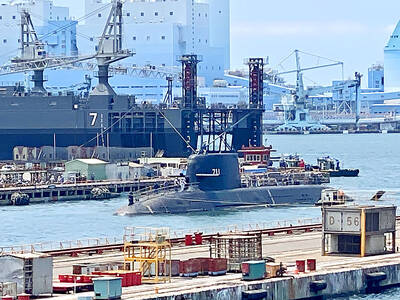
AGING: While Japan has 22 submarines, Taiwan only operates four, two of which were commissioned by the US in 1945 and 1946, and transferred to Taiwan in 1973 Taiwan would need at least 12 submarines to reach modern fleet capabilities, CSBC Corp, Taiwan chairman Chen Cheng-hung (陳政宏) said in an interview broadcast on Friday, citing a US assessment. CSBC is testing the nation’s first indigenous defense submarine, the Hai Kun (海鯤, Narwhal), which is scheduled to be delivered to the navy next month or in July. The Hai Kun has completed torpedo-firing tests and is scheduled to undergo overnight sea trials, Chen said on an SET TV military affairs program. Taiwan would require at least 12 submarines to establish a modern submarine force after assessing the nation’s operational environment and defense

A white king snake that frightened passengers and caused a stir on a Taipei MRT train on Friday evening has been claimed by its owner, who would be fined, Taipei Rapid Transit Corp (TRTC) said yesterday. A person on Threads posted that he thought he was lucky to find an empty row of seats on Friday after boarding a train on the Bannan (Blue) Line, only to spot a white snake with black stripes after sitting down. Startled, he jumped up, he wrote, describing the encounter as “terrifying.” “Taipei’s rat control plan: Release snakes on the metro,” one person wrote in reply, referring
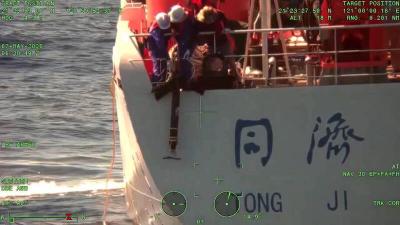
The coast guard today said that it had disrupted "illegal" operations by a Chinese research ship in waters close to the nation and driven it away, part of what Taipei sees a provocative pattern of China's stepped up maritime activities. The coast guard said that it on Thursday last week detected the Chinese ship Tongji (同濟號), which was commissioned only last year, 29 nautical miles (54km) southeast of the southern tip of Taiwan, although just outside restricted waters. The ship was observed lowering ropes into the water, suspected to be the deployment of scientific instruments for "illegal" survey operations, and the coast
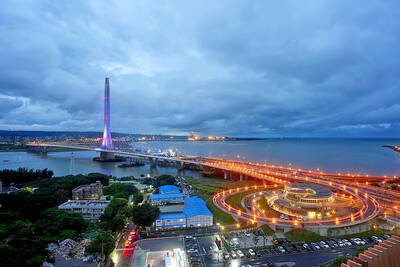
An inauguration ceremony was held yesterday for the Danjiang Bridge, the world’s longest single-mast asymmetric cable-stayed bridge, ahead of its official opening to traffic on Tuesday, marking a major milestone after nearly three decades of planning and construction. At the ceremony in New Taipei City attended by President William Lai (賴清德), Premier Cho Jung-tai (卓榮泰), Minister of Transportation and Communications Chen Shih-kai (陳世凱) and New Taipei City Mayor Hou Yu-ih (侯友宜), the bridge was hailed as both an engineering landmark and a long-awaited regional transport link connecting Tamsui (淡水) and Bali (八里)


 RSS
RSS