


The legislative watchdog Citizen Congress Watch (CCW) and a student group at National Taiwan University (NTU) yesterday unveiled the results of their evaluation of the performance of a committee during the current legislative session, singling out two Chinese Nationalist Party (KMT) legislators for their good performance.
At a press conference at NTU, about 15 students of the university’s Leadership Program gave KMT legislators Chao Li-yun (趙麗雲) and Chiang Nai-shin (蔣乃辛) praise for being fully prepared for the bills reviewed by the Education and Culture Committee last week.
The students spent two sessions watching video clips of five randomly selected meetings of the committee on the legislature’s video-on-demand (VOD) system and graded the performance of members of the committee.
The students singled out Chao and Chiang as model committee members, but did not highlight any legislators with poor ratings.
Yu Chia-jung (游家蓉), a student in the program, however, said the students agreed that lawmakers usually resorted to “inappropriate methods” during their question-and-answer sessions, such as questioning officials based on unverified reports in the media or raising issues unrelated to bills being reviewed.
CCW chief executive Ho Tsung-hsun (何宗勳) said the organization hoped the evaluation would lead to the students taking more interest in politics, adding that he hoped similar evaluations could also be held in elementary and junior high schools. Ho said CCW would include the students’ feedback in its weekly journal and mail it to legislators.
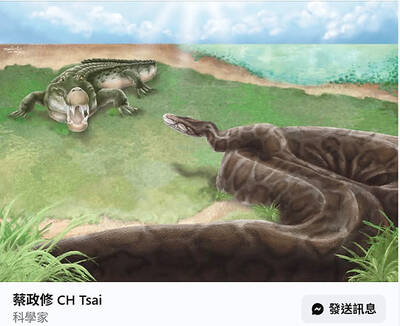
Taiwanese paleontologists have discovered fossil evidence that pythons up to 4m long inhabited Taiwan during the Pleistocene epoch, reporting their findings in the international scientific journal Historical Biology. National Taiwan University (NTU) Institute of Ecology and Evolutionary Biology associate professor Tsai Cheng-hsiu (蔡政修) led the team that discovered the largest snake fossil ever found in Taiwan. The single trunk vertebra was discovered in Tainan at the Chiting Formation, dated to between 400,000 and 800,000 years ago in the Middle Pleistocene, the paper said. The area also produced Taiwan’s first avian fossil, as well as crocodile, mammoth, saber-toothed cat and rhinoceros fossils, it said. Discoveries

Taiwanese paleontologists have discovered fossil evidence that pythons up to 4m long inhabited Taiwan during the Pleistocene epoch, reporting their findings in the international scientific journal Historical Biology. National Taiwan University (NTU) Institute of Ecology and Evolutionary Biology associate professor Tsai Cheng-hsiu (蔡政修) led the team that discovered the largest snake fossil ever found in Taiwan. A single trunk vertebra was discovered in Tainan at the Chiting Formation, dated to between 800,000 to 400,000 years ago in the Middle Pleistocene, the paper said. The area also produced Taiwan’s first avian fossil, as well as crocodile, mammoth, sabre-toothed cat and rhinoceros fossils, it said. Discoveries
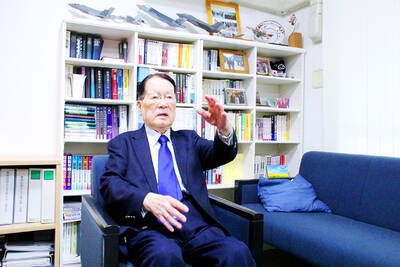
Whether Japan would help defend Taiwan in case of a cross-strait conflict would depend on the US and the extent to which Japan would be allowed to act under the US-Japan Security Treaty, former Japanese minister of defense Satoshi Morimoto said. As China has not given up on the idea of invading Taiwan by force, to what extent Japan could support US military action would hinge on Washington’s intention and its negotiation with Tokyo, Morimoto said in an interview with the Liberty Times (sister paper of the Taipei Times) yesterday. There has to be sufficient mutual recognition of how Japan could provide
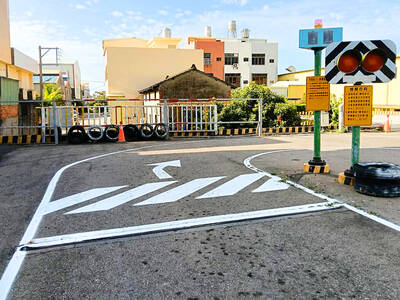
UPDATED TEST: The new rules aim to assess drivers’ awareness of risky behaviors and how they respond under certain circumstances, the Highway Bureau said Driver’s license applicants who fail to yield to pedestrians at intersections or to check blind spots, or omit pointing-and-calling procedures would fail the driving test, the Highway Bureau said yesterday. The change is set to be implemented at the end of the month, and is part of the bureau’s reform of the driving portion of the test, which has been criticized for failing to assess whether drivers can operate vehicles safely. Sedan drivers would be tested regarding yielding to pedestrians and turning their heads to check blind spots, while drivers of large vehicles would be tested on their familiarity with pointing-and-calling


 RSS
RSS