

The Mongolian and Tibetan Affairs Commission (MTAC) said yesterday that those who were not confirmed as having Tibetan refugee status by the commission earlier this year — and who have been on a hunger strike since Monday — are simply not Tibetans.
Earlier this year, 78 of 134 people who claimed to be Tibetan refugees living in Taiwan without proper documents received confirmation of their status as Tibetans from MTAC, and were quickly granted residency by the National Immigration Agency (NIA) following amendments to the Immigration Act (入出國及移民法).
MTAC Chief Secretary Chien Shih-yin (錢世英) told the Taipei Times that the entire confirmation process follows a strict set of procedures, including verifying identity documents with the issuing governments, checking references and doing interviews.
However, around 30 of those who failed to pass the MTAC review began a hunger strike outside the commission on Monday, accusing it of applying double standards when reviewing the cases.
“All 134 people were given temporary residency last year as Tibetans after MTAC’s review, but some of them were denied this year. What are the criteria?” Taiwan Tibetan Welfare Association chairman Jamga asked. “Also, there are even two brothers, where the elder brother was granted residency, while the younger brother wasn’t — how is this possible?”
One of the protestors, Deu Bahadur Tamang, admitted that he doesn’t speak Tibetan, but insisted that he was born in Tibet and went into exile in Nepal with his parents when he was only three.
“My parents died when I was kid, and I grew up in a Nepalese community, so I don’t speak Tibetan, but I am a Tibetan,” he said, adding that he was on a short trip to Taiwan organized by MTAC for Tibetans in Nepal in 1994.
“If they considered me a Tibetan then, why am I not now?” Tamang said.
MTAC said that Tamang did not pass the review because the documents he provided were obviously altered.
In a statement released on Thursday night, MTAC denied that there were double standards, and insisted that those protesting were simply not classed as Tibetans.
“These people, of unknown nationalities, cannot be verified as Tibetans,” the statement said. “Since they are not Tibetans, they are considered people of foreign nationalities or stateless people residing in Taiwan, and we urge the NIA to handle any issues related to such people according to the law.”
The statement went on to explain that these people did not receive verification of their Tibetan status because they either provided forged documents, false references or do not have a fundamental knowledge of the Tibetan language or Tibetan culture.
Meanwhile, the Democratic Progressive Party caucus plans to propose a resolution next week to extend the temporary residency — which ends on Dec. 29 — of the people who did not receive verification of Tibetan status for another year so there is more time to resolve the issue.

Taiwan’s growing defense preparations might be sending a stronger signal to the US than to Beijing, highlighting the need for Taipei to tailor its deterrence efforts to different audiences, a US security academic said yesterday. Stanford University Freeman Spogli Institute for International Studies fellow Oriana Skylar Mastro made the comment during a Taipei Security Dialogue panel examining lessons Taiwan could draw from the wars in Ukraine and the Middle East. Mastro said she was impressed by Taiwan’s increased defense spending, emphasis on asymmetric capabilities and efforts to prepare society for conflict, but questioned whom those initiatives were influencing. She said when she asked
A total of 400 foreign “high- level” professionals have been naturalized as Republic of China (Taiwan) citizens over the past decade as the government has eased nationality rules to attract talent from a wider range of fields, the Ministry of the Interior said yesterday. The 400th high-level professional, who works in the electronics industry, was approved for ROC citizenship on Aug. 26, the MOI said. The MOI quoted the newly naturalized citizen as saying that Taiwan is a leader in fields such as semiconductors, electronics manufacturing, artificial intelligence development and energy technology. He also said
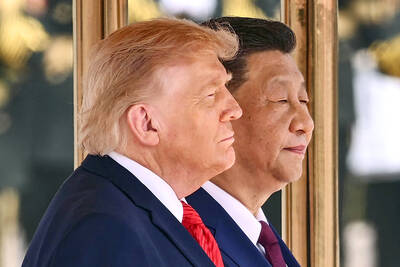
China has warned that it could cancel a planned US-China leaders’ summit if Washington approves new arms sales to Taiwan, a Japanese media outlet quoted sources as saying yesterday. US President Donald Trump, “apparently eager to showcase some diplomatic achievements ahead of November’s midterm congressional elections, places great importance on holding the summit with Chinese President Xi Jinping (習近平),” Japan’s Kyodo News reported. “While preparing for Xi’s upcoming trip, China has restated its position that the Taiwan issue is a ‘red line’ in bilateral relations,” the report said. The report said that when Xi met with Trump in Beijing in May, Xi said
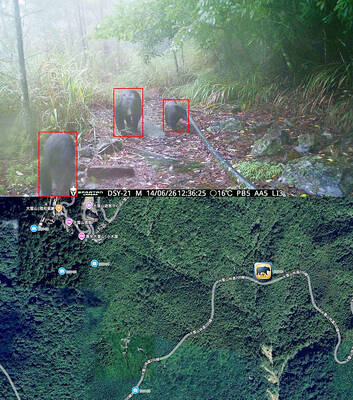
RARE PEEK: The footage released showed one of the bears staying in a cave for as long as 70 days, providing the first record of Formosan black bear’s overwintering The Forestry and Nature Conservation Agency yesterday released tracking records of released Formosan black bears for the first time, showing that they get much closer to human settlements than previously thought. The agency said it had captured two bears, Da Qu-ali (達古阿里) and Aziman (阿里曼), in indigenous villages in Hualien County and began to track them with a camera-mounted satellite collar after releasing them back into the wild. The results confirmed that the bears have moved from deep mountain areas into lowland hills closer to human communities, leading to an increase in human-bear conflicts, it said. The agency has introduced artificial intelligence-assisted early


 RSS
RSS