


President Ma Ying-jeou (馬英九) said yesterday the government would consider transforming all international covenants into domestic laws to demonstrate Taiwan’s determination to promote human rights.
The Act Governing International Covenant on Civil and Political Rights and the International Covenant on Economic, Social and Cultural Rights (公民與政治權利國際公約及經濟社會文化權利國際公約施行法) made the two covenants part of domestic law as of Thursday, and the government would look into turning all international covenants into domestic laws, Ma said.
“The government will conduct a thorough review on international covenants that Taiwan was unable to participate in and ponder the possibility of turning them into domestic laws,” Ma said when meeting with representatives from legal groups at the Presidential Office.
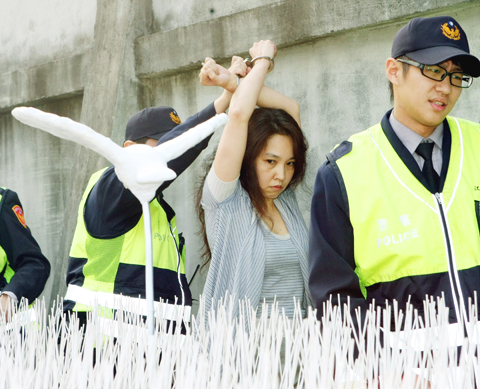
PHOTO: CNA
Ma signed the covenants in May and sent them to the UN Secretariat but they were returned because the country left the UN in 1971.
Ma said the Ministry of Justice would also amend related regulations that violated the two covenants in two years, to demonstrate Taiwan’s willingness to participate in the international community and perform its international obligations.
Ma lauded the ministry for allowing suspects to see the depositions simultaneously starting on Jan. 1 as a means to protect the rights of the suspects.
In response to the representatives’ advice to establish a judicial reform committee under the Presidential Office and to publish the progress of judicial reform every three months, Ma promised to ask the Justice Ministry and Judicial Yuan to present a practical strategy in one month.
In other news, at a separate setting yesterday, former vice president Annette Lu (呂秀蓮) lashed out at the Ma government, accusing it of trying to cover up the ugly acts of the former Chinese Nationalist Party (KMT) regime by using works of art to beautify the Taiwan Human Rights Memorial Park.
Lu called on the public not to visit the park until the government restored its original appearance.
The Council of Cultural Affairs organized an exhibition at the memorial park on Thursday, including a public art installation. Chen Chia-chun (陳嘉君), wife of anti-Chen Shui-bian (陳水扁) movement leader Shih Ming-teh (施明德), tried to attack the artwork and was arrested.
Chen criticized artist Yu Wen-fu (游文富) for displaying his work where Wang Hsi-ling (汪希苓), former head of the Military Intelligence Bureau was kept under house arrest for ordering the murder of Chinese-American writer Henry Liu (劉宜良). Chen said that placing the art work there was the same as commemorating Wang.
“The memorial held many dissidents including myself and tortured us during the martial law period, and it is ironic that President Ma allowed the government to beautify the memorial with public art works and dancing,” Lu said during a human rights forum held by the Yushan Media.
Lu urged Ma to face up to the old KMT regime’s crimes and called for a boycott of the memorial until it is restored to its original state.
Before becoming the Taiwan Human Rights Memorial Park, Taipei’s Jingmei military detention center was used to try and detain political dissidents before sending them to prison or to be executed from the late 1960s to the 1980s.
ADDITIONAL REPORTING BY CNA

FUKUOKA SITUATION: Japanese media reported that the pathogen is expected to be identified by the summer, while the CDC downplayed the idea that it was hMPV A “mysterious cold-like illness” reported in Japan’s Fukuoka Prefecture does not seem to be a new disease, but Japanese authorities have been asked about the situation, the Centers for Disease Control (CDC) said yesterday. The Fukuoka Prefectural Medical Association on Wednesday told a news conference that a “mystery cold” that has become a hot topic on social media is “highly likely to be caused by some kind of viral infection,” Japan’s KBC News reported. “Many people are experiencing symptoms starting with a sore throat, followed by a runny nose, phlegm and a severe cough,” KBC News reported, citing association officials. Health authorities are

Nvidia Corp CEO Jensen Huang (黃仁勳) arrived in Taiwan yesterday ahead of upcoming AI and technology events, saying he plans to meet with clients and Taiwan Semiconductor Manufacturing Co Chairman C.C. Wei (魏哲家) during his visit. After landing at Taipei Songshan Airport, Huang posed for photos with fans and handed out Yakult drinks to reporters and supporters waiting at the scene, saying he has “a lot to do” during the trip. Asked about reports that Nvidia’s planned headquarters site in Taipei’s Beitou Shilin Technology Park could break ground on May 27, Huang said that if the company holds an event, he would
Carrefour Taiwan is to begin using a new name from the start of July, but it cannot divulge the name until then, the chairman of the supermarket chain's parent company said today. President Chain Store Co chairman Lo Chih-hsien (羅智先) was asked by reporters after a shareholders' meeting to confirm whether the company has settled on a new name for the supermarket brand. In March, the government-registered name of two Carrefour Taiwan branches was quietly changed to "Le Chia Kang" (樂家康) in Chinese, raising speculation that has been selected as the name. Lo said that because of local regulations and contractual obligations, the
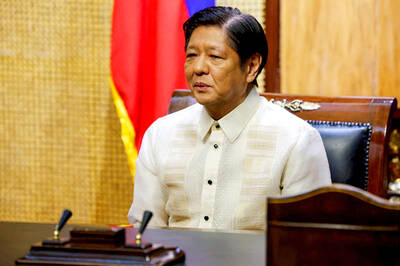
The Philippines would likely be involved in any conflict over Taiwan due to its proximity to the democracy claimed by China, President Ferdinand Marcos Jr said, reiterating a stance that risks angering Beijing. “In the Philippines, we do not have a choice because Taiwan is so close to the Philippines and we have almost 200,000 Filipino nationals living and working in Taiwan,” Marcos said in an interview with Japanese media in Manila on Monday. The Philippine leader’s comments come ahead of a state visit to Japan next week, where he is to meet with Japanese Prime Minister Sanae Takaichi to discuss security


 RSS
RSS