


Wearing blue jeans and a blue shirt while making his weekly trip around the country to promote Taiwanese nationalism, Su Beng (史明) is widely revered as a man of action devoted to socialism and Taiwanese independence.
Born in 1918, Su is expected to be released from a hospital in Japan where he has been treated for uremia and kidney problems since late last month, with a group of activists planning to greet him at Taiwan Taoyuan International Airport on his return.
Su has been in Tokyo since late October to supervise the reopening of the New Gourmet (新珍味), a noodle shop he opened in 1954 as a way to earn a living and as a base for training staff who carried out anti-government arson attacks in Taiwan in the 1970s.
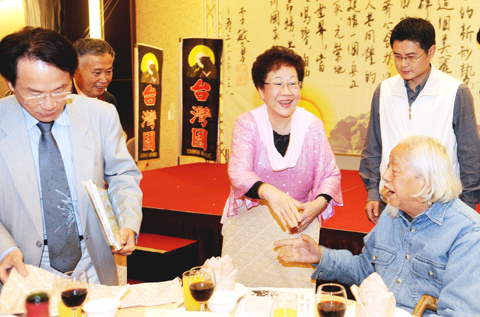
PHOTO: CHIEN JUNG-FONG, TAIPEI TIMES
The noodle shop had since become the main source of funding for his endeavors before it closed for renovation for much of the past year.
In 1952, Su was a fugitive wanted by the Chiang Kai-shek (蔣介石) regime because of a plot to assassinate the dictator.
Disguising himself as a worker at Keelung Harbor, Su managed to stow away on a boat to Japan — where he attended Waseda University in the 1940s, with a degree in political science and economics — and sought political asylum.
The years spent in exile further shaped Su’s interest in socialism after seeing the masses’ frustration with communist rule in the Soviet Union and Eastern Europe, as well as China. He completed his classic book on the history of Taiwan, comprehensively formulating his theory of building Taiwan as an independent nation-state with an equitable distribution of wealth.
Originally named Shih Chao-hui (施朝暉), he changed his name to Su Beng — which means “historically clear” in Hoklo — to underline the importance of getting a clear understanding of history.
Taiwan’s 400 Years of History (台灣人四百年史) was first published in Japanese in 1962 and helped raise Taiwanese consciousness among his generation. The Mandarin and English versions were published in the 1980s, while the updated edition that included the period 1980-1998 came out in 1998.
Liao I-en (廖宜恩), a professor of computer science and engineering at National Chung-Hsiung University and vice chairman of the Taiwan Association of University Professors, was one of his followers.
“Since the 1980s, Su has traveled regularly between Japan and the US to lecture Taiwanese students abroad about [Taiwanese] history at his own expense. I met him nearly every summer,” Liao said.
To reach as many as students as possible at different US campuses, Su learned how to drive in his 60s and commuted frugally using an old vehicle.
“Su enlightened us on the repressed history of Taiwan and told us that the first step to establish an independent country was to shed the Chinese nationalism deeply instilled in our brains under the Chinese Nationalist Party [KMT] regime,” Liao said.
Su’s ideas on Taiwanese nationalism grew partly from his experience in joining the Chinese Communist Party’s (CCP) fight against Japanese forces in the War of the Pacific between 1942 and 1945 and the following years when he came back to Taiwan under Chiang’s rule.
Against a backdrop of a new wave of states formed on the basis of national identity and ethnicity after World War II, Su came to believe that there was a fundamental difference in national identity between Chinese and Taiwanese.
Chen Fang-ming (陳芳明), the dean of the Graduate Institute of Taiwanese Literature at National Chengchi University and a historian, said that Su’s conception of history was mainly formed by three elements: He defined KMT rule as another colonial regime; he viewed history from the perspective of class; and he created the notion of Taiwanese nationalism.
“All his analysis in this regard has passed the test of time over the past 40 years, vividly materializing in many situations right in front of our eyes,” Chen said.
The history of Taiwan was a continuous and linear development of Japanese colonization to the KMT’s re-colonization, and it was not until the first direct presidential election in 1996 that the controversy over the legitimacy of KMT rule began to fade, Chen said.
Over the years, the country has seen the emergence of Taiwanese nationalism and the calls for an equal, just society and world, as globalization has worsened inequality among and within countries, proving that Su’s thoughts have echoed down the years, Chen said.
What impressed Chen most was not only Su’s intellectual work, but that he has put his beliefs into practice in everyday life.
“He is a real leftist. Unlike many self-claimed leftists who always talk the talk but don’t walk the walk, the biggest distinction between them is that Su thinks he can carry out his beliefs and he makes every effort to make it happen,” Chen said.
For many Taiwanese independence activists, Su is well known for his generosity, as he has always provided money earned from his noodle shop to help their cause.
When he worked on Taiwan’s 400 Years of History, he cooked by day and wrote by night.
“He is a wonderful man, never thinking of himself. I visited him in the 1980s, saw him prepare a very simple breakfast for himself — rice porridge and pickles. He saved all the money he earned for the Taiwan Independence Association [TIA] and his comrades,” Chen said.
The blacklisted Su managed to get on a Taiwanese fishing boat back to Taiwan in 1993 and since then has worked tirelessly to educate people on Taiwan’s history.
He organizes TIA motorcades, making the rounds on weekends to deliver messages on Taiwanese nationalism over a megaphone. He has rewritten his book into more readable version for elementary and junior high school students, as well as writing other books on the 228 Incident, Western philosophy, democracy and other topics. He has also mobilized his taxi driver base to protest at meetings between senior KMT and CCP officials, among others.
“What Su preaches might seem quixotic to some people, but for me, he has been deadly earnest about what he wants to do. His mission means everything to him, and his life is all about accomplishing his missions,” said Nuke-4 Referendum Initiative Association chief executive Iap Phok-bun (葉博文), who helped Su establish the Su Beng Education Foundation in 2001.
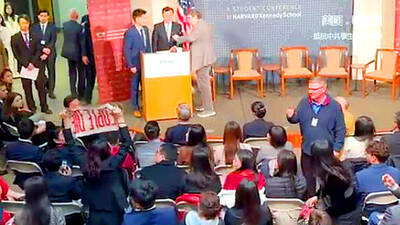
A group of Taiwanese-American and Tibetan-American students at Harvard University on Saturday disrupted Chinese Ambassador to the US Xie Feng’s (謝鋒) speech at the school, accusing him of being responsible for numerous human rights violations. Four students — two Taiwanese Americans and two from Tibet — held up banners inside a conference hall where Xie was delivering a speech at the opening ceremony of the Harvard Kennedy School China Conference 2024. In a video clip provided by the Coalition of Students Resisting the CCP (Chinese Communist Party), Taiwanese-American Cosette Wu (吳亭樺) and Tibetan-American Tsering Yangchen are seen holding banners that together read:

UNAWARE: Many people sit for long hours every day and eat unhealthy foods, putting them at greater risk of developing one of the ‘three highs,’ an expert said More than 30 percent of adults aged 40 or older who underwent a government-funded health exam were unaware they had at least one of the “three highs” — high blood pressure, high blood lipids or high blood sugar, the Health Promotion Administration (HPA) said yesterday. Among adults aged 40 or older who said they did not have any of the “three highs” before taking the health exam, more than 30 percent were found to have at least one of them, Adult Preventive Health Examination Service data from 2022 showed. People with long-term medical conditions such as hypertension or diabetes usually do not
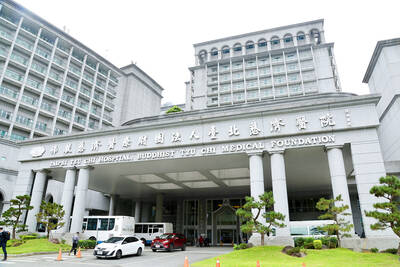
POLICE INVESTIGATING: A man said he quit his job as a nurse at Taipei Tzu Chi Hospital as he had been ‘disgusted’ by the behavior of his colleagues A man yesterday morning wrote online that he had witnessed nurses taking photographs and touching anesthetized patients inappropriately in Taipei Tzu Chi Hospital’s operating theaters. The man surnamed Huang (黃) wrote on the Professional Technology Temple bulletin board that during his six-month stint as a nurse at the hospital, he had seen nurses taking pictures of patients, including of their private parts, after they were anesthetized. Some nurses had also touched patients inappropriately and children were among those photographed, he said. Huang said this “disgusted” him “so much” that “he felt the need to reveal these unethical acts in the operating theater
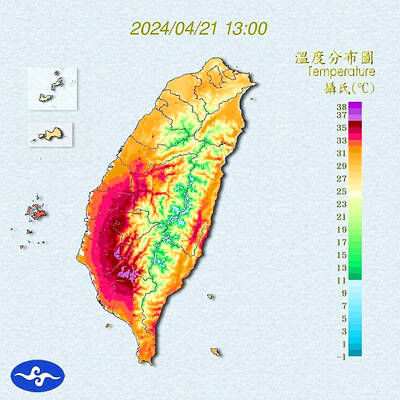
Heat advisories were in effect for nine administrative regions yesterday afternoon as warm southwesterly winds pushed temperatures above 38°C in parts of southern Taiwan, the Central Weather Administration (CWA) said. As of 3:30pm yesterday, Tainan’s Yujing District (玉井) had recorded the day’s highest temperature of 39.7°C, though the measurement will not be included in Taiwan’s official heat records since Yujing is an automatic rather than manually operated weather station, the CWA said. Highs recorded in other areas were 38.7°C in Kaohsiung’s Neimen District (內門), 38.2°C in Chiayi City and 38.1°C in Pingtung’s Sandimen Township (三地門), CWA data showed. The spell of scorching


 RSS
RSS