


Democratic Progressive Party (DPP) Chairperson Tsai Ing-wen (蔡英文) yesterday publicly endorsed Hualien’s incumbent deputy commissioner Chang Chih-ming (張志明) as the next Hualien County head, hoping a cross-party effort would be sufficient to end the Chinese Nationalist Party (KMT)’s longstanding monopoly over the eastern county.
While the DPP does not have its own nominee for Hualien in the local government chief race this Saturday, the pan-blue camp faces a three-way split that threatens Tu Li-hua (杜麗華), the KMT’s candidate.
The other two — incumbent KMT Legislator Fu Kun-chi (傅崑萁) and Chang — were both expelled from the KMT for insisting on running as independent candidates.
Fu was indicted on Feb. 2, 2000, for speculating in Taiwan Pineapple group shares in 1998. In 2003, the Taipei District Court sentenced him to six years in jail, fined him NT$150 million (US$4.5 million) and deprived him of his civil rights for four years.
He filed an appeal with the Taiwan High Court and on June 11 the court sentenced him to four years in jail and a fine of NT$20 million. His second appeal is ongoing.
Shaking hands with Chang at an open meeting, Tsai said the DPP decided to throw its weight behind Chang because he shared many political beliefs, while the party and the DPP was confident his platform centered on helping the marginalized would bring maximum benefits to the residents of Hualien.
Tsai praised Chang for having an honest and clean political record and his reputation as a staunch supporter of the underdog.
“We ask all voters to help Chang get into office so that Hualien can have a fresh start after the KMT’s ineffective governance for so many years,” said Tsai, who wrote an open letter to all DPP members urging them to support the party’s choice.
Speaking at another election rally in Hualien, Tsai attacked President Ma Ying-jeou (馬英九), who has been zig-zagging around the country to stump for KMT nominees in his capacity as KMT chairman, of making fragile political promises to woo voters.
The DPP said Ma’s presence in various election events could lead voters into thinking that KMT nominees would enjoy full backing from the central government if elected.

LOUD AND PROUD Taiwan might have taken a drubbing against Australia and Japan, but you might not know it from the enthusiasm and numbers of the fans Taiwan might not be expected to win the World Baseball Classic (WBC) but their fans are making their presence felt in Tokyo, with tens of thousands decked out in the team’s blue, blowing horns and singing songs. Taiwanese fans have packed out the Tokyo Dome for all three of their games so far and even threatened to drown out home team supporters when their team played Japan on Friday. They blew trumpets, chanted for their favorite players and had their own cheerleading squad who dance on a stage during the game. The team struggled to match that exuberance on the field, with
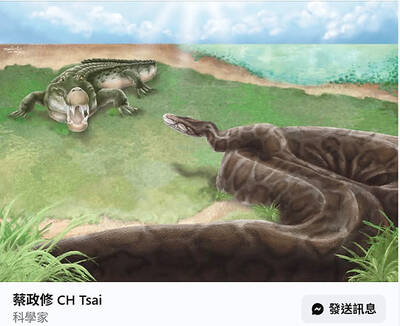
Taiwanese paleontologists have discovered fossil evidence that pythons up to 4m long inhabited Taiwan during the Pleistocene epoch, reporting their findings in the international scientific journal Historical Biology. National Taiwan University (NTU) Institute of Ecology and Evolutionary Biology associate professor Tsai Cheng-hsiu (蔡政修) led the team that discovered the largest snake fossil ever found in Taiwan. The single trunk vertebra was discovered in Tainan at the Chiting Formation, dated to between 400,000 and 800,000 years ago in the Middle Pleistocene, the paper said. The area also produced Taiwan’s first avian fossil, as well as crocodile, mammoth, saber-toothed cat and rhinoceros fossils, it said. Discoveries

Taiwanese paleontologists have discovered fossil evidence that pythons up to 4m long inhabited Taiwan during the Pleistocene epoch, reporting their findings in the international scientific journal Historical Biology. National Taiwan University (NTU) Institute of Ecology and Evolutionary Biology associate professor Tsai Cheng-hsiu (蔡政修) led the team that discovered the largest snake fossil ever found in Taiwan. A single trunk vertebra was discovered in Tainan at the Chiting Formation, dated to between 800,000 to 400,000 years ago in the Middle Pleistocene, the paper said. The area also produced Taiwan’s first avian fossil, as well as crocodile, mammoth, sabre-toothed cat and rhinoceros fossils, it said. Discoveries

Whether Japan would help defend Taiwan in case of a cross-strait conflict would depend on the US and the extent to which Japan would be allowed to act under the US-Japan Security Treaty, former Japanese minister of defense Satoshi Morimoto said. As China has not given up on the idea of invading Taiwan by force, to what extent Japan could support US military action would hinge on Washington’s intention and its negotiation with Tokyo, Morimoto said in an interview with the Liberty Times (sister paper of the Taipei Times) yesterday. There has to be sufficient mutual recognition of how Japan could provide


 RSS
RSS