


A small group of bloggers and Internet users staged a “flash mob” protest in front of the Presidential Office yesterday afternoon to oppose the government’s decision to relax restrictions on US bone-in beef and beef products.
Chen Tai-yuan (陳泰源), who led the nine-strong protest, said yesterday was just the beginning of a long campaign and they hoped to stage at least one flash mob protest a day at mass rapid transit system (MRT) stations. Videos of the protests would be posted on YouTube, he said.
Chanting “Oppose toxic beef! Just say no! Relaunch negotiations,” participants in black lay on the ground for two minutes playing dead. They staged two protests, an hour apart.
Chen said they wore black to signify a funeral for President Ma Ying-jeou (馬英九) and his administration, which he said had failed to protect the health of the public.
“Vegetarians can get mad cow disease,” he said. “There is a proven case in India.”
While the administration has reassured the public on the safety of US bone-in beef and beef products, Chen said he was not convinced.
“If it is safe, why did Taichung Mayor Jason Hu (胡志強) say he would only eat US beef if President Ma eats it,” he said.
When asked whether he would eat US beef if Ma ate it in public to vouch for its safety, Chen said if Ma was willing to risk his own life that was his business.
Chen said he looked at the matter from two perspectives. One was whether US beef was safe and the other was how the administration had conducted its negotiations with Washington.
On the safety of US beef, Chen said Japan had sent food safety experts to the US to examine the slaughter of cattle younger than 20 months old and the expenses had been paid for by the US government. Taiwan, on the other hand, was conducting random checks at its own expense.
“Why? Are we second-class citizens or something?” he said. “Where is our dignity?”
Participants in yesterday’s protest said they supported the cause, but did not want their faces to be seen.
An 18-year-old who covered his face with a denim jacket said media exposure would not be good for his modeling career. Another participant wearing a surgical mask, black sunglasses and a baseball cap said he was not a supporter of the Democratic Progressive Party, but he believed in the ban on US bone-in beef. His position, however, ran counter to that of his company, a TV station.
Peng Lung-san (彭龍三), a motor scooter mechanic, lamented the fact that ordinary people were powerless, saying the government did whatever it wanted in its own interests.
Speaking from his own experience, Peng said the Taipei City Government had turned a deaf ear to his pleas not to demolish his apartment to make way for a new, bigger building complex. He said the city approved of such projects under the pretext of “urban planning.”

NATIONAL SECURITY: Authorities are working to confirm the identities of the military personnel involved and investigating possible illegal conduct and regulatory violations Authorities are probing possible national security implications after Kinmen police and immigration officers on Sunday found a Chinese woman allegedly posing as a tourist while engaging in prostitution involving more than 10 military personnel. The woman, surnamed Chen (陳), has since been deported, authorities said, adding that investigators are still working to confirm the identities of those implicated, as the records only listed code names and aliases. The case stemmed from a report received by the Kinmen District Prosecutors’ Office on Friday last week from the Jinhu Precinct of the Kinmen County Police Bureau. On Sunday, police, along with the National Immigration

GLOBALGIVING: ‘ Caving to external pressure is not acceptable for an organization that has cultivated justice reform and human rights for 30 years,’ one NGO said A slew of non-government organizations (NGOs) have withdrawn from the GlobalGiving fundraising platform after it announced it would use “Chinese Taipei” instead of “Taiwan” from next month. The Taiwan Good Rice Association wrote on Facebook on Friday that it was informed on April 28 via a teleconference call of the change, which was made because the platform wanted to operate in China. Taiwan Good Rice is to terminate all cooperative relationships with GlobalGiving in response to the platform’s “unilateral and non-negotiable” decision to remove references to Taiwan, the NGO said. “Taiwan is in the official name of Taiwan Good Rice Association and the

HEAVY WEATHER: Typhoon Jangmi is due to crash straight into the Ryukyus as airlines look to shift flights to larger aircraft or cancel flights to Okinawa entirely Taiwan’s international air carriers announced flight adjustments over the weekend as Typhoon Jangmi is forecast to hit the Ryukyu Islands today and tomorrow. The Central Weather Administration (CWA) upgraded Jangmi from a tropical storm to a typhoon at 8am yesterday, with the eye located 580km south of Naha city. It was moving north at 19kph. Today, China Airlines’ CI-120, CI-121, CI-122 and CI-123 flights between Taoyuan and Naha, Okinawa, have been canceled as well as CI-132 and CI-133 between Kaohsiung and Naha. EVA Air’s BR-112, BR-113, BR-186 and BR-185 flights between Taoyuan and Naha are also canceled. Low-cost carrier Tigerair Taiwan canceled IT-230,
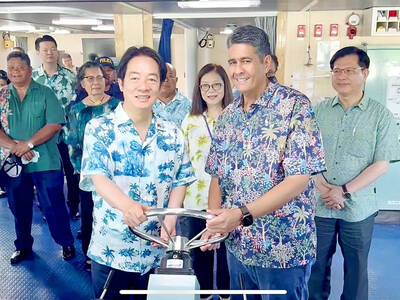
MULTIPRONGED APPROACH: China has sought to pressure Palau across a number of fronts, but the island nation has staunchly resisted overtures to ditch Taiwan Palau has been firm in backing Taiwan despite Chinese pressure that uses tourism economics, cyberattacks and criminal infiltration as tools to threaten the Pacific ally into renouncing its recognition of Taiwan as a sovereign state. The Presidential Office yesterday announced that Vice President Hsiao Bi-khim (蕭美琴) would visit Palau from Saturday to Wednesday next week at the invitation of Palauan President Surangel Whipps Jr. Whipps in April said in an interview that China had outspokenly asked Palau to “denounce Taiwan.” “And we have said: ‘We have no enemies, but nobody tells us who our friends are,’” he said. Whipps has told reporters multiple times


 RSS
RSS