


Taiwan is well-positioned to compete with other Asian countries in promoting medical services to foreigners, especially overseas Chinese, because of the country's advanced medical technology and highly qualified physicians, a Department of Health (DOH) official said yesterday.
“Although Taiwan got a late start in the field compared with other Asian countries such as Singapore, Thailand and India, it still has enormous potential given that we have first-class doctors and medical expenses are much cheaper than they are in Western countries,” said Hwang Kung-chang (黃焜璋), specialist general and executive director of the DOH's Hospital Administration Commission.
Hwang spoke of Taiwan's medical potential after the signing of a letter of intent to develop medical referral services between an insurance firm based in California and nine private hospitals in Taiwan.
The partnership will allow Central Health Plan of California — the third-largest medical service management company in southern California — to represent Taiwanese hospitals in the US and refer its clients, or the clients of other US health insurers, to the health care institutions to receive care in Taiwan.
Hwang said the DOH began working with the Taiwan External Trade Development Council (TAITRA) three years ago to help promote local hospitals in foreign countries.
Its goal was to bring together the hospitals and foreign insurance companies and supervise the quality of the medical services provided under the arrangement.
Hwang said Taiwan might be at a disadvantage compared with Singapore and India because of the language barrier, but it was still competitive given comparable high-quality care, but lower costs than its Western rivals.
The cost of cardiac catheterization and stent operations in Taiwan, for instance, is only a quarter of similar procedures in the US, which can be a good incentive for patients and insurance companies in the US, Hwang said.
Overseas Chinese are the main target clients for Taiwanese hospitals because of the shared language, culture and customs, he said.
TAITRA president and CEO Chao Yuen-chuan (趙永全) said signing the MOI was significant because it could clear the biggest barrier for local hospitals to gain a foothold in the US medical service market.
Chao said the US medical service market, which is estimated to reach US$2.5 trillion this year, would grow to US$4.3 trillion by 2018, when it is projected to constitute 20 percent of US GDP.
TAITRA predicted that the medical tourism market in Asia would reach US$4 billion by 2012, attracting 1.3 million people to countries like Taiwan, Thailand, Singapore, India, South Korea and Malaysia.
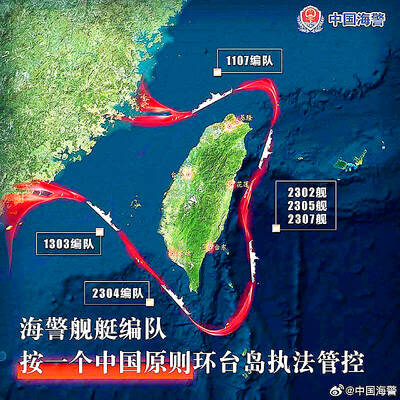
Taiwan would benefit from more integrated military strategies and deployments if the US and its allies treat the East China Sea, the Taiwan Strait and the South China Sea as a “single theater of operations,” a Taiwanese military expert said yesterday. Shen Ming-shih (沈明室), a researcher at the Institute for National Defense and Security Research, said he made the assessment after two Japanese military experts warned of emerging threats from China based on a drill conducted this month by the Chinese People’s Liberation Army’s (PLA) Eastern Theater Command. Japan Institute for National Fundamentals researcher Maki Nakagawa said the drill differed from the
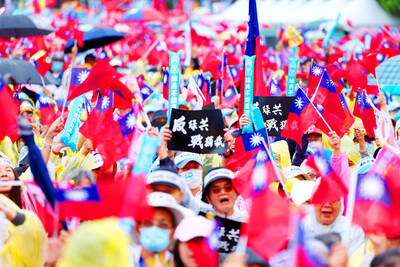
‘WORSE THAN COMMUNISTS’: President William Lai has cracked down on his political enemies and has attempted to exterminate all opposition forces, the chairman said The legislature would motion for a presidential recall after May 20, Chinese Nationalist Party (KMT) Chairman Eric Chu (朱立倫) said yesterday at a protest themed “against green communists and dictatorship” in Taipei. Taiwan is supposed to be a peaceful homeland where people are united, but President William Lai (賴清德) has been polarizing and tearing apart society since his inauguration, Chu said. Lai must show his commitment to his job, otherwise a referendum could be initiated to recall him, he said. Democracy means the rule of the people, not the rule of the Democratic Progressive Party (DPP), but Lai has failed to fulfill his
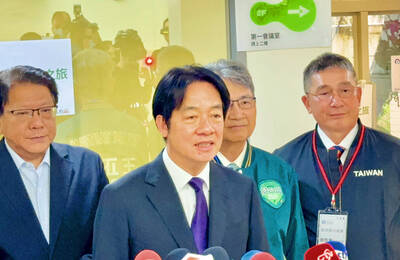
A rally held by opposition parties yesterday demonstrates that Taiwan is a democratic country, President William Lai (賴清德) said yesterday, adding that if opposition parties really want to fight dictatorship, they should fight it on Tiananmen Square in Beijing. The Chinese Nationalist Party (KMT) held a protest with the theme “against green communists and dictatorship,” and was joined by the Taiwan People’s Party. Lai said the opposition parties are against what they called the “green communists,” but do not fight against the “Chinese communists,” adding that if they really want to fight dictatorship, they should go to the right place and face
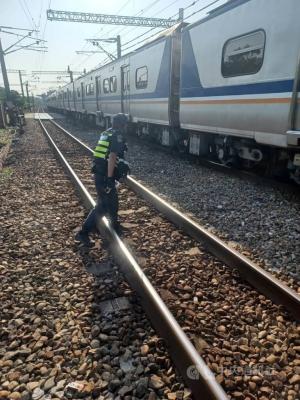
A 79-year-old woman died today after being struck by a train at a level crossing in Taoyuan, police said. The woman, identified by her surname Wang (王), crossed the tracks even though the barriers were down in Jhongli District’s (中壢) Neili (內壢) area, the Taoyuan Branch of the Railway Police Bureau said. Surveillance footage showed that the railway barriers were lowered when Wang entered the crossing, but why she ventured onto the track remains under investigation, the police said. Police said they received a report of an incident at 6:41am involving local train No. 2133 that was heading from Keelung to Chiayi City. Investigators


 RSS
RSS