


Tainan County Commissioner Su Huan-chih (蘇煥智) said yesterday that tests had not detected excessive levels of heavy metals in samples of rice grain from Houbi Township (後壁), where soil from rice paddies was reported to be contaminated with chromium and arsenic.
For years, rice from Houbi Township was highly regarded, but recent reports that the town’s rice paddies adjacent to a slag recycling plant contained excessive amounts of chromium have raised concerns about its quality.
These worries prompted the county government on Monday to send experts to take rice grain samples from three pieces of farmland suspected to be contaminated for testing.
Su announced the test results, which showed no excessive levels of heavy metals, at a press conference yesterday.
Su said that chromium and arsenic are not normally absorbed by rice plants since they are not vital for growth.
Although Taiwan has not set a standard for maximum allowable levels of arsenic in grain, the level of arsenic contained in the samples from Houbi was much lower than the German residue limit for wheat at 1 part per million, Su said.
Su said that the Council of Agriculture’s Agriculture and Food Agency had taken more samples, including hulled grains from Houbi, for testing, but found no excessive levels of heavy metals.
With the quality of rice from Houbi assured, Su said that the county government would concentrate its efforts on helping farmers sell their produce. In addition to setting up purchasing hotlines, it will sponsor programs to promote Houbi rice.

LOUD AND PROUD Taiwan might have taken a drubbing against Australia and Japan, but you might not know it from the enthusiasm and numbers of the fans Taiwan might not be expected to win the World Baseball Classic (WBC) but their fans are making their presence felt in Tokyo, with tens of thousands decked out in the team’s blue, blowing horns and singing songs. Taiwanese fans have packed out the Tokyo Dome for all three of their games so far and even threatened to drown out home team supporters when their team played Japan on Friday. They blew trumpets, chanted for their favorite players and had their own cheerleading squad who dance on a stage during the game. The team struggled to match that exuberance on the field, with
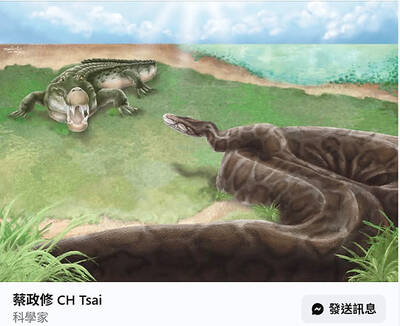
Taiwanese paleontologists have discovered fossil evidence that pythons up to 4m long inhabited Taiwan during the Pleistocene epoch, reporting their findings in the international scientific journal Historical Biology. National Taiwan University (NTU) Institute of Ecology and Evolutionary Biology associate professor Tsai Cheng-hsiu (蔡政修) led the team that discovered the largest snake fossil ever found in Taiwan. The single trunk vertebra was discovered in Tainan at the Chiting Formation, dated to between 400,000 and 800,000 years ago in the Middle Pleistocene, the paper said. The area also produced Taiwan’s first avian fossil, as well as crocodile, mammoth, saber-toothed cat and rhinoceros fossils, it said. Discoveries

Taiwanese paleontologists have discovered fossil evidence that pythons up to 4m long inhabited Taiwan during the Pleistocene epoch, reporting their findings in the international scientific journal Historical Biology. National Taiwan University (NTU) Institute of Ecology and Evolutionary Biology associate professor Tsai Cheng-hsiu (蔡政修) led the team that discovered the largest snake fossil ever found in Taiwan. A single trunk vertebra was discovered in Tainan at the Chiting Formation, dated to between 800,000 to 400,000 years ago in the Middle Pleistocene, the paper said. The area also produced Taiwan’s first avian fossil, as well as crocodile, mammoth, sabre-toothed cat and rhinoceros fossils, it said. Discoveries
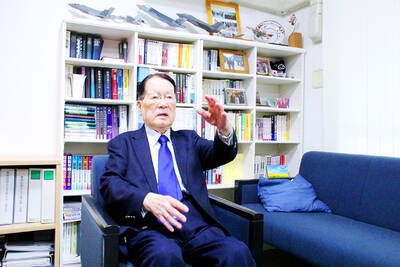
Whether Japan would help defend Taiwan in case of a cross-strait conflict would depend on the US and the extent to which Japan would be allowed to act under the US-Japan Security Treaty, former Japanese minister of defense Satoshi Morimoto said. As China has not given up on the idea of invading Taiwan by force, to what extent Japan could support US military action would hinge on Washington’s intention and its negotiation with Tokyo, Morimoto said in an interview with the Liberty Times (sister paper of the Taipei Times) yesterday. There has to be sufficient mutual recognition of how Japan could provide


 RSS
RSS