


The National Communications Commission (NCC) yesterday approved a draft amendment to the Satellite Broadcasting Act (衛星廣播電視法) that would prohibit the government from embedding its agenda in TV programming.
NCC spokesperson Chen Jeng-chang (陳正倉) said the amendment would be sent to the Executive Yuan for review. The Executive Yuan will submit the final version to the legislature.
The commission proposed the amendment in February, but the version drew sharp criticism from political commentators and TV stations.
The NCC then held a series of hearings to gather opinions before revising its proposal.
The new draft suggests that satellite TV services be banned from promoting the agendas of their sponsors or advertisers in TV news and children’s programs.
The government and other advertisers would be allowed to sponsor the production of feature news programs as well as sports and arts programs provided that the names of the sponsors are stated clearly at the beginning or end of the program.
“The amendment would not mean that TV stations can take money and explicitly, legitimately advertise the products in their programs,” NCC member Weng Hsiao-ling (翁曉玲) said. “Advertisers cannot interfere with the production or editorial process of the programs.”
Weng said the amendment was designed to encourage large corporations to sponsor sports and arts events.
In the amendment, “sponsors” are defined as corporations, organizations, groups or individuals that provide monetary or non-monetary resources for programming without compromising the independence of the program’s content.
By contrast, “product placement” is defined as TV stations promoting concepts, products, or logos on behalf of corporations, organizations, groups or individuals based on interests including monetary compensation.
Jason Ho (何吉森), director of NCC’s communication content department, said that a feature news program would violate the Act if it does not clearly distinguish advertising from other program content.
Meanwhile, Weng said the NCC was working toward relaxing the restrictions on the government, political parties and the military holding shares in media companies.
Although the NCC has upheld the ban on political and military investment in media, this has at times caused problems, she said.
“The commission has strictly adhered to the spirit of Article 1 of the National Communications Commission Organization Act [通傳會組織法] — that we must maintain the principle of the government, political parties and the military withdrawing from the media,” Weng said. “In the past, this meant that none of the stated parties could own a single share in media.”
Weng said this principle was significant but had generated problems in some of the NCC’s rulings.
As some media corporations are publicly traded, the government can purchase shares on the stock market, she said, calling this unavoidable.
Weng said the commission would continue to monitor shareholding in media companies, but the NCC will focus on determining which shareholders have actual influence on company operations.
Government and military officials and representatives of political parties cannot hold management positions, she said.
After deliberation, the NCC is considering two solutions to the problem, Weng said. The first would cap direct shareholding by the stated parties at 5 percent and indirect shareholding at 10 percent. The second would ban all direct investment and cap indirect investment at 10 percent.
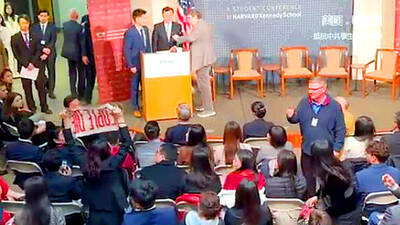
A group of Taiwanese-American and Tibetan-American students at Harvard University on Saturday disrupted Chinese Ambassador to the US Xie Feng’s (謝鋒) speech at the school, accusing him of being responsible for numerous human rights violations. Four students — two Taiwanese Americans and two from Tibet — held up banners inside a conference hall where Xie was delivering a speech at the opening ceremony of the Harvard Kennedy School China Conference 2024. In a video clip provided by the Coalition of Students Resisting the CCP (Chinese Communist Party), Taiwanese-American Cosette Wu (吳亭樺) and Tibetan-American Tsering Yangchen are seen holding banners that together read:

UNAWARE: Many people sit for long hours every day and eat unhealthy foods, putting them at greater risk of developing one of the ‘three highs,’ an expert said More than 30 percent of adults aged 40 or older who underwent a government-funded health exam were unaware they had at least one of the “three highs” — high blood pressure, high blood lipids or high blood sugar, the Health Promotion Administration (HPA) said yesterday. Among adults aged 40 or older who said they did not have any of the “three highs” before taking the health exam, more than 30 percent were found to have at least one of them, Adult Preventive Health Examination Service data from 2022 showed. People with long-term medical conditions such as hypertension or diabetes usually do not
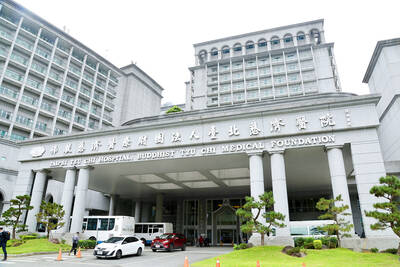
POLICE INVESTIGATING: A man said he quit his job as a nurse at Taipei Tzu Chi Hospital as he had been ‘disgusted’ by the behavior of his colleagues A man yesterday morning wrote online that he had witnessed nurses taking photographs and touching anesthetized patients inappropriately in Taipei Tzu Chi Hospital’s operating theaters. The man surnamed Huang (黃) wrote on the Professional Technology Temple bulletin board that during his six-month stint as a nurse at the hospital, he had seen nurses taking pictures of patients, including of their private parts, after they were anesthetized. Some nurses had also touched patients inappropriately and children were among those photographed, he said. Huang said this “disgusted” him “so much” that “he felt the need to reveal these unethical acts in the operating theater
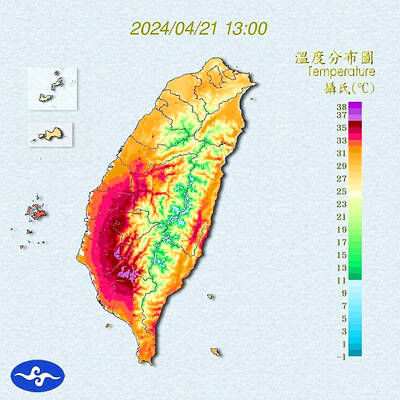
Heat advisories were in effect for nine administrative regions yesterday afternoon as warm southwesterly winds pushed temperatures above 38°C in parts of southern Taiwan, the Central Weather Administration (CWA) said. As of 3:30pm yesterday, Tainan’s Yujing District (玉井) had recorded the day’s highest temperature of 39.7°C, though the measurement will not be included in Taiwan’s official heat records since Yujing is an automatic rather than manually operated weather station, the CWA said. Highs recorded in other areas were 38.7°C in Kaohsiung’s Neimen District (內門), 38.2°C in Chiayi City and 38.1°C in Pingtung’s Sandimen Township (三地門), CWA data showed. The spell of scorching


 RSS
RSS