


A group of Internet users yesterday staged a demonstration outside the Taipei Railway Station to protest the government’s decision to lift the ban on imports of US bone-in beef and bovine organs.
Despite a legislative resolution adopted in January 2006 stipulating the government must consult with and gain approval from the legislature before lifting the ban, the government announced last month that it had already signed an agreement with the US lifting the ban after years of negotiation.
The announcement created uproar around the country and drew strong opposition from local government heads, as well as legislators of both the Chinese Nationalist Party (KMT) and the Democratic Progressive Party.
Following a candle-lit demonstration in Hsinchu organized by Internet users last Saturday to protest the policy and to demand the renegotiation of the beef agreement with the US, Internet users in Taipei also staged a demonstration yesterday.
“President Ma Ying-jeou [馬英九] always says that he represents the voice of all 23 million Taiwanese, but that’s just bullshit,” a woman surnamed Chang (張) who brought her daughter to the protest said. “The government negotiated with the US on the beef deal for years, but the public only found out about it after the agreement was signed.”
Another protester surnamed Chen (陳) said that Ma and officials at both the Presidential Office and the Executive Yuan should eat bone-in beef and bovine organs from the US every day, since they have told people it is safe.
“A handful of officials have already said that they wouldn’t eat it — so why should the public?” he said.
Chang condemned Premier Wu Den-yih (吳敦義) for being irresponsible when he said the public should serve as the last checkpoint for US beef and make up their own minds as to whether they want to eat it.
“Well, if they don’t lift the ban, the people don’t have to take that risk,” she said. “Why don’t we just legalize drugs and guns and turn off all traffic lights — just leave it to the public to decide?”
Chu Cheng-chi (朱政麒), a student at National Taiwan University’s Department of Sociology who became well-known after uploading a video of himself eating cow excrement in protest of the lifting of the ban, also joined the protest.
“No matter how small it is, there is still a chance that mad cow disease could enter Taiwan in the more hazardous parts of US beef and once it comes, it stays for generations,” Chu said. “If Taiwan becomes an affected area, it would be hard to root out the disease.”
In related news, Lin Ja-liang (林杰樑), a clinical toxicology specialist at Chang Gung Memorial Hospital in Linkou, yesterday advised people not to nibble the bones when consuming US bone-in beef.
Those who do so are four times more likely to become ill than those who do not, he said.
Lin also suggested that the government separate the waste generated from the consumption of US beef and incinerate it so that it would not contaminate other food waste.
While the government has banned farmers from feeding their cattle bone meal imported from infected areas, Lin said it should also ban products containing substances made from beef in the infected areas, including collagen, bone dust used in medical surgery and vaccines.
ADDITIONAL REPORTING BY SHELLEY SHAN
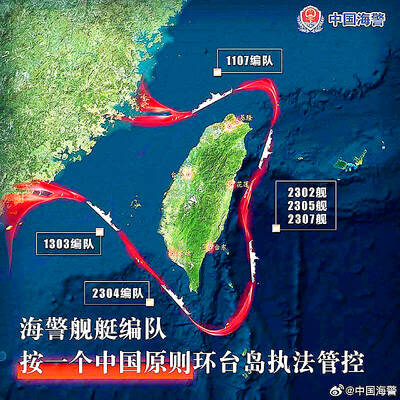
Taiwan would benefit from more integrated military strategies and deployments if the US and its allies treat the East China Sea, the Taiwan Strait and the South China Sea as a “single theater of operations,” a Taiwanese military expert said yesterday. Shen Ming-shih (沈明室), a researcher at the Institute for National Defense and Security Research, said he made the assessment after two Japanese military experts warned of emerging threats from China based on a drill conducted this month by the Chinese People’s Liberation Army’s (PLA) Eastern Theater Command. Japan Institute for National Fundamentals researcher Maki Nakagawa said the drill differed from the
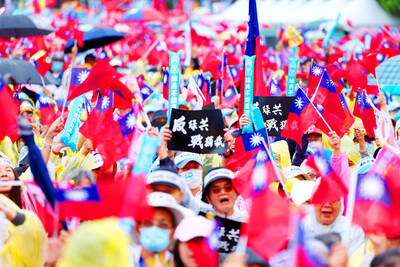
‘WORSE THAN COMMUNISTS’: President William Lai has cracked down on his political enemies and has attempted to exterminate all opposition forces, the chairman said The legislature would motion for a presidential recall after May 20, Chinese Nationalist Party (KMT) Chairman Eric Chu (朱立倫) said yesterday at a protest themed “against green communists and dictatorship” in Taipei. Taiwan is supposed to be a peaceful homeland where people are united, but President William Lai (賴清德) has been polarizing and tearing apart society since his inauguration, Chu said. Lai must show his commitment to his job, otherwise a referendum could be initiated to recall him, he said. Democracy means the rule of the people, not the rule of the Democratic Progressive Party (DPP), but Lai has failed to fulfill his
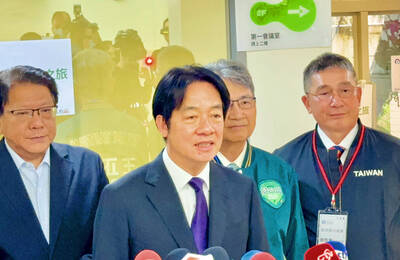
A rally held by opposition parties yesterday demonstrates that Taiwan is a democratic country, President William Lai (賴清德) said yesterday, adding that if opposition parties really want to fight dictatorship, they should fight it on Tiananmen Square in Beijing. The Chinese Nationalist Party (KMT) held a protest with the theme “against green communists and dictatorship,” and was joined by the Taiwan People’s Party. Lai said the opposition parties are against what they called the “green communists,” but do not fight against the “Chinese communists,” adding that if they really want to fight dictatorship, they should go to the right place and face
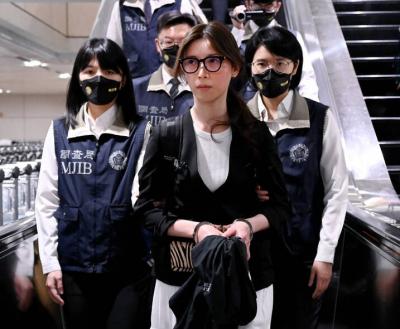
A fugitive in a suspected cosmetic surgery fraud case today returned to Taiwan from Canada, after being wanted for six years. Internet celebrity Su Chen-tuan (蘇陳端), known as Lady Nai Nai (貴婦奈奈), and her former boyfriend, plastic surgeon Paul Huang (黃博健), allegedly defrauded clients and friends of about NT$1 billion (US$30.66 million). Su was put on a wanted list in 2019 when she lived in Toronto, Canada, after failing to respond to subpoenas and arrest warrants from the Taipei District Prosecutors’ Office. Su arrived at Taiwan Taoyuan International Airport at 5am today on an EVA Air flight accompanied by a


 RSS
RSS