


An online game developed by Taiwan’s top research institute, Academia Sinica, was unveiled yesterday to help players learn more about Chinese characters and appreciate the beauty of the Chinese language.
The game, dubbed Chinese Scrabble and crafted by researchers from the Institute of Linguistics and the Institute of History and Philology at Academia Sinica, allows players to tell, via a thinning method, how a Chinese character is made up with radicals.
The game is the latest result of a collaboration between the two institutes since 2002 on a language archive project, which has now entered its second phase.
The game was only one part of a digital archives exhibition titled “Language in Space and Time,” that was opened at Academia Sinica.
The exhibition features five themes, including digitalized archives of oral languages used by Aborigines and their ancestors who speak Austronesian-languages.
Also on display are digital reproductions and grammatical annotations of words carved on excavated oracle bones, bronzes and bamboo, or imprinted on silk documents. The displays also include other ancient Chinese texts passed down through the millennia.
Digitized recordings and transcriptions of Taiwan’s Min and Hakka languages and an archive of the sounds of modern Chinese are also on display.
Addressing the opening of the exhibition, Sun Tien-hsin (孫天心), director of the Institute of History and Philology, said: “In the past, linguistic records could only be preserved in written form on shells and bones, bronze, bamboo, stone, paper, silk, and so on. Now we can not only use digitization methods to reproduce such records and annotate them but can also use multimedia to record and further analyze the oral language.”
At the exhibition, visitors can also choose to make their own electronic New Year’s greeting cards using oracle bones or bronze inscription characters.
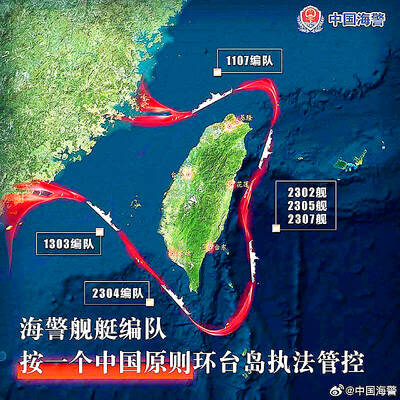
Taiwan would benefit from more integrated military strategies and deployments if the US and its allies treat the East China Sea, the Taiwan Strait and the South China Sea as a “single theater of operations,” a Taiwanese military expert said yesterday. Shen Ming-shih (沈明室), a researcher at the Institute for National Defense and Security Research, said he made the assessment after two Japanese military experts warned of emerging threats from China based on a drill conducted this month by the Chinese People’s Liberation Army’s (PLA) Eastern Theater Command. Japan Institute for National Fundamentals researcher Maki Nakagawa said the drill differed from the

‘WORSE THAN COMMUNISTS’: President William Lai has cracked down on his political enemies and has attempted to exterminate all opposition forces, the chairman said The legislature would motion for a presidential recall after May 20, Chinese Nationalist Party (KMT) Chairman Eric Chu (朱立倫) said yesterday at a protest themed “against green communists and dictatorship” in Taipei. Taiwan is supposed to be a peaceful homeland where people are united, but President William Lai (賴清德) has been polarizing and tearing apart society since his inauguration, Chu said. Lai must show his commitment to his job, otherwise a referendum could be initiated to recall him, he said. Democracy means the rule of the people, not the rule of the Democratic Progressive Party (DPP), but Lai has failed to fulfill his

A rally held by opposition parties yesterday demonstrates that Taiwan is a democratic country, President William Lai (賴清德) said yesterday, adding that if opposition parties really want to fight dictatorship, they should fight it on Tiananmen Square in Beijing. The Chinese Nationalist Party (KMT) held a protest with the theme “against green communists and dictatorship,” and was joined by the Taiwan People’s Party. Lai said the opposition parties are against what they called the “green communists,” but do not fight against the “Chinese communists,” adding that if they really want to fight dictatorship, they should go to the right place and face
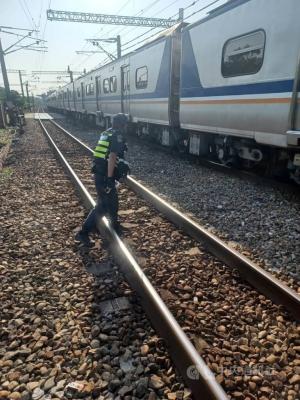
A 79-year-old woman died today after being struck by a train at a level crossing in Taoyuan, police said. The woman, identified by her surname Wang (王), crossed the tracks even though the barriers were down in Jhongli District’s (中壢) Neili (內壢) area, the Taoyuan Branch of the Railway Police Bureau said. Surveillance footage showed that the railway barriers were lowered when Wang entered the crossing, but why she ventured onto the track remains under investigation, the police said. Police said they received a report of an incident at 6:41am involving local train No. 2133 that was heading from Keelung to Chiayi City. Investigators


 RSS
RSS