


The rate of women’s participation in the workforce has been rising steadily in recent years and is expected to exceed 50 percent for the first time next year, the Council for Economic Planning and Development (CEPD) said yesterday.
However, as the total number of jobs has not substantially increased, the growing number of women joining the workforce could squeeze employment opportunities for men, with men older than 40 being most vulnerable, council officials said.
The participation rate is the percentage of working-age persons — those aged 16 to 64 — who are employed or are unemployed but looking for a job.
Council statistics show men’s labor participation rate has fallen in the past seven years, from 68.22 percent in 2002 to 67 percent last year.
Women’s participation, by contrast, has been on the rise. In the past, the rate tended to hover around 46 percent, as many women could not seek work outside the home because of household and child-rearing responsibilities.
However, the situation has changed since 2002 when the rate began its rise, moving from 46.59 percent that year to 49.67 percent last year.
Globally, women generally lag behind men in terms of labor force participation, the officials said.Women’s participation in the workforce in most advanced economies tends to be more than 50 percent.
In the US and many European countries, the rate is more than 70 percent. In Japan, it is 67 percent, while South Korea’s is 59 percent.
Marriage has been one of the most important factors affecting women’s labor participation, officials said.
Council statistics show that labor participation rates are almost the same among unmarried men and women, approaching 60 percent. But the rate falls below 50 percent for married women.
Participation by single women was 9 percentage points higher than that of married women last year, the council tallies show.
Over the past seven years, married women’s labor participation has risen more than 3 percent, the officials said.
One factor might be that married women have been forced to enter the job market because their husbands are earning less than before. Another factor might be the influx of single young women into the job market, the official said, adding that higher levels of education has made it easier for women to land jobs.
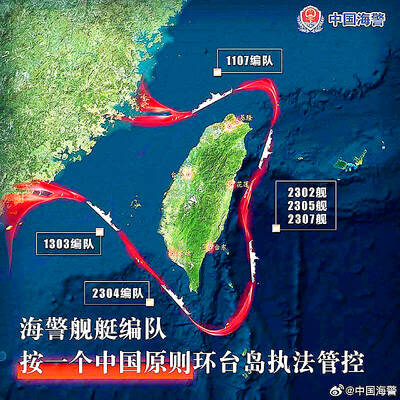
Taiwan would benefit from more integrated military strategies and deployments if the US and its allies treat the East China Sea, the Taiwan Strait and the South China Sea as a “single theater of operations,” a Taiwanese military expert said yesterday. Shen Ming-shih (沈明室), a researcher at the Institute for National Defense and Security Research, said he made the assessment after two Japanese military experts warned of emerging threats from China based on a drill conducted this month by the Chinese People’s Liberation Army’s (PLA) Eastern Theater Command. Japan Institute for National Fundamentals researcher Maki Nakagawa said the drill differed from the

‘WORSE THAN COMMUNISTS’: President William Lai has cracked down on his political enemies and has attempted to exterminate all opposition forces, the chairman said The legislature would motion for a presidential recall after May 20, Chinese Nationalist Party (KMT) Chairman Eric Chu (朱立倫) said yesterday at a protest themed “against green communists and dictatorship” in Taipei. Taiwan is supposed to be a peaceful homeland where people are united, but President William Lai (賴清德) has been polarizing and tearing apart society since his inauguration, Chu said. Lai must show his commitment to his job, otherwise a referendum could be initiated to recall him, he said. Democracy means the rule of the people, not the rule of the Democratic Progressive Party (DPP), but Lai has failed to fulfill his

A rally held by opposition parties yesterday demonstrates that Taiwan is a democratic country, President William Lai (賴清德) said yesterday, adding that if opposition parties really want to fight dictatorship, they should fight it on Tiananmen Square in Beijing. The Chinese Nationalist Party (KMT) held a protest with the theme “against green communists and dictatorship,” and was joined by the Taiwan People’s Party. Lai said the opposition parties are against what they called the “green communists,” but do not fight against the “Chinese communists,” adding that if they really want to fight dictatorship, they should go to the right place and face

A 79-year-old woman died today after being struck by a train at a level crossing in Taoyuan, police said. The woman, identified by her surname Wang (王), crossed the tracks even though the barriers were down in Jhongli District’s (中壢) Neili (內壢) area, the Taoyuan Branch of the Railway Police Bureau said. Surveillance footage showed that the railway barriers were lowered when Wang entered the crossing, but why she ventured onto the track remains under investigation, the police said. Police said they received a report of an incident at 6:41am involving local train No. 2133 that was heading from Keelung to Chiayi City. Investigators


 RSS
RSS