


Premier Wu Den-yih (吳敦義) said yesterday that exiled Uighur rights activist Rebiya Kadeer was welcome to visit Taiwan under the condition that Dolkun Isa steps down as World Uyghur Congress (WUC) secretary-general, or if Kadeer resigns as the organization’s president.
Wu made the remarks at a press conference when asked by reporters if the government’s decision to bar Kadeer visiting Taiwan was to avoid irritating Beijing.
Wu said the government made the decision because of Kadeer’s “close working relationship” at the WUC with Isa, whom Wu said was closely related to two terrorist groups by Interpol.
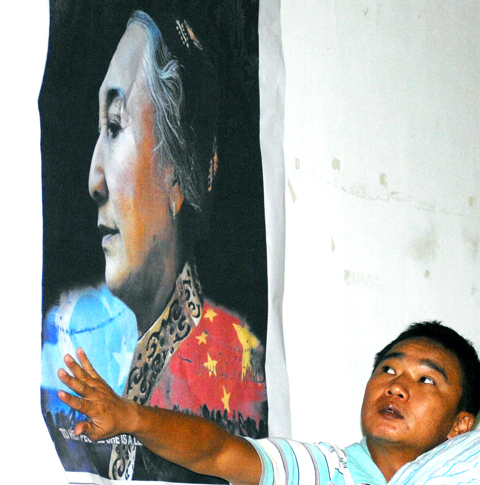
PHOTO: PATRICK LIN, AFP
When told that New York University law professor Jerome Cohen — President Ma Ying-jeou’s (馬英九) professor at Harvard University — had described the government’s decision not to allow Kadeer to visit as “ridiculous,” Wu said he respected different opinions, but added: “The interests of the country and the public are not understood by people who take no responsibility for the country and who do not live in the country.”
Meanwhile, several civic and human rights groups held screenings of a documentary on Kadeer around the country yesterday on the same day the People’s Republic of China celebrated the 60th anniversary of its founding.
“We picked Oct. 1 because we wanted to remind the world that the Chinese regime is still repressing the peoples of East Turkestan and Tibet,” said Chow Mei-li (周美里), chairwoman of the Taiwan Friends of Tibet, which co-hosted the screening at the Da-an District Administration Center in Taipei.
Besides showing the documentary on Kadeer, The 10 Conditions of Love, another documentary, Leaving Fear Behind, was also shown in which Tibetans inside Tibet speak out against Chinese rule.
The footage in Leaving Fear Behind was smuggled out of Tibet and director Dhondup Wangchen has been jailed since March last year for making the film.
By showing the films, Chow said she wanted to remind the world that Kadeer’s four children in Xinjiang were in prison because of their mother’s activism and that Dhondup was also still in custody.
“We call on the world to pressure China for their release,” she said.
Besides the screening at the Da-an District Administration Center, screenings were held at Taipei City Council, in Taichung, Tainan, Kaohsiung and Pingtung yesterday.
In related news, Taiwanese actor Aaron Chen (陳昭榮) came under fire over a blog entry that called the screening of The 10 Conditions of Love a provocative act intended to harm cross-strait relations and urged “all Chinese to stand united” for the prosperity of China.
“After so many years [of separation], the two sides [of the Taiwan Strait] have finally entered a honeymoon period and I hope no one will try to damage hard-earned cross-strait harmony for their own personal interests,” Chen said in a blog entry posted last week. “Showing the documentary on Kadeer is an attempt by some people to destroy the peaceful development of cross-strait relations ... As a Chinese, would anyone support the separatist acts of Kadeer?”
Chen compared those who pushed the screening to members of the Boxer Rebellion, an anti-imperialist uprising in China at the turn of the 20th century.
“We should all work together to make the Chinese a proud people,” Chen said.
Despite the comments, he said at the end of the blog entry that he didn’t understand politics and that “artists should not get involved in politics.”
Although the entry was posted last week, many Internet users only found out about it yesterday and started to distribute it via e-mail and on social networking sites, saying they were disappointed and calling Chen’s remarks “shameful.”
Aaron Chen did not respond to the criticism, but he did remove the blog entry.
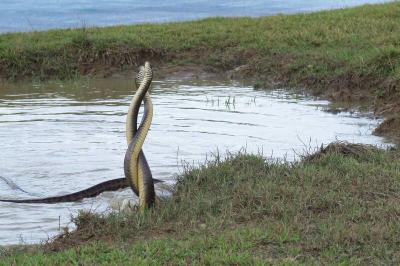
Kenting National Park service technician Yang Jien-fon (楊政峰) won a silver award in World Grand Prix Photography Awards Spring Season for his photograph of two male rat snakes intertwined in combat. Yang’s colleagues at Kenting National Park said he is a master of nature photography who has been held back by his job in civil service. The awards accept entries in all four seasons across six categories: architectural and urban photography, black-and-white and fine art photography, commercial and fashion photography, documentary and people photography, nature and experimental photography, and mobile photography. Awards are ranked according to scores and divided into platinum, gold and

More than half of the bamboo vipers captured in Tainan in the past few years were found in the city’s Sinhua District (新化), while other districts had smaller catches or none at all. Every year, Tainan captures about 6,000 snakes which have made their way into people’s homes. Of the six major venomous snakes in Taiwan, the cobra, the many-banded krait, the brown-spotted pit viper and the bamboo viper are the most frequently captured. The high concentration of bamboo vipers captured in Sinhua District is puzzling. Tainan Agriculture Bureau Forestry and Nature Conservation Division head Chu Chien-ming (朱健明) earlier this week said that the

BREACH OF CONTRACT: The bus operators would seek compensation and have demanded that the manufacturer replace the chips with ones that meet regulations Two bus operators found to be using buses with China-made chips are to demand that the original manufacturers replace the systems and provide compensation for breach of contract, the Veterans Affairs Council said yesterday. Democratic Progressive Party Legislator Michelle Lin (林楚茵) yesterday said that Da Nan Bus Co and Shin-Shin Bus Co Ltd have fielded a total of 82 buses that are using Chinese chips. The bus models were made by Tron-E, while the systems provider was CYE Electronics, Lin said. Lin alleged that the buses were using chips manufactured by Huawei subsidiary HiSilicon Co, which presents a national security risk if the

The National Immigration Agency has banned two Chinese from returning to Taiwan, after they published social media content it described as disrespectful to national sovereignty. The agency imposed a two-month ban on a Chinese man surnamed Liang (梁) and a permanent ban on a woman surnamed Yang (楊), an influencer with 23 million followers, in October last year and last week respectively. Minister of the Interior Liu Shyh-fang (劉世芳) yesterday said on the sidelines of a legislative meeting that Chinese visitors to Taiwan are required to comply with the rules and regulations governing their entry permits. The government has handled the ban and


 RSS
RSS