


The government’s decision to block exiled Uighur rights activist Rebiya Kadeer’s visit in December sparked an outcry among Internet users, with many condemning the decision.
“What an ‘honor’ for Taiwan that such shameful news has spread throughout the world so quickly,” a member of the online social networking system Plurk called “E23” said early yesterday morning when replying to a post by fellow Plurker Lavendersea that linked to reports published by several foreign media outlets on the government’s refusal of Kadeer’s intended visit.
The news outlets included the BBC, Reuters, Agence France-Presse, Voice of America, the Switzerland-based Radio Suisse Romande and the Barcelona-based Noticias ADN.
“The world must be quite surprised that there is another country besides China [to ban a visit by Kadeer],” Lavendersea said.
The criticism from Internet users came in response to Minister of the Interior Jiang Yi-huah’s (江宜樺) announcement on the legislative floor that he would suggest the government ban a visit by World Uyghur Congress (WUC) president Rebiya Kadeer, based on “best interests for the country and for the people.”
The position was supported by Premier Wu Den-yih (吳敦義) later the same day
Jiang said the WUC has close connections to a terrorist group, and that its secretary-general Dolkun Isa is on the Interpol Red Notice list, hence the decision is justified as the Immigration Act (入出國及移民法) stipulates that Taiwan may deny entry to foreigners who may damage Taiwan’s national interest and disturb public order.
Joe and Jenny, a married Taiwanese couple living in Paris, said on a blog that they co-write that Isa is not considered a terrorist by most countries in the world besides China.
“Instead, he was a guest speaker at a UN hearing [last month] on eliminating racial discrimination,” the couple said on their blog.
Citing an AFP report that concluded the government made the decision to avoid irritating China, the couple said “Jiang has become famous — yet infamous at the same time — internationally.”
Others said if the law Jiang cited applies to Kadeer’s visit, then it equally applies to visits by China’s Association for Relations Across the Taiwan Strait Chairman Chen Yunlin (陳雲林) and should be used to block his entry into Taiwan since his visit last year created an uproar and led to severe physical clashes between the police and protesters.
“It’s just too much that the Chinese Nationalist Party [KMT] government calls Kadeer a terrorist and blocks her visit while that Chinese official could come,” said Fan Chiang (范姜), member of local hip hop band Kou Chou Ching (拷秋勤).
Guts United Taiwan secretary-general Gary Chiang (江季剛), who has known Jiang for six years since Jiang was a political science professor at National Taiwan University, said he was surprised and disappointed at Jiang’s announcement.
“I still think Jiang is a nice person who is easy to get along with. Professor Jiang — who was known to be a follower of liberalism — has taught me a new lesson,” said Chiang who studied political science as a graduate student at National Chengchi University. “Now I know the meaning of ‘actions speak louder than words’ and the ‘temptation of power’ — he has given his soul in exchange for power.”

FUKUOKA SITUATION: Japanese media reported that the pathogen is expected to be identified by the summer, while the CDC downplayed the idea that it was hMPV A “mysterious cold-like illness” reported in Japan’s Fukuoka Prefecture does not seem to be a new disease, but Japanese authorities have been asked about the situation, the Centers for Disease Control (CDC) said yesterday. The Fukuoka Prefectural Medical Association on Wednesday told a news conference that a “mystery cold” that has become a hot topic on social media is “highly likely to be caused by some kind of viral infection,” Japan’s KBC News reported. “Many people are experiencing symptoms starting with a sore throat, followed by a runny nose, phlegm and a severe cough,” KBC News reported, citing association officials. Health authorities are

Nvidia Corp CEO Jensen Huang (黃仁勳) arrived in Taiwan yesterday ahead of upcoming AI and technology events, saying he plans to meet with clients and Taiwan Semiconductor Manufacturing Co Chairman C.C. Wei (魏哲家) during his visit. After landing at Taipei Songshan Airport, Huang posed for photos with fans and handed out Yakult drinks to reporters and supporters waiting at the scene, saying he has “a lot to do” during the trip. Asked about reports that Nvidia’s planned headquarters site in Taipei’s Beitou Shilin Technology Park could break ground on May 27, Huang said that if the company holds an event, he would

The Ministry of Finance this afternoon announced the winning numbers for the March-April uniform invoice lottery. The winning number for the NT$10 million (US$318,060) special prize is 19531471, and the winning number for the NT$2 million grand prize is 85941329. Three numbers were drawn for the NT$200,000 first prize: 07225810, 20231230 and 83518781. Those with receipts matching the last seven digits of any of the first-prize numbers will win the NT$40,000 second prize, while those matching the last six digits will win the NT$10,000 third prize. Those whose receipts match the last five digits of the first-prize numbers can claim the NT$4,000 fourth prize,
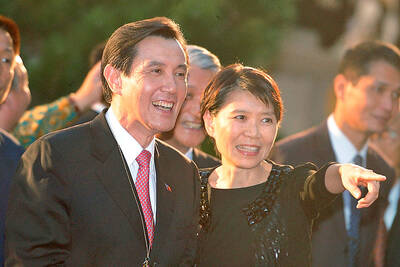
Former president Ma Ying-jeou (馬英九) yesterday expressed “shock and regret” over a statement issued by his wife without his consent, and rejected her assertion that his eldest sister, Ma Yi-nan (馬以南), would manage his medical care or act as his spokesperson amid an ongoing embezzlement probe into his foundation. Ma Ying-jeou in a statement said he was shocked by a statement by his wife, Chou Mei-ching (周美青), regarding his affairs. Ma Yi-nan “must not” be in charge of his healthcare and other personal affairs, nor can she be allowed to represent the Ma family, the former president said. He said he was also


 RSS
RSS