


A study conducted by a US non-profit organization has found that Taiwan has the world’s lowest fertility rate, with an average of one child per woman, and that its fertility rate is declining.
Carl Haub, a senior demographer at the Washington-based Population Reference Bureau (PRB), wrote the report on birth rates in low fertility countries, which was published on Aug. 12 on the PRB Web site alongside the PRB’s 2009 World Population Data Sheet.
The data sheet said Taiwan registered only eight births per 1,000 people, the lowest level in the world.
The nation’s population as of June was 23.1 million, it said.
The world’s highest fertility rate was in Niger, with 7.4 children per woman, PRB said.
The data sheet also showed that the global population reached 6.8 billion this year and is on track to total 8.1 billion in 2050.
China has the world’s largest population, at 1.33 billion, but by 2050 India is expected to take that spot, with a projected population of 1.75 billion. China’s population is projected to be 1.437 billion in 2050.
In its report, PRB said that although the fertility rate continued to fall in developed countries, the global population would reach 7 billion in 2011, just 12 years after it hit the 6 billion mark.
PRB president Bill Butz said such growth was “unprecedented in world history.”
The report said that during the 20th century, nearly 90 percent of population growth came from less developed regions — parts of Africa, Asia, Latin America and the Caribbean and Oceania — as a result of declining death rates.
“The great bulk of today’s 1.2 billion youth — 90 percent — are in developing countries,” said Haub, adding that eight in 10 youths live in Africa and Asia.
In the next few decades, “these young people will most likely continue the current trend of moving from rural areas to cities in search of education and training opportunities, gainful employment and adequate health care,” he said.
As a result, one of the major social questions in the next few decades will be meeting their expectations, Haub said.
PRB seeks to gather and publicize information about population growth, health and the environment to advance the well-being of current and future generations.
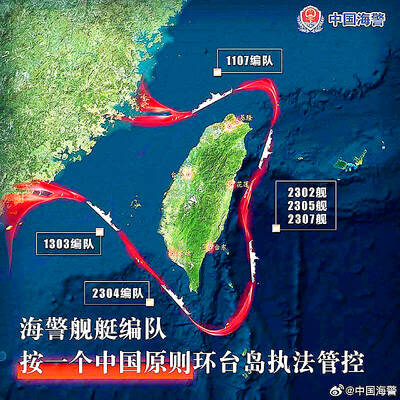
Taiwan would benefit from more integrated military strategies and deployments if the US and its allies treat the East China Sea, the Taiwan Strait and the South China Sea as a “single theater of operations,” a Taiwanese military expert said yesterday. Shen Ming-shih (沈明室), a researcher at the Institute for National Defense and Security Research, said he made the assessment after two Japanese military experts warned of emerging threats from China based on a drill conducted this month by the Chinese People’s Liberation Army’s (PLA) Eastern Theater Command. Japan Institute for National Fundamentals researcher Maki Nakagawa said the drill differed from the
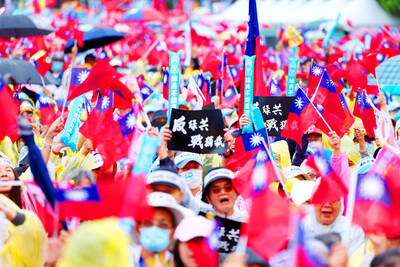
‘WORSE THAN COMMUNISTS’: President William Lai has cracked down on his political enemies and has attempted to exterminate all opposition forces, the chairman said The legislature would motion for a presidential recall after May 20, Chinese Nationalist Party (KMT) Chairman Eric Chu (朱立倫) said yesterday at a protest themed “against green communists and dictatorship” in Taipei. Taiwan is supposed to be a peaceful homeland where people are united, but President William Lai (賴清德) has been polarizing and tearing apart society since his inauguration, Chu said. Lai must show his commitment to his job, otherwise a referendum could be initiated to recall him, he said. Democracy means the rule of the people, not the rule of the Democratic Progressive Party (DPP), but Lai has failed to fulfill his

OFF-TARGET: More than 30,000 participants were expected to take part in the Games next month, but only 6,550 foreign and 19,400 Taiwanese athletes have registered Taipei city councilors yesterday blasted the organizers of next month’s World Masters Games over sudden timetable and venue changes, which they said have caused thousands of participants to back out of the international sporting event, among other organizational issues. They also cited visa delays and political interference by China as reasons many foreign athletes are requesting refunds for the event, to be held from May 17 to 30. Jointly organized by the Taipei and New Taipei City governments, the games have been rocked by numerous controversies since preparations began in 2020. Taipei City Councilor Lin Yen-feng (林延鳳) said yesterday that new measures by
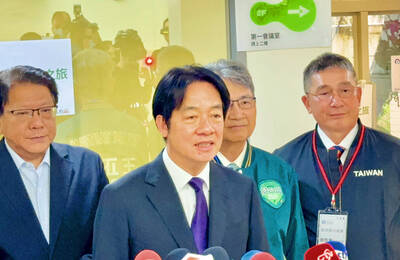
A rally held by opposition parties yesterday demonstrates that Taiwan is a democratic country, President William Lai (賴清德) said yesterday, adding that if opposition parties really want to fight dictatorship, they should fight it on Tiananmen Square in Beijing. The Chinese Nationalist Party (KMT) held a protest with the theme “against green communists and dictatorship,” and was joined by the Taiwan People’s Party. Lai said the opposition parties are against what they called the “green communists,” but do not fight against the “Chinese communists,” adding that if they really want to fight dictatorship, they should go to the right place and face


 RSS
RSS