


Aboriginal residents rescued from areas devastated by Typhoon Morakot panned the government yesterday over its reconstruction plan, asking newly sworn-in Premier Wu Den-yih (吳敦義) to suspend the plan until further discussions take place.
“The government’s reconstruction plan adopted under [former] premier Liu Chao-shiuan [劉兆玄] did not follow a proper procedure. It was passed at the wrong time and picked the wrong locations [for reconstruction],” Palri Aruladeng, a Rukai preacher at a church in Pingtung County’s Wutai Township (霧台), told a news conference in Taipei yesterday.
Aruladeng, who was evacuated along with more than 300 people from his township, urged Wu to suspend reconstruction and draw up another plan after further discussions with locals.
“What the government should be doing now is fixing damaged roads and bridges to help survivors return home, then take more time to carefully assess whether reconstruction is possible, and talk with locals about it,” he said. “If resettling is the only option, where to resettle the survivors should be decided through a democratic process.”
Aruladeng added that resettlement plans should aim to move families within their village or township where possible. While some charities and corporations have announced that they would donate new houses to victims, Aruladeng said that what they need now are transitional houses.
“After all, we left in a hurry, and we need more time to think about our future,” he said.
Taiwan Aboriginal Society chairman Wang Ming-huey (汪明輝), a Tsou Aborigine from the Alishan (阿里山) region, agreed.
“What Aborigines want are homes, not just houses,” he said. “If the government does not respect us and unilaterally decides where we should live, we’ll just resist locally.”
He said that after living in the mountains and by rivers for thousands of years, many Aborigines have profound knowledge of the natural environment they live in, and sometimes such knowledge is more accurate than what scientists can discover using modern technologies.
Wang cited Sinhaocha Village (新好茶) in Wutai and Jialan Village (嘉蘭) in Jinfong Township (金峰), Taitung County, as examples of where arbitrary resettlement based on scientific assessment had not necessarily been the best option for residents. Both villages were relocated to their current locations by the government and were both hit hard by the storm, while the original village sites remained untouched by the typhoon, Wang said.
In related news, Non-Partisan Solidarity Union Legislator May Chin’s (高金素梅) office aides and supporters clashed with protesters on Wednesday night when she attended a televised forum on post-Typhoon Morakot reconstruction in Kaohsiung County.
As the forum took place at an army engineers school in Yanchao Township (燕巢), Kaohsiung County, where hundreds of typhoon survivors from Namasiya Township (那瑪夏) are staying, several Namasiya residents held up banners asking Chin not to use Aborigines for political gain and panned her support for construction work believed to have caused massive mudslides during the typhoon.
As the time for broadcast approached, Chin’s aides and supporters from Majia Township (瑪家), Pingtung County, tried to take down the banners.
The protesters resisted and the two sides clashed physically until police officers arrived on the scene to separate them, before asking Chin’s aides and her supporters to leave.
Chin sat through the conflict without any apparent reaction and continued to participate in the forum.

A group of Taiwanese-American and Tibetan-American students at Harvard University on Saturday disrupted Chinese Ambassador to the US Xie Feng’s (謝鋒) speech at the school, accusing him of being responsible for numerous human rights violations. Four students — two Taiwanese Americans and two from Tibet — held up banners inside a conference hall where Xie was delivering a speech at the opening ceremony of the Harvard Kennedy School China Conference 2024. In a video clip provided by the Coalition of Students Resisting the CCP (Chinese Communist Party), Taiwanese-American Cosette Wu (吳亭樺) and Tibetan-American Tsering Yangchen are seen holding banners that together read:

UNAWARE: Many people sit for long hours every day and eat unhealthy foods, putting them at greater risk of developing one of the ‘three highs,’ an expert said More than 30 percent of adults aged 40 or older who underwent a government-funded health exam were unaware they had at least one of the “three highs” — high blood pressure, high blood lipids or high blood sugar, the Health Promotion Administration (HPA) said yesterday. Among adults aged 40 or older who said they did not have any of the “three highs” before taking the health exam, more than 30 percent were found to have at least one of them, Adult Preventive Health Examination Service data from 2022 showed. People with long-term medical conditions such as hypertension or diabetes usually do not
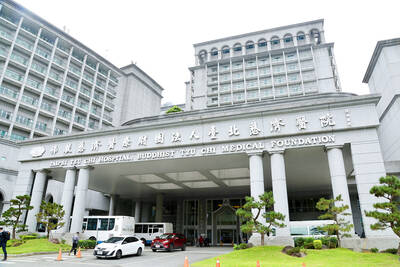
POLICE INVESTIGATING: A man said he quit his job as a nurse at Taipei Tzu Chi Hospital as he had been ‘disgusted’ by the behavior of his colleagues A man yesterday morning wrote online that he had witnessed nurses taking photographs and touching anesthetized patients inappropriately in Taipei Tzu Chi Hospital’s operating theaters. The man surnamed Huang (黃) wrote on the Professional Technology Temple bulletin board that during his six-month stint as a nurse at the hospital, he had seen nurses taking pictures of patients, including of their private parts, after they were anesthetized. Some nurses had also touched patients inappropriately and children were among those photographed, he said. Huang said this “disgusted” him “so much” that “he felt the need to reveal these unethical acts in the operating theater
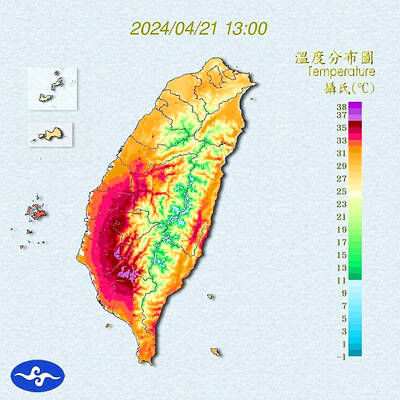
Heat advisories were in effect for nine administrative regions yesterday afternoon as warm southwesterly winds pushed temperatures above 38°C in parts of southern Taiwan, the Central Weather Administration (CWA) said. As of 3:30pm yesterday, Tainan’s Yujing District (玉井) had recorded the day’s highest temperature of 39.7°C, though the measurement will not be included in Taiwan’s official heat records since Yujing is an automatic rather than manually operated weather station, the CWA said. Highs recorded in other areas were 38.7°C in Kaohsiung’s Neimen District (內門), 38.2°C in Chiayi City and 38.1°C in Pingtung’s Sandimen Township (三地門), CWA data showed. The spell of scorching


 RSS
RSS