


Former National Fire Administration (NFA) director-general Chao Kang (趙鋼) yesterday said the government should abolish the Central Emergency Operation Center (CEOC) and create a standing Cabinet-level institution to coordinate damage prevention and emergency preparedness.
Chao made the remarks as he commented on President Ma Ying-jeou’s (馬英九) recent proposal to establish an agency under the Ministry of the Interior (MOI) to handle disaster-related tasks.
“A disaster management agency won’t work if it is not elevated to Cabinet-level status,” Chao said at a legislative hearing on disaster relief work hosted by Chinese Nationalist Party (KMT) Legislator Cheng Li-wen (鄭麗文) yesterday.
SAME OLD STORY
Chao said it would be just the same old story if a disaster management agency were established under the MOI, and that it wouldn’t make any changes to the existing rescue system, which is mainly managed by the National Fire Agency (NFA) — also under the MOI.
Under the current disaster response system governed by the Disaster Prevention and Protection Act (災害防救法), an ad hoc CEOC is to be activated when an emergency occurs, with the NFA in charge of its operations and senior civil servants from different Cabinet-level agencies taking turns serving the center during the period.
The Act states that the CEOC is to be overseen by the chairman of the Executive Yuan’s National Disaster Prevention and Protection Commission. Currently, the duty falls on Vice Premier Paul Chiu’s (邱正雄) shoulders.
PADDING
“Given the make-up of the CEOC, it’s impossible that it will run well. Its members won’t concentrate on disaster-related tasks, which they consider as adjunct work,” Chao said.
Chien Shien-wen (簡賢文), an associate professor at Central Police University’s Fire Science Department, agreed with Chao, saying that it was not appropriate for the ad hoc agency to serve as a facility for civil servants to pad their resumes with experience at disaster prevention and relief.
REFUGEES
Liu Chung-ming (柳中明), the head of National Taiwan University’s Global Change Research Center, said the damage caused by Typhoon Morakot had created the first instance of “climate refugees” in the country, and urged the government to quickly classify other areas that are under threat.
Liao Pen-chuan (廖本全), an associate professor at National Taipei University’s Department of Real Estate and Building Environment, called on the government to propose a plan to restore deforested and overdeveloped national land.
“Typhoon Morakot tells us that disasters will occur again and again, not only in southern Taiwan, but elsewhere. The whole country is immersed in crisis,” Liao said.
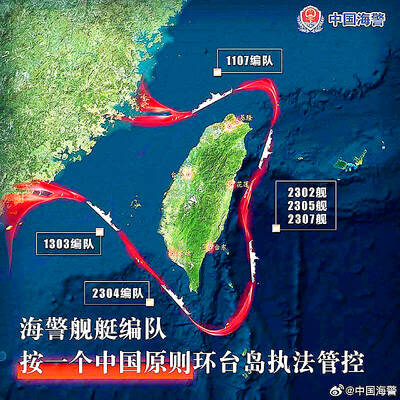
Taiwan would benefit from more integrated military strategies and deployments if the US and its allies treat the East China Sea, the Taiwan Strait and the South China Sea as a “single theater of operations,” a Taiwanese military expert said yesterday. Shen Ming-shih (沈明室), a researcher at the Institute for National Defense and Security Research, said he made the assessment after two Japanese military experts warned of emerging threats from China based on a drill conducted this month by the Chinese People’s Liberation Army’s (PLA) Eastern Theater Command. Japan Institute for National Fundamentals researcher Maki Nakagawa said the drill differed from the
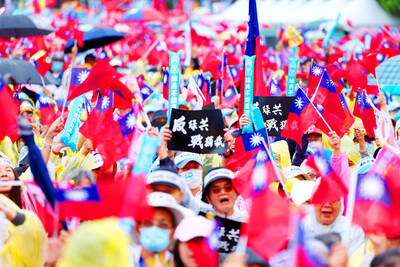
‘WORSE THAN COMMUNISTS’: President William Lai has cracked down on his political enemies and has attempted to exterminate all opposition forces, the chairman said The legislature would motion for a presidential recall after May 20, Chinese Nationalist Party (KMT) Chairman Eric Chu (朱立倫) said yesterday at a protest themed “against green communists and dictatorship” in Taipei. Taiwan is supposed to be a peaceful homeland where people are united, but President William Lai (賴清德) has been polarizing and tearing apart society since his inauguration, Chu said. Lai must show his commitment to his job, otherwise a referendum could be initiated to recall him, he said. Democracy means the rule of the people, not the rule of the Democratic Progressive Party (DPP), but Lai has failed to fulfill his

OFF-TARGET: More than 30,000 participants were expected to take part in the Games next month, but only 6,550 foreign and 19,400 Taiwanese athletes have registered Taipei city councilors yesterday blasted the organizers of next month’s World Masters Games over sudden timetable and venue changes, which they said have caused thousands of participants to back out of the international sporting event, among other organizational issues. They also cited visa delays and political interference by China as reasons many foreign athletes are requesting refunds for the event, to be held from May 17 to 30. Jointly organized by the Taipei and New Taipei City governments, the games have been rocked by numerous controversies since preparations began in 2020. Taipei City Councilor Lin Yen-feng (林延鳳) said yesterday that new measures by
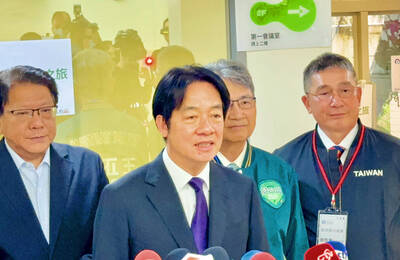
A rally held by opposition parties yesterday demonstrates that Taiwan is a democratic country, President William Lai (賴清德) said yesterday, adding that if opposition parties really want to fight dictatorship, they should fight it on Tiananmen Square in Beijing. The Chinese Nationalist Party (KMT) held a protest with the theme “against green communists and dictatorship,” and was joined by the Taiwan People’s Party. Lai said the opposition parties are against what they called the “green communists,” but do not fight against the “Chinese communists,” adding that if they really want to fight dictatorship, they should go to the right place and face


 RSS
RSS