


The distress call rang out at 12:42am on Aug. 9, a desperate cry for help from 31-year-old Tsai Ya-hsueh (蔡雅雪) to her sister after her car plunged off Shuangyuan Bridge (雙園大橋) crossing the Gaoping River (高屏溪) and into the abutment of the bridge.
“The bridge is out! I have fallen in ... Come save me! Hurry,” she said on the telephone.
Tsai’s mobile phone signal soon died, however, in the rampaging waters fed by Typhoon Morakot, and she became one of the storm’s early casualties.
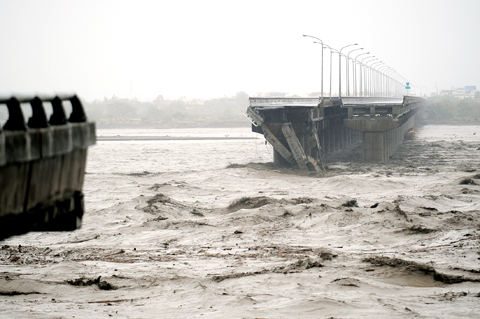
PHOTO: CHANG CHUNG-YI, TAIPEI TIMES
Similar tragedies played out on roads and bridges around central and southern regions, focusing the spotlight on the country’s traditionally vulnerable bridges that often collapse during natural disasters.
What was different this time was the scale and severity of the destruction, especially in Pingtung, Kaohsiung, Chiayi and Nantou counties, and the questions this raises about how bridges in Taiwan will be built and managed in the future.
As of noon on Wednesday, a total of 90 bridges around the nation had collapsed, with another nine requiring repairs to abutments, said Yao Nai-jia (姚乃嘉), head of National Central University’s Center for Bridge Engineering Research, who has been monitoring the situation with government officials.
That number, he said, still did not include bridges on the Southern Cross Island Highway (Highway 20) that may have collapsed in areas that remain inaccessible.
“Never before has a single typhoon caused bridge damage on such a massive scale,” said Lin Chia-hsin, a Directorate-General of Highways (DGH) official in charge of highway and bridge maintenance.
Particularly worrisome to officials is the fact that only three of the 14 major bridges that collapsed on nationally administered roads — the Tajin Bridge (大津橋), the Liouguei Bridge (六龜大橋) and the Ciwei Bridge (旗尾橋), all in Kaohsiung County — were listed as “dangerous” following a countrywide inspection last year.
Bridges such as the New Ciwei Bridge (新旗尾橋) and the No. 1 Bridge (一號橋) that were pronounced “structurally sound with no serious problems” in last year’s assessment also fell victim to Morakot’s raging floodwaters.
Highway officials and bridge engineers generally agree that the staggering amount of rainfall dumped by Morakot over a very short period — 2.5m of precipitation, or a year’s rain in three days — was the main culprit behind the high number of bridges destroyed.
Given more extreme weather patterns caused by climate change, massive storms such as Morakot could become more common in the future.
Academics said that with this in mind, the government should update bridge management procedures, including revising criteria for closing bridges in stormy weather.
Water levels have traditionally been the sole criteria for bridge closure amid flooding. This time around, many bridges were not closed before they collapsed.
Take, for instance, the 2,083m Shuangyuan Bridge, which was actually two separate bridges, one for each direction of traffic.
The water level in the Gaoping River was still 4.5m lower than the riverbank when the northbound bridge’s No. 1 and No. 15 piers, and the southbound bridge’s No. 1 and No. 16 piers were washed away by the currents.
Under current guidelines, bridges do not need to be closed off until the water level rises to within 1.5m of the riverbank’s upper level.
“The rules should be overhauled and should take into consideration the velocity of river flows, the geological condition of each bridge and the extent of abutment erosion,” said Tsai Chun-yi (蔡俊育), a structural engineer and an assistant professor at National Central University.
Another key to improving bridge safety lies in design and construction, Tsai said. Most of Taiwan’s 27,183 bridges are girder bridges, built of pre-cast concrete and steel, which feature short spans and often require many piers — the pillars supporting the individual spans.
“New thinking should be employed in designing Taiwan’s river bridges,” Tsai said.
Two recent high-profile bridge collapses — that of the 22-year-old Gaoping Bridge (高屏大橋) in Kaohsiung in 2000 and the 18-year-old Houfeng Bridge (后豐大橋) in Taichung last year — were both caused by bridge piers giving out after being battered by flash floods.
Noting that erosion, earthquakes and typhoons are three key elements that should be factored into the design of Taiwan’s river bridges, Tsai said reducing the number of piers or eliminating them completely would be the most effective way to enhance the safety and durability of bridges, a view echoed by his colleague.
“Riverbed bridge piers tend to disrupt water flow, increasing the hazard of piers being eroded or washed away. Therefore, the fewer the number of piers in a riverbed, the safer the bridge,” Yao said.
The Shuangyuan Bridge, for example, had more than 60 piers in the river, with no span longer than 31m.
“With so many piers sitting in the riverbed, the erosion of a single pier could lead to the collapse of other piers and the whole bridge,” Yao said.
In light of Taiwan’s unique climate and topography, Yao said bridges longer than 100m should use cable-stayed or extradosed bridges, which use cables suspended from towers rather than a series of piers to support long bridge spans.
Most of Taiwan’s river bridges, which stretch between 200m and more than 1,000m, are suitable for these styles.
Whether the cable-stayed or extradosed model is chosen depends on the breadth of the rivers over which a bridge is to be built.
Yao said the span of a cable-stayed bridge can stretch from 400m to 500m, while that of an extradosed bridge can extend from 200m to 300m.
However, high costs might deter the use of these bridge types. Construction of cable-stayed bridges is three to four times more expensive than the cost of building girder bridges, while an extradosed bridge costs about twice as much as a girder bridge.
Noting that the higher costs are mainly a result of higher technological thresholds, Yao said Taiwan was technologically capable of building suspension-style bridges.
The 2,617m highway bridge on the Yancao (菸草) to Jiuru (九如) section of Freeway No. 3 that crosses the Gaoping River is a cable-stayed model that has become a landmark and is the longest such bridge in Asia.
With the technology available, the only problem is funding, but Yao said he did not think all Taiwan’s bridges needed to be changed to cable-stayed or extradosed models.
“I think such models need to be introduced just for long river bridges that require longer spans to overcome abutment-scouring problems,” Yao said.
As to the cost, while cable-stayed and extradosed bridges are more expensive than girder ones, they are easier to maintain, he said.
While girder bridges may cost less to construct, they tend to need more maintenance and incur higher repair fees. In the event of a collapse, huge compensation has to be paid to those who are affected, while the reconstruction of such bridges costs even more, Yao said.
Apart from bridge design, equally important is environmental protection. Yao, who led a team last week to investigate why a large number of bridges in Chiayi County failed, said the main reason behind the collapse of so many bridges before water levels reached officially set alarm levels lay in the fact that the huge amounts of silt, soil, rocks and driftwood washed into the rivers by typhoon-triggered flash floods and landslides enormously increased the impact of the river flows.
“Silt, soil and driftwood from the mountains are testimony to illegal logging, excessive land development and residential construction on mountain slopes,” Yao said. “If rampant overuse of slopeland and riverside agriculture cannot be halted, bridges will be doomed to continue collapsing, no matter how advanced the technology used to build them.”
To solve the root of the problem, Yao said, some areas should no longer be inhabited.
“Land planning and river management should be addressed to resolve bridge safety problems once and for all,” he said.
While Taiwan has one of the world’s highest densities of bridges, it is sadly lacking in manpower for bridge maintenance and management. Before the deadly earthquake of Sept. 21, 1999, the DGH had a bridge supervisory system that was in charge of 4,564 provincial highway bridges.
After the 921 earthquake, Yao said, the Ministry of Transportation and Communications commissioned the National Central University’s bridge research center to conduct a nationwide survey, which found Taiwan had 20,000-plus bridges, but only a limited number of staff to oversee them. For instance, Chiayi County had 993 bridges, but only one full-time engineering official and several contract workers to manage them.
Meanwhile, bridge experts said that the government should conduct a nationwide bridge examination and single out dangerous bridges.
Chen Ming-huang, president of the National Federation of Construction Industry Associations, said many bridges, particularly those in rural townships or villages, were situated on narrow rivers and were dilapidated.
“Environmental and climatic changes might have undermined their structures. Even though they remain standing after the typhoon, they might nonetheless require maintenance,” Chen said.
Also See: Constructing ‘intelligent bridges’ an option: group

A group of Taiwanese-American and Tibetan-American students at Harvard University on Saturday disrupted Chinese Ambassador to the US Xie Feng’s (謝鋒) speech at the school, accusing him of being responsible for numerous human rights violations. Four students — two Taiwanese Americans and two from Tibet — held up banners inside a conference hall where Xie was delivering a speech at the opening ceremony of the Harvard Kennedy School China Conference 2024. In a video clip provided by the Coalition of Students Resisting the CCP (Chinese Communist Party), Taiwanese-American Cosette Wu (吳亭樺) and Tibetan-American Tsering Yangchen are seen holding banners that together read:

UNAWARE: Many people sit for long hours every day and eat unhealthy foods, putting them at greater risk of developing one of the ‘three highs,’ an expert said More than 30 percent of adults aged 40 or older who underwent a government-funded health exam were unaware they had at least one of the “three highs” — high blood pressure, high blood lipids or high blood sugar, the Health Promotion Administration (HPA) said yesterday. Among adults aged 40 or older who said they did not have any of the “three highs” before taking the health exam, more than 30 percent were found to have at least one of them, Adult Preventive Health Examination Service data from 2022 showed. People with long-term medical conditions such as hypertension or diabetes usually do not
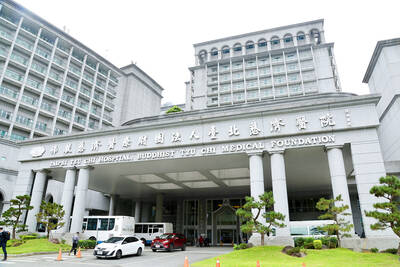
POLICE INVESTIGATING: A man said he quit his job as a nurse at Taipei Tzu Chi Hospital as he had been ‘disgusted’ by the behavior of his colleagues A man yesterday morning wrote online that he had witnessed nurses taking photographs and touching anesthetized patients inappropriately in Taipei Tzu Chi Hospital’s operating theaters. The man surnamed Huang (黃) wrote on the Professional Technology Temple bulletin board that during his six-month stint as a nurse at the hospital, he had seen nurses taking pictures of patients, including of their private parts, after they were anesthetized. Some nurses had also touched patients inappropriately and children were among those photographed, he said. Huang said this “disgusted” him “so much” that “he felt the need to reveal these unethical acts in the operating theater
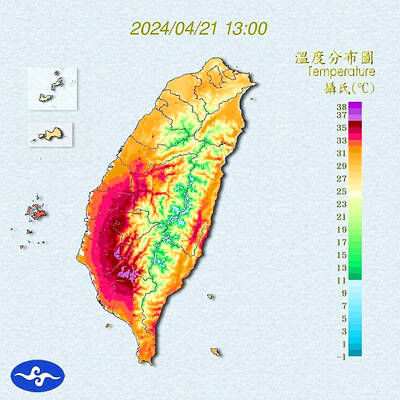
Heat advisories were in effect for nine administrative regions yesterday afternoon as warm southwesterly winds pushed temperatures above 38°C in parts of southern Taiwan, the Central Weather Administration (CWA) said. As of 3:30pm yesterday, Tainan’s Yujing District (玉井) had recorded the day’s highest temperature of 39.7°C, though the measurement will not be included in Taiwan’s official heat records since Yujing is an automatic rather than manually operated weather station, the CWA said. Highs recorded in other areas were 38.7°C in Kaohsiung’s Neimen District (內門), 38.2°C in Chiayi City and 38.1°C in Pingtung’s Sandimen Township (三地門), CWA data showed. The spell of scorching


 RSS
RSS