


Media Watch chairman Kuang Chung-hsiang (管中祥) said yesterday there was a risk that media would focus on the trauma of Typhoon Morakot but neglect the underlying issues behind the disaster.
“In their coverage of the disaster caused by Typhoon Morakot, the media seem to be taking advantage of tragedy and turning the victims into [profits]” by using their stories to boost viewer ratings, Kuang told the Taipei Times in a telephone interview. “They ask reporters to risk their lives to go into devastated areas and advertise the reports as ‘exclusive’ to boost their viewership.”
“On Monday, the Apple Daily even put a huge picture of the bodies of victims on its front page, which made many readers, including the families of the victims, uncomfortable,” he said.

PHOTO: REUTERS
Although some news programs and political commentary shows are scrutinizing the government’s response, “they are not looking at the long-term problems that lead to disasters, such as the quality of public infrastructure and water management,” Kuang said.
If the government makes promises to improve the situation, the media needs to follow it up, he said.
Media Reform Taiwan member Cheng Kuo-wei (鄭國威) said media were neglecting key questions.
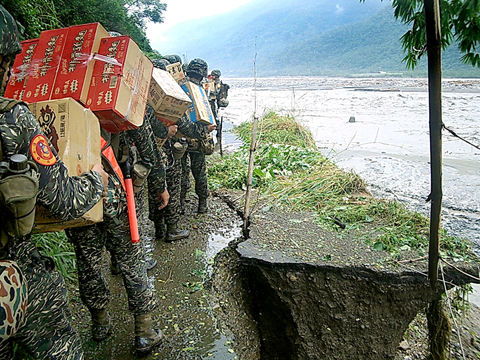
PHOTO: AFP
“What obstructed the flow of rivers? Who built the embankments along riverbanks? Who permitted constant digging of sandstone [from river beds] and changed the course of rivers? Who used up underground water? Who allocated all the resources to cities, leaving death and injury for the countryside? Why is it that elderly people and children are left to save themselves when disasters strike rural areas?” Cheng said.
Cheng said the media and the public need to pay attention to infrastructure and water management projects. While the media broadcast nonstop footage of tearful villagers, no one is talking about the effects of construction and high-altitude agriculture on the natural mountain vegetation and the role this plays in flooding.
“Knowing why something happens and preventing it from happening” again should be a top priority, he said.
Meanwhile, National Communications Commission (NCC) Chairwoman Bonnie Peng (彭芸) issued a statement on Tuesday recognizing the role of media in rescue efforts.
However, while it is positive that TV news correspondents gather information about the situation, media outlets should try to verify reports before airing them.
Jason Ho (何吉森), director of the NCC’s communications content department, said one TV station had reported that 30 corpses were spotted floating down a river, then said 15 minutes later that the report was wrong.
Peng said TV stations should also inform viewers whether footage they air is a live broadcast of the current situation.
Viewers “need to know if the roads that were blocked are now accessible or if the trapped victims have been rescued,” Ho said.

A group of Taiwanese-American and Tibetan-American students at Harvard University on Saturday disrupted Chinese Ambassador to the US Xie Feng’s (謝鋒) speech at the school, accusing him of being responsible for numerous human rights violations. Four students — two Taiwanese Americans and two from Tibet — held up banners inside a conference hall where Xie was delivering a speech at the opening ceremony of the Harvard Kennedy School China Conference 2024. In a video clip provided by the Coalition of Students Resisting the CCP (Chinese Communist Party), Taiwanese-American Cosette Wu (吳亭樺) and Tibetan-American Tsering Yangchen are seen holding banners that together read:

UNAWARE: Many people sit for long hours every day and eat unhealthy foods, putting them at greater risk of developing one of the ‘three highs,’ an expert said More than 30 percent of adults aged 40 or older who underwent a government-funded health exam were unaware they had at least one of the “three highs” — high blood pressure, high blood lipids or high blood sugar, the Health Promotion Administration (HPA) said yesterday. Among adults aged 40 or older who said they did not have any of the “three highs” before taking the health exam, more than 30 percent were found to have at least one of them, Adult Preventive Health Examination Service data from 2022 showed. People with long-term medical conditions such as hypertension or diabetes usually do not
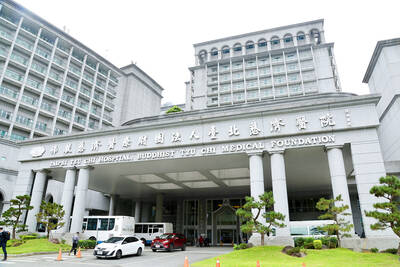
POLICE INVESTIGATING: A man said he quit his job as a nurse at Taipei Tzu Chi Hospital as he had been ‘disgusted’ by the behavior of his colleagues A man yesterday morning wrote online that he had witnessed nurses taking photographs and touching anesthetized patients inappropriately in Taipei Tzu Chi Hospital’s operating theaters. The man surnamed Huang (黃) wrote on the Professional Technology Temple bulletin board that during his six-month stint as a nurse at the hospital, he had seen nurses taking pictures of patients, including of their private parts, after they were anesthetized. Some nurses had also touched patients inappropriately and children were among those photographed, he said. Huang said this “disgusted” him “so much” that “he felt the need to reveal these unethical acts in the operating theater
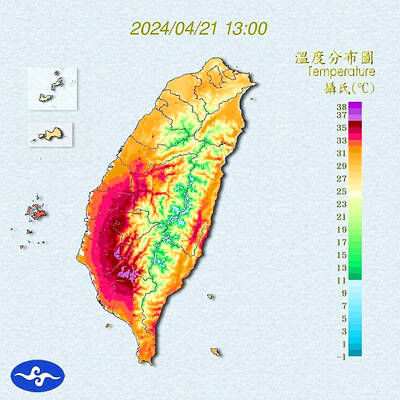
Heat advisories were in effect for nine administrative regions yesterday afternoon as warm southwesterly winds pushed temperatures above 38°C in parts of southern Taiwan, the Central Weather Administration (CWA) said. As of 3:30pm yesterday, Tainan’s Yujing District (玉井) had recorded the day’s highest temperature of 39.7°C, though the measurement will not be included in Taiwan’s official heat records since Yujing is an automatic rather than manually operated weather station, the CWA said. Highs recorded in other areas were 38.7°C in Kaohsiung’s Neimen District (內門), 38.2°C in Chiayi City and 38.1°C in Pingtung’s Sandimen Township (三地門), CWA data showed. The spell of scorching


 RSS
RSS