


The Taipei Teachers’ Association (TTA) yesterday urged the Taipei City Government to drop its insistence on controlling which textbooks are used in the city’s primary and junior high schools.
In a press release, the TTA called on the city government to accept a ruling by the Council of Grand Justices on Friday last week that schools be permitted to choose their own textbooks as long as the textbooks follow the Ministry of Education’s (MOE) curriculum guidelines.
“Section 2 of Article 2 of the National Education Act (國民教育法) allows a school to choose different versions of textbooks based on the characteristics of that school’s community and the needs of its students,” the TTA said.
There remain great discrepancies between schools in the city, the TTA said, adding that forcing every school in the city to adopt the same textbooks runs counter to the spirit of the National Education Act.
The TTA’s call came after Taipei Mayor Hau Lung-bin (郝龍斌) on Monday said that Taipei City, Taipei County and Keelung would continue to pursue a “one curriculum guideline, one textbook” policy, despite the council’s rejection of an appeal by the city government.
The appeal filed on May 3, 2007, by the Taipei City Government and seven other county and city governments governed by the Chinese Nationalist Party (KMT) asked the Grand Justices for a constitutional interpretation of the National Education Act and the ministry’s policy that local governments cannot decide what textbooks a school should use.
The ministry allows schools to choose different versions of textbooks, as long as the books follow the ministry’s curriculum guidelines.
Up until the 2002 school year, the ministry required students nationwide to use textbooks published by the National Institute For Compilation and Translation. The change was aimed at ensuring a diversity of perspectives in textbooks.
The eight local governments said, however, that it was unreasonable for the ministry not to allow them to have the final say over which textbooks were to be used in their jurisdictions. The governments claimed they had the authority to choose one textbook for each subject.
The TTA said that a survey carried out by the TTA and the National Teachers Association last year showed that the number of students attending cram schools had surged after Taipei City’s Department of Education required that all schools in the city used the same textbook for each subject.
“The ministry has said it would cut Taipei City’s educational funding should it stick to its policy. This would seriously affect the rights of students in Taipei,” the TTA said.
Also yesterday, the Humanistic Education Foundation (HEF) said that it had always objected to Taipei’s textbook policy.
“The Council of Grand Justices have made the interpretation that it’s up to central government — not the local government — to interpret the National Education Act, so Taipei City Government should follow the ministry’s policy, not invent its own,” HEF executive director Joanna Feng (馮喬蘭) told the Taipei Times during a phone interview.
Feng condemned Taipei City for trying to alter the textbook selection process.
“Although the city government would ask schools to choose textbooks, choices made by the schools have to be submitted to the city government for approval,” she said. “So in the end, it’s still a few people who make the decision — this is in violation of the spirit of the National Education Act and disrespects the professionalism of teachers.”
What Feng worries about most, however, was that the city government’s policy could restrict diversity in education and make “meaningless tests” the purpose of education. While the city government claims that the policy lifts the pressure on students, Feng disagreed, adding that the core problem was “the idea that everyone wants to attend certain [high-ranking] schools, but there are only so many people who can get into those schools.”
She also urged the central government to take action to stop the city government’s policy.
“It doesn’t help if the central government simply just continuously repeats its stance,” she said.

Yangmingshan National Park authorities yesterday urged visitors to respect public spaces and obey the law after a couple was caught on a camera livestream having sex at the park’s Qingtiangang (擎天崗) earlier in the day. The Shilin Police Precinct in Taipei said it has identified a suspect and his vehicle registration number, and would summon him for questioning. The case would be handled in accordance with public indecency charges, it added. The couple entered the park at about 11pm on Thursday and began fooling around by 1am yesterday, the police said, adding that the two were unaware of the park’s all-day live

Fast food chain McDonald's is to raise prices by up to NT$5 on some products at its restaurants across Taiwan, starting on Wednesday next week, the company announced today. The prices of all extra value meals and sharing boxes are to increase by NT$5, while breakfast combos and creamy corn soup would go up by NT$3, the company said in a statement. The price of the main items of those meals, if ordered individually, would remain the same. Meanwhile, the price of a medium-sized lemon iced tea and hot cappuccino would rise by NT$3, extra dipping sauces for chicken nuggets would go up
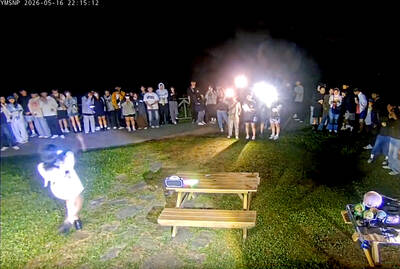
Yangmingshan National Park’s Qingtiangang (擎天崗) nature area has gone viral after a park livestream camera observed a couple in the throes of intimate congress, which was broadcast live on YouTube, drawing large late-night crowds and sparking a backlash over noise, bright lights and disruption to wildlife habitat. The area’s livestream footage appeared to show a couple engaging in sexual activity on a picnic table in the park on Friday last week, with the uncensored footage streamed publicly online. The footage quickly spread across social media, prompting a tide of visitors to travel to the site to “check in” and recreate the

Minister of Digital Affairs Lin Yi-ching (林宜敬) yesterday cited regulatory issues and national security concerns as an expert said that Taiwan is among the few Asian regions without Starlink. Lin made the remarks on Facebook after funP Innovation Group chief executive officer Nathan Chiu (邱繼弘) on Friday said Taiwan and four other countries in Asia — China, North Korea, Afghanistan and Syria — have no access to Starlink. Starlink has become available in 166 countries worldwide, including Ukraine, Malaysia, the Philippines and Vietnam, in the six years since it became commercial, he said. While China and North Korea block Starlink, Syria is not


 RSS
RSS