


The Mainland Affairs Council (MAC) said yesterday that it was too early for China and Taiwan to hold talks on political matters, despite Beijing’s interest in doing so.
MAC Vice Chairman Fu Don-cheng (傅棟成) said that cross-strait negotiations were still focused on economic issues, adding that future issues would likely include cultural or media exchanges.
The timing and conditions were not ripe for talks on political issues, he said.
Fu made the remarks in response to complaints lodged by the Democratic Progressive Party (DPP).
Citing a recent report on the situation in China, DPP Spokesman Cheng Wen-tsang (鄭文燦) said that as China is preparing for political dialogue with Taiwan, some were worried that President Ma Ying-jeou (馬英九) would break his promise of not discussing unification during his presidency.
If the Ma administration engaged in political negotiations with China, it would cause a grave crisis and pose a serious threat to Taiwan’s sovereignty, he said.
Ma has pledged not to discuss unification with Beijing during his presidency, not to pursue or support de jure Taiwanese independence and not to use military force to resolve any cross-strait dispute.
Cheng said that as Ma has been currying favor with Beijing, the price Beijing had asked Taipei to pay in return had increased over time.
In related news, Fu yesterday said that they expected to launch negotiations in October on “administrative affairs” related to an economic cooperation framework agreement (ECFA), as both sides have said that they hope to sign the proposed pact next year.
Fu was evasive, however, about when the accord would be forged, saying it would happen “as soon as the negotiations were completed.”
The news indicates the administration will push ahead with the ECFA plan despite opposition from the DPP, which has requested that the administration hold a referendum to decide the matter.
An assessment study and report conducted by the Chung-Hua Institution for Economic Research concluded that the inking of an ECFA with China could generate between 257,000 and 263,000 jobs per year in Taiwan and raise the annual GDP by between 1.65 percent and by 1.72 percent.
Fu yesterday said that the planned business deal was merely a framework agreement, which would include the items to be addressed, a time table to address the issues and an “early harvest” mechanism, which is designed to accelerate the implementation of an agreement, often by reducing the tariffs on some specific products.
The businesses covered by the “early harvest” mechanism would not be many, Fu said, and they would “not be harmful” to either side.
“[The proposed framework agreement] is similar to a free trade agreement whose goal is trade liberalization,” he said. “But before both sides sit down and talk about details, we don’t know what the content will be.”
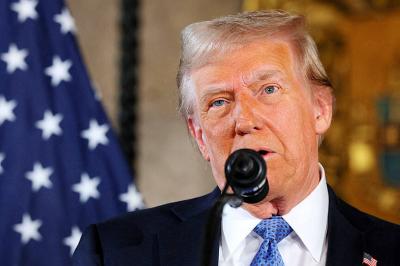
US President Donald Trump said "it’s up to" Chinese President Xi Jinping (習近平) what China does on Taiwan, but that he would be "very unhappy" with a change in the "status quo," the New York Times said in an interview published yesterday. Xi "considers it to be a part of China, and that’s up to him what he’s going to be doing," Trump told the newspaper on Wednesday. "But I’ve expressed to him that I would be very unhappy if he did that, and I don’t think he’ll do that," he added. "I hope he doesn’t do that." Trump made the comments in
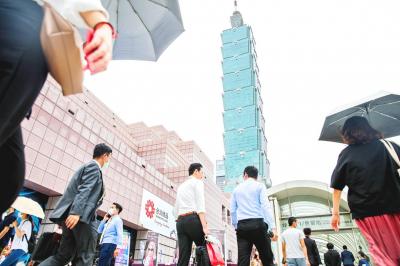
Japanese footwear brand Onitsuka Tiger today issued a public apology and said it has suspended an employee amid allegations that the staff member discriminated against a Vietnamese customer at its Taipei 101 store. Posting on the social media platform Threads yesterday, a user said that an employee at the store said that “those shoes are very expensive” when her friend, who is a migrant worker from Vietnam, asked for assistance. The employee then ignored her until she asked again, to which she replied: "We don't have a size 37." The post had amassed nearly 26,000 likes and 916 comments as of this
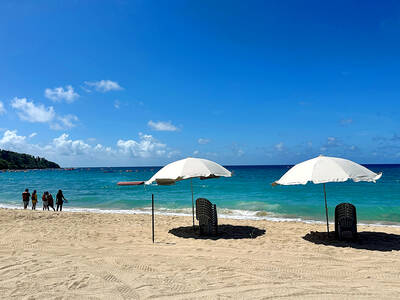
Tourism in Kenting fell to a historic low for the second consecutive year last year, impacting hotels and other local businesses that rely on a steady stream of domestic tourists, the latest data showed. A total of 2.139 million tourists visited Kenting last year, down slightly from 2.14 million in 2024, the data showed. The number of tourists who visited the national park on the Hengchun Peninsula peaked in 2015 at 8.37 million people. That number has been below 2.2 million for two years, although there was a spike in October last year due to multiple long weekends. The occupancy rate for hotels
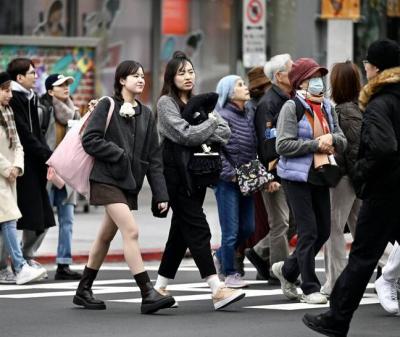
A cold surge advisory was today issued for 18 cities and counties across Taiwan, with temperatures of below 10°C forecast during the day and into tonight, the Central Weather Administration (CWA) said. New Taipei City, Taipei, Taoyuan and Hsinchu, Miaoli and Yilan counties are expected to experience sustained temperatures of 10°C or lower, the CWA said. Temperatures are likely to temporarily drop below 10°C in most other areas, except Taitung, Pingtung, Penghu and Lienchiang (Matsu) counties, CWA data showed. The cold weather is being caused by a strong continental cold air mass, combined with radiative cooling, a process in which heat escapes from


 RSS
RSS