

High levels of ultraviolet light have been a regular feature of the past month, with statistics released by the Environmental Protection Administration (EPA) yesterday showing that the country has seen some very high levels of ultraviolet rays.
“In our monthly tally, we found the ultraviolet index level reached a record high of 22 on Lulin Mountain (鹿林) on July 18. In the Ilan area, ultraviolet levels were higher than the safe limit of 26 out of 31 days,” said Chu Yu-chi (朱雨其), head of the EPA’s environmental monitoring and information management division.
To fully protect themselves, people should wear plenty of high protection sunblock when outside, Chu said, adding that “if possible, avoid going out between noon and 2pm, as ultraviolet light levels peak during that time.”
Aside from sporadic afternoon showers forecast for the eastern part of the country, which is under the influence of the outer band of a tropical depression, the hot weather persisted yesterday, with temperatures reaching 35ºC to 36ºC in northern Taiwan and 33ºC to 34ºC in the rest of the country, the Central Weather Bureau said.
Chu said people braving the blazing sun over the next few days should protect their skin using plenty of sun block and also protect themselves against pollutants in the air, as the ultraviolet light and pollutant levels will be high all over the country.
“Downdrafts on the rim of the tropical depression, combined with high temperatures, will keep the ultraviolet light and ozone levels very high for the next few days,” he said.
Chu said that two tropical depressions — one close to Chongsha (中沙) and Sisha (西沙) islands and another to the east of the Phillippines — are approaching Taiwan. Whether either depression will evolve into a tropical storm or typhoon is still unknown, Chu said, but at the rim of tropical depressions are downdrafts, which slow the diffusion of pollutant particles.
Air quality in Taiwan proper — particularly in central and southern areas — will be therefore be poor, Chu said, adding that the main pollutant would be ozone.
The downdrafts similarly affect ultraviolet light levels, Chu said.
“When there are downdrafts, the atmosphere has relatively less cloud, so more ultraviolet light reaches the Earth, making the levels high,” he said.
ADDITIONAL REPORTING BY CNA

The donation of offshore patrol vessel Kinmen to the Philippines includes provisions that protect Taiwanese fishers and facilitate security cooperation across the First Island Chain, officials said yesterday. The comment was made during the Cabinet’s comprehensive administrative report at the legislature after Chinese Nationalist Party (KMT) Legislator Hsu Yu-chen (許宇甄) expressed concerns about the decision to give a ship to a country whose coast guard had in 2013 fired on a Taiwanese trawler and killed its captain without provocation. The Cabinet should lay out the safeguards that have been established to prevent the Philippine government from using the Kinmen to harass, expel
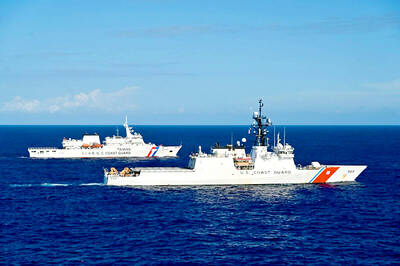
GROWING TIES: The CGA is planning a goodwill mission to the Philippines, in what would be the first time since 1975 a Taiwanese paramilitary vessel has visited the country The Coast Guard Administration (CGA) plans to significantly expand its participation in international security cooperative frameworks and its operational capabilities, a budget proposal for next year showed. The budget indicates a transformation of the CGA from a maritime law enforcement arm into a national defense and intelligence gathering entity capable of tackling larger regional security matters. The proposal showed that personnel from the coast guard’s Intelligence Division and Special Action Support Center are to participate in high-level national security talks with the US. As the CGA has dealt with China’s rising “gray zone” threats around Taiwan, it has become a valuable asset to
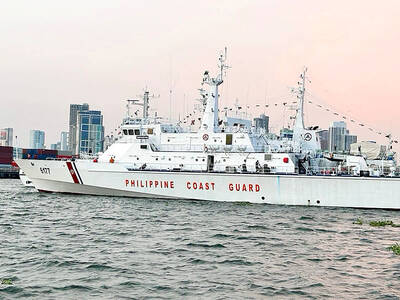
A patrol vessel donated by the Coast Guard Administration (CGA) to the Philippines was commissioned into the Philippine Coast Guard (PCG) on Friday, a Philippine non-governmental organization said. The CGA on Sept. 16 confirmed media reports that Taiwan had donated a retired 500-tonne patrol vessel to the Philippines. The Manila-based We Protect Our Seas (WPS) foundation, which served as an intermediary in the transfer, said that the vessel was formerly the CGA’s 500-tonne petrol vessel Kinmen (CG123). The WPS, in a statement issued on Friday, said the vessel, renamed as the BRP Sarangani, had been commissioned into the PCG the
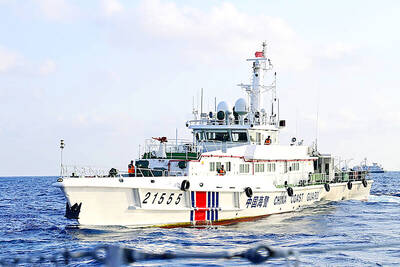
‘GRAY ZONE’ TACTICS: Beijing sent two China Coast Guard vessels to escort a ‘supposedly private research ship,’ a Philippine Coast Guard spokesman said The Coast Guard Administration (CGA) yesterday confirmed that it had recently deployed three patrol vessels to waters in Taiwan’s overlapping exclusive economic zone with the Philippines to monitor three Chinese vessels. CGA Deputy Director-General Hsieh Ching-chin (謝慶欽) said the agency regularly monitors Chinese vessels around Taiwan, and that the deployment south of Oluanpi (鵝鑾鼻), Taiwan proper’s southernmost point, was carried out in accordance with standard procedures. He added that the waters fall within the overlapping exclusive economic zones of Taiwan and the Philippines, which extend 200 nautical miles (370km) from their coastlines. Hsieh made the comments when asked about a


 RSS
RSS