


A college lecturer who has collected bread rolls and loaves from bakeries for three years to distribute to people living in remote mountain villages every week is now known by indigenous children in Pingtung County as their “bread winner.”
Wang Chang-ju (王常如), a lecturer at Fooyin University in Kaohsiung County, has never taken time off distributing food in Sandimen Township (三地門), a mountainous area populated by the Rukai tribe, since being told more than three years ago that children there needed “bread” far more than money or video games.
Wang, currently a doctorate candidate in dentistry at Kaohsiung Medical University, was in the area doing research on betel nuts and their impact on indigenous culture when she discovered that children in the township were generally shorter and thinner than their counterparts elsewhere in Taiwan.
She learned that Sandimen was an economic backwater lacking basic necessities because of poor transportation links. Because of the lack of access, most children suffered malnutrition.
“There wasn’t even a bakery there,” she said.
Because children in the isolated village dreamed of “having bread to eat,” Wang launched her bread donation program. But it got off to a bumpy start.
When she asked bakeries in the Kaohsiung area to donate their unwanted bread to the cause, many mistook her for a fraudster trying to con them into giving away their bread.
Undaunted, she visited one bakery after another throughout Kaohsiung City and County, telling them she wanted to collect unwanted but edible rolls or toast for malnourished children living in the mountains of Pingtung County.
Her persistence paid off. She eventually recruited 16 bakeries to regularly contribute bread.
After collecting the bread, Wang and two friends drove from Kaohsiung to Pingtung to deliver it to the eager children. Over the years, Wang and her friends have brought more than 50,000 rolls to the township annually, and their compassionate deed has inspired others.
Members of the Chiayi Charity Organization based in Chiayi County decided to rebuild a bridge in Wutai (霧台) — another Rukai township bordering Sandimen — that had been damaged by a typhoon many years ago. After raising NT$10 million (US$304,800) for the project, the organization began construction of the bridge early this year and completed it on May 23. It was the 400th bridge that the charity group has built in Taiwan at its own expense.
Wang said the bridge would serve as a new lifeline for residents of the township.
Wang has also helped Sandimen farmers sell their crops to several restaurants located near Kaohsiung Medical University, and has arranged for the restaurants to give their leftovers to the farmers to be used in making soap or organic fertilizers.
All of these activities, Wang said, have only one purpose, one that she remains committed to.
“I hope our ‘bread trips’ to the mountains will have an even greater impact on improving the well-being of people living up there,” she said.

AGING: While Japan has 22 submarines, Taiwan only operates four, two of which were commissioned by the US in 1945 and 1946, and transferred to Taiwan in 1973 Taiwan would need at least 12 submarines to reach modern fleet capabilities, CSBC Corp, Taiwan chairman Chen Cheng-hung (陳政宏) said in an interview broadcast on Friday, citing a US assessment. CSBC is testing the nation’s first indigenous defense submarine, the Hai Kun (海鯤, Narwhal), which is scheduled to be delivered to the navy next month or in July. The Hai Kun has completed torpedo-firing tests and is scheduled to undergo overnight sea trials, Chen said on an SET TV military affairs program. Taiwan would require at least 12 submarines to establish a modern submarine force after assessing the nation’s operational environment and defense

A white king snake that frightened passengers and caused a stir on a Taipei MRT train on Friday evening has been claimed by its owner, who would be fined, Taipei Rapid Transit Corp (TRTC) said yesterday. A person on Threads posted that he thought he was lucky to find an empty row of seats on Friday after boarding a train on the Bannan (Blue) Line, only to spot a white snake with black stripes after sitting down. Startled, he jumped up, he wrote, describing the encounter as “terrifying.” “Taipei’s rat control plan: Release snakes on the metro,” one person wrote in reply, referring
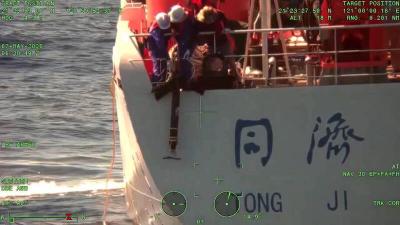
The coast guard today said that it had disrupted "illegal" operations by a Chinese research ship in waters close to the nation and driven it away, part of what Taipei sees a provocative pattern of China's stepped up maritime activities. The coast guard said that it on Thursday last week detected the Chinese ship Tongji (同濟號), which was commissioned only last year, 29 nautical miles (54km) southeast of the southern tip of Taiwan, although just outside restricted waters. The ship was observed lowering ropes into the water, suspected to be the deployment of scientific instruments for "illegal" survey operations, and the coast

Yangmingshan National Park authorities yesterday urged visitors to respect public spaces and obey the law after a couple was caught on a camera livestream having sex at the park’s Qingtiangang (擎天崗) earlier in the day. The Shilin Police Precinct in Taipei said it has identified a suspect and his vehicle registration number, and would summon him for questioning. The case would be handled in accordance with public indecency charges, it added. The couple entered the park at about 11pm on Thursday and began fooling around by 1am yesterday, the police said, adding that the two were unaware of the park’s all-day live


 RSS
RSS