


Twenty-seven-year-old Lin Wen-hung (林文弘) was an office worker until he decided to return to his village in central Taiwan and help his parents with their betel nut plantation.
Quickly realizing that growing betel nuts was no longer lucrative because of a shrinking domestic market, in 2005 Lin decided to grow coffee on the family’s land in Guosing Township (國姓), Nantou County.
“The golden age of betel nuts has passed, and my parents could no longer do hard work,” Lin said.
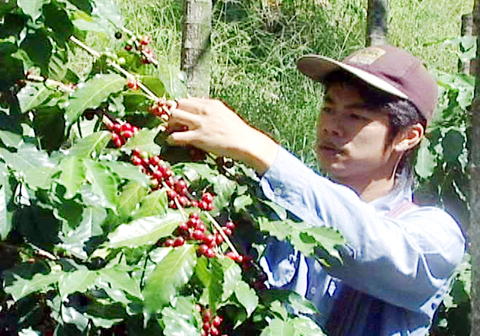
PHOTO: CNA
But unlike many of the agricultural success stories trumpeted in recent months to encourage people to go into farming, Lin has struggled, and his experience provides a cautionary tale for city slickers lured by the promise of high-end agriculture.
He has learned that without marketing savvy and the right crop, romantic notions of getting back to nature can be dashed.
Lin’s interest in growing coffee was spurred by the trend for local-grown coffee that took off after Gukeng Township (古坑), Yunlin County, organized the first Taiwan Coffee Festival in October 2003.
“It gave us the idea that maybe coffee could bring us extra income” since coffee is one of the most popular drinks in Taiwan, the young farmer said.
Using some of his betel nut trees to shade the coffee trees — which thrive in temperatures ranging from 19ºC to 25ºC — also meant he would not have to cut down his betel nut trees to make way for another crop.
Lin said the shelter provided by the betel nut trees, along with his use of organic fertilizer, resulted in good-quality coffee beans, but as he has since found out, quality is not enough.
Though his harvest of 2 tonnes to 3 tonnes of coffee last year was the biggest of any coffee farm in Guosing — one of Taiwan’s five largest coffee growing areas — he has so far sold only about a third.
“I still haven’t been able to find a marketing channel. So far, I’ve only been able to sell my product to friends and relatives,” he said. “I still have to rely on betel nuts to feed the family.”
Lin has invested around NT$2 million (US$60,000) in seedlings and machines to grow his coffee beans, and plenty more in labor and time, but after a three-year wait for the trees to bear fruit, he has sold only NT$500,000 worth of product to date.
“Marketing is the biggest challenge,” Lin said.
One potential outlet for his coffee beans are the thousands of specialty coffee shops around Taiwan, many of which sell so-called estate-grown coffee, but there are two main barriers to entry for local growers: price and availability.
The Taipei-based Jeanlook Co imports beans from acclaimed farms around the world, and roasts and brews them in their own coffee shop. Taiwanese beans are not on the menu even though the shop would like to offer customers the choice.
“Customers must ask for it and we’ll serve it if we happen to have the beans,” said Jeanlook’s Tika Lu, who runs the company’s coffee shop.
The problem, he said, is that Taiwan’s coffee output is generally small-scale and unstable, and the beans are expensive.
Not only is it hard to get a consistent supply of a variety of beans from local suppliers, the cost of buying local coffee beans is 40 times higher than that of importing raw beans from Ethiopia, Lu said.
Wu Yi-ling (吳怡玲), the chairwoman of the Taiwan Coffee Association, agrees that price is a major barrier to market entry.
She said the cost of coffee imported from Colombia, a favorite among locals, averaged about US$3 per kg last year, while locally grown coffee wholesales for between NT$500 and NT$800 per kilogram.
Wu attributed the price gap in part to Taiwan’s high labor costs.
“Although Taiwan coffee is fresher than imported beans, we only make a 20 percent profit when we sell a kilo of beans for NT$500,” Lin said.
Quality is less of an issue, Lu says. Although Taiwan’s coffee may not be appreciated by coffee aficionados, it suits the local palate because it is generally mild, plain and without strong characteristics.
What Lin has trouble understanding is why Gukeng’s apparent success has failed to translate to other coffee growing regions in Taiwan, such as Guosing, especially since Gukeng is forced to import beans just to meet its own needs.
The Gukeng Farmers’ Association says its area’s coffee output, on 120 hectares according to 2004 figures, accounts for more than 33 percent of Taiwan’s total.
That scale of farming cannot possibly satisfy the demand of the millions who visit Gukeng each year, Lu said, a view confirmed by Lin.
“I heard some local coffee shop owners tried to buy Taiwan-grown coffee from farmers in Gukeng, but couldn’t because so many beans there were imported,” Lin said.
“There are actually not as many farmers growing coffee there as believed,” he said.
However, even with a flood of imported beans, Gukeng continues to draw crowds and attention while Guosing is relatively ignored — demonstrating the importance of marketing.
Last year, Gukeng, population 36,000, attracted nearly 2 million visitors, and it pulled in an estimated NT$45 million during the coffee festival that year in the month of December alone, the local farmers’ association said.
A Taiwan Coffee Association report said the future of Taiwan’s coffee market would be defined by reasonable prices, high quality, convenient access, multiple flavor choices, personalization and uniqueness, which lend themselves to the Gukeng model.
Growers in Guosing seem to be getting the message. Unlike the Gukeng farmers’ association, the Guosing farmers’ association is not familiar with coffee, so coffee growers are starting to fend for themselves.
Lin says farmers, recreational farms and hostel operators, as well as other service businesses in the township are now working together to form a “tour strategy alliance” in an attempt to match coffee with tourism.
Until the plan comes to fruition, Lin will continue to struggle, but he has no intention of abandoning his coffee plants.
Asked why he continues to grow coffee in the face of so many challenges, Lin said that having decided on this course, he is committed to doing everything he can to make the business successful.
He is planning to produce a line of drip coffee bags with homemade coffee to sell to hostels and hotels.
“I won’t give up being a farmer,” he said. “It is my commitment to the family.”
Also See: Singtex transforms waste coffee into eco-friendly fabrics

A group of Taiwanese-American and Tibetan-American students at Harvard University on Saturday disrupted Chinese Ambassador to the US Xie Feng’s (謝鋒) speech at the school, accusing him of being responsible for numerous human rights violations. Four students — two Taiwanese Americans and two from Tibet — held up banners inside a conference hall where Xie was delivering a speech at the opening ceremony of the Harvard Kennedy School China Conference 2024. In a video clip provided by the Coalition of Students Resisting the CCP (Chinese Communist Party), Taiwanese-American Cosette Wu (吳亭樺) and Tibetan-American Tsering Yangchen are seen holding banners that together read:

UNAWARE: Many people sit for long hours every day and eat unhealthy foods, putting them at greater risk of developing one of the ‘three highs,’ an expert said More than 30 percent of adults aged 40 or older who underwent a government-funded health exam were unaware they had at least one of the “three highs” — high blood pressure, high blood lipids or high blood sugar, the Health Promotion Administration (HPA) said yesterday. Among adults aged 40 or older who said they did not have any of the “three highs” before taking the health exam, more than 30 percent were found to have at least one of them, Adult Preventive Health Examination Service data from 2022 showed. People with long-term medical conditions such as hypertension or diabetes usually do not
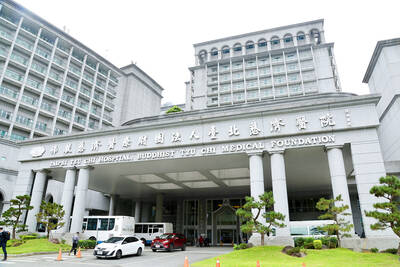
POLICE INVESTIGATING: A man said he quit his job as a nurse at Taipei Tzu Chi Hospital as he had been ‘disgusted’ by the behavior of his colleagues A man yesterday morning wrote online that he had witnessed nurses taking photographs and touching anesthetized patients inappropriately in Taipei Tzu Chi Hospital’s operating theaters. The man surnamed Huang (黃) wrote on the Professional Technology Temple bulletin board that during his six-month stint as a nurse at the hospital, he had seen nurses taking pictures of patients, including of their private parts, after they were anesthetized. Some nurses had also touched patients inappropriately and children were among those photographed, he said. Huang said this “disgusted” him “so much” that “he felt the need to reveal these unethical acts in the operating theater
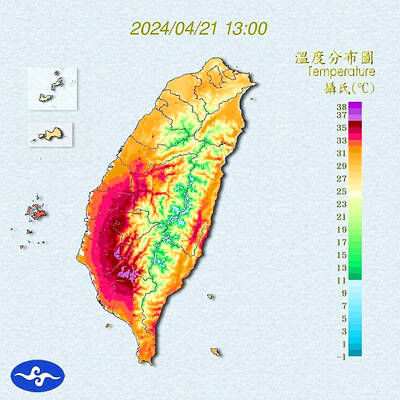
Heat advisories were in effect for nine administrative regions yesterday afternoon as warm southwesterly winds pushed temperatures above 38°C in parts of southern Taiwan, the Central Weather Administration (CWA) said. As of 3:30pm yesterday, Tainan’s Yujing District (玉井) had recorded the day’s highest temperature of 39.7°C, though the measurement will not be included in Taiwan’s official heat records since Yujing is an automatic rather than manually operated weather station, the CWA said. Highs recorded in other areas were 38.7°C in Kaohsiung’s Neimen District (內門), 38.2°C in Chiayi City and 38.1°C in Pingtung’s Sandimen Township (三地門), CWA data showed. The spell of scorching


 RSS
RSS