


Academics, farmers’ associations and several civic groups have launched a campaign to have the Wushantou Reservoir (烏山頭水庫) in Tainan County and its irrigation system added to UNESCO’s World Heritage list.
The reservoir was designed by Japanese civil engineer Hatta Yoichi and was completed in 1930 after 10 years of construction.
The dam has a capacity of 150 million cubic meters and can help irrigate 100,000 hectares of farmland through a network of irrigation channels with a total length of 16,000km in Chiayi and Tainan counties.
“The Chianan Plain [嘉南平原] is now the biggest rice production region in the country because of the Wushantou Reservoir,” said Hsu Kuang-hui (許光輝), a law professor at Taiwan Police College who proposed the campaign.
“Before the reservoir was built, there was only about 6,000 hectares of arable land in the region. Now there’s more than 100,000 hectares,” he said.
While most may not consider the reservoir an important structure, Hsu said it was important for Taiwanese
“Over the past 80 years since its completion, the Wushantou Reservoir has fed about four generations of Taiwanese,” he said. “It is likely that everyone who lives in Taiwan — including you and I — has eaten rice grown on the Chianan Plain with water from the Wushantou Reservoir.”
In fact, Hsu did not know about the significance of the reservoir until he saw how much local farmers appreciated Hatta’s contribution to the construction when he attended an annual gathering on May 8 — the day of Hatta’s death in 1942 — at the tomb of Hatta and his wife, Hatta Sotoyo, near the reservoir.
Hsu said he was more impressed when he learned the dam was constructed in an environment-friendly method using natural materials and designed for rotating farming that would extend the arable life of the earth.
“Can you think of another construction in Taiwan that is as remarkable as this reservoir? I can’t,” Hsu said.
However, since Taiwan is not a member of the UN and is therefore unable to submit the application, Hsu hoped Japan could do it.
“Of course the Japanese colonial government did many bad things to Taiwanese, but the reservoir is the sign of friendship between a Japanese civil engineer and Taiwanese farmers,” he said. “If the two countries work together to make it a World Heritage site, it would be a significant gesture of friendship between two countries and reconciliation for past mistakes.”
“I hope we could get 1 million people in each country to sign a petition to make the reservoir a World Heritage site. I know it’s very, very challenging, but we never know what will happen unless we try,” Hsu said.
National Taiwan University agronomy professor Warren Kuo (郭華倫), who is in charge of mobilizing support for the project, said the project had got off to a good start.
“Although we’ll officially launch the signature campaign in September, more than 100 farmers’ associations and civic groups across the country have already voiced support for the project and agreed to help,” Kuo said.
The petition can be downloaded at seed.agron.ntu.edu.tw/hatta.

Hong Kong singer Eason Chan’s (陳奕迅) concerts in Kaohsiung this weekend have been postponed after he was diagnosed with Covid-19 this morning, the organizer said today. Chan’s “FEAR and DREAMS” concert which was scheduled to be held in the coming three days at the Kaohsiung Arena would be rescheduled to May 29, 30 and 31, while the three shows scheduled over the next weekend, from May 23 to 25, would be held as usual, Universal Music said in a statement. Ticket holders can apply for a full refund or attend the postponed concerts with the same seating, the organizer said. Refund arrangements would

Former president Tsai Ing-wen (蔡英文) on Monday called for greater cooperation between Taiwan, Lithuania and the EU to counter threats to information security, including attacks on undersea cables and other critical infrastructure. In a speech at Vilnius University in the Lithuanian capital, Tsai highlighted recent incidents in which vital undersea cables — essential for cross-border data transmission — were severed in the Taiwan Strait and the Baltic Sea over the past year. Taiwanese authorities suspect Chinese sabotage in the incidents near Taiwan’s waters, while EU leaders have said Russia is the likely culprit behind similar breaches in the Baltic. “Taiwan and our European
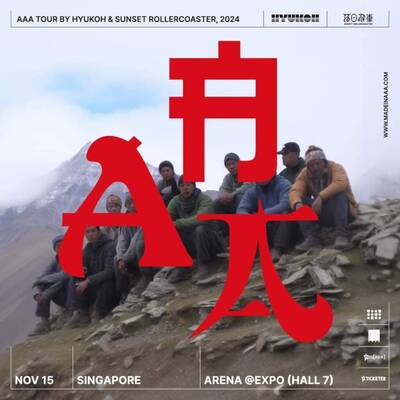
Taiwanese indie band Sunset Rollercoaster and South Korean outfit Hyukoh collectively received the most nominations at this year’s Golden Melody Awards, earning a total of seven nods from the jury on Wednesday. The bands collaborated on their 2024 album AAA, which received nominations for best band, best album producer, best album design and best vocal album recording. “Young Man,” a single from the album, earned nominations for song of the year and best music video, while another track, “Antenna,” also received a best music video nomination. Late Hong Kong-American singer Khalil Fong (方大同) was named the jury award winner for his 2024 album

Nvidia founder and CEO Jensen Huang (黃仁勳) hosted a dinner in Taipei last night with key Taiwanese suppliers to celebrate the successful mass production of the company’s new Blackwell AI systems. Speaking to the media earlier yesterday, Huang thanked Nvidia’s Taiwanese partners for their contributions to the company’s ecosystem, while also sharing his plans to meet with Taiwan Semiconductor Manufacturing Co (TSMC) founder Morris Chang (張忠謀). In response to rumors that Nvidia will launch a downgraded Hopper H20 chip for China in July, Huang dismissed the reports, saying, “That is not true.” He clarified that there


 RSS
RSS