


Premier Liu Chao-shiuan (劉兆玄) yesterday called on the agricultural sector to support a government plan to sign an economic cooperation framework agreement (ECFA) with China and counter opposition from the Democratic progressive Party (DPP).
Liu's remarks came in the wake of the DPP's proposal to launch a referendum on the proposed ECFA. The Chinese Nationalist Party (KMT) administration has rejected the idea.
“Once you have a better understanding of the content of the ECFA and its impact, I hope you can all support the policy,” Liu told 116 representatives of agricultural associations attending a forum organized by the Council of Agriculture.
Liu said the strong opposition from the DPP has led to some misunderstandings about the effects of an ECFA on the country.
The administration says that an ECFA with Beijing would boost the nation's competitiveness and prevent Taiwan from being marginalized after the ASEAN-China free trade bloc takes effect next year.
Liu assured the leaders that the government would maintain its “three nos” and “three yes” policies during negotiations with Beijing.
The “three nos” refer to President Ma Ying-jeou's (馬英九) promise of no unification, no independence and no use of force.
“[Signing an ECFA] will not compromise Taiwan's sovereignty. We will not open the country to Chinese workers, nor will we agree to more imports of [Chinese] agricultural products,” Liu said.
Taiwan opened its market to 1,417 Chinese agricultural products during the DPP administration after Taiwan and China joined the WTO in 2002, Liu said, adding that his administration would maintain the ban on another 830 agricultural products from China.
With regards to the “three yes,” Liu said the government would first seek public consensus on signing an ECFA, as well as adopt a gradual approach to opening the country's market to China and easing restrictions on China-bound investments.
Liu said the third yes would be to expand relations with other countries as signing an ECFA with China would help reduce barriers to Taiwan signing free-trade agreements with its trading partners.
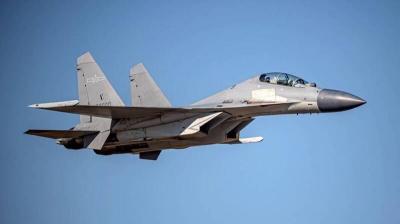
Eight Chinese naval vessels and 24 military aircraft were detected crossing the median line of the Taiwan Strait between 6am yesterday and 6am today, the Ministry of National Defense said this morning. The aircraft entered Taiwan’s northern, central, southwestern and eastern air defense identification zones, the ministry said. The armed forces responded with mission aircraft, naval vessels and shore-based missile systems to closely monitor the situation, it added. Eight naval vessels, one official ship and 36 aircraft sorties were spotted in total, the ministry said.
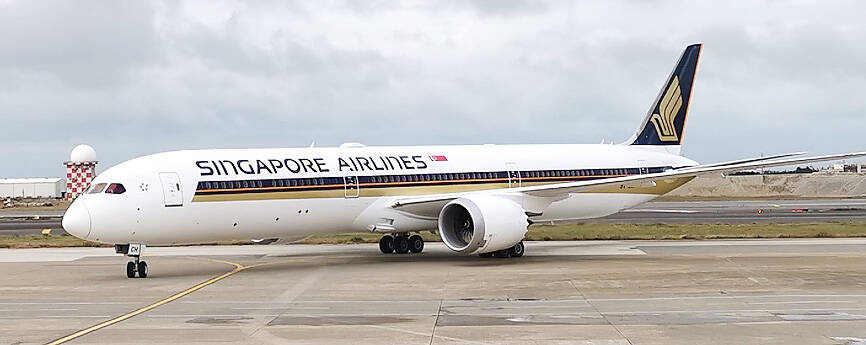
INCREASED CAPACITY: The flights on Mondays, Wednesdays, Fridays and Sundays would leave Singapore in the morning and Taipei in the afternoon Singapore Airlines is adding four supplementary flights to Taipei per week until May to meet increased tourist and business travel demand, the carrier said on Friday. The addition would raise the number of weekly flights it operates to Taipei to 18, Singapore Airlines Taiwan general manager Timothy Ouyang (歐陽漢源) said. The airline has recorded a steady rise in tourist and business travel to and from Taipei, and aims to provide more flexible travel arrangements for passengers, said Ouyang, who assumed the post in July last year. From now until Saturday next week, four additional flights would depart from Singapore on Monday, Wednesday, Friday
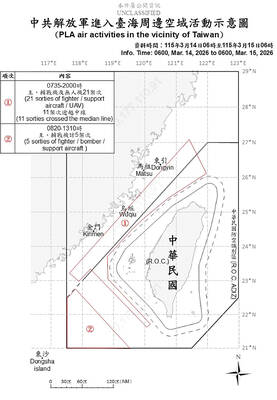
The Ministry of National Defense yesterday reported the return of large-scale Chinese air force activities after their unexplained absence for more than two weeks, which had prompted speculation regarding Beijing’s motives. China usually sends fighter jets, drones and other military aircraft around the nation on a daily basis. Interruptions to such routine are generally caused by bad weather. The Ministry of National Defense said it had detected 26 Chinese military aircraft in the Taiwan Strait over the previous 24 hours. It last reported that many aircraft on Feb. 25, when it spotted 30 aircraft, saying Beijing was carrying out another “joint combat
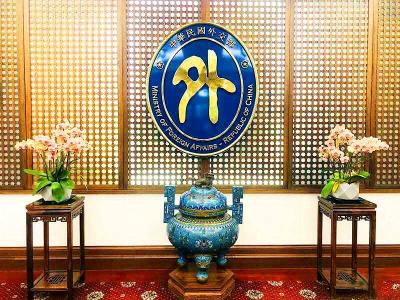
The Ministry of Foreign Affairs (MOFA) today said that if South Korea does not reply appropriately to its request to correct Taiwan’s name on its e-Arrival card system before March 31, it would take corresponding measures to alter how South Korea is labeled on the online Taiwan Arrival Card system. South Korea’s e-Arrival card system lists Taiwan as “China (Taiwan)” in the “point of departure” and “next destination” fields. The ministry said that it changed the nationality for South Koreans on Taiwan’s Alien Resident Certificates from “Korea” to “South Korea” on March 1, in a gesture of goodwill and based on the


 RSS
RSS