


Legislative Speaker Wang Jin-pyng (王金平) yesterday said he opposed holding extraordinary legislative sessions after the end of each regular session despite the failure to pass a number of bills on the Executive Yuan’s priority list.
Wang told reporters in the legislature that lawmakers should not convene extraordinary sessions to pass more bills unless they could find a legitimate reason.
“We should never allow ourselves to form a habit of holding extraordinary legislative sessions,” Wang said. “We should determine if the agenda is worth discussing and whether there is an urgent need to hold a extra session to deal with the agenda.”
Wang’s remarks followed proposals by Democratic Progressive Party (DPP) legislators to hold extraordinary sessions to allow lawmakers more time to pass bills.
The legislature’s spring session ended on Sunday, but Legislators agreed to extend the session by about two weeks to June 16 because the majority of bills on the Executive Yuan’s priority list had yet to clear the legislative floor as of Monday last week.
The 52 bills included three “green” bills on renewable energy, carbon dioxide emissions reduction and energy management.
Also on the list were a proposed amendment to the Organic Act of the Executive Yuan (行政院組織法) to downsize the Cabinet, an amendment to the Assembly and Parade Act (集會遊行法) that would require rally organizers to report their plans to police and proposals to allow Chinese students to enroll in local schools.
As of Monday last week, only 18 of the priority bills had been passed. Thirty-one were pending review, while three proposals had yet to be put to a preliminary review.
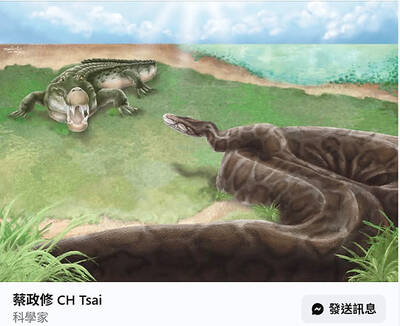
Taiwanese paleontologists have discovered fossil evidence that pythons up to 4m long inhabited Taiwan during the Pleistocene epoch, reporting their findings in the international scientific journal Historical Biology. National Taiwan University (NTU) Institute of Ecology and Evolutionary Biology associate professor Tsai Cheng-hsiu (蔡政修) led the team that discovered the largest snake fossil ever found in Taiwan. The single trunk vertebra was discovered in Tainan at the Chiting Formation, dated to between 400,000 and 800,000 years ago in the Middle Pleistocene, the paper said. The area also produced Taiwan’s first avian fossil, as well as crocodile, mammoth, saber-toothed cat and rhinoceros fossils, it said. Discoveries

Taiwanese paleontologists have discovered fossil evidence that pythons up to 4m long inhabited Taiwan during the Pleistocene epoch, reporting their findings in the international scientific journal Historical Biology. National Taiwan University (NTU) Institute of Ecology and Evolutionary Biology associate professor Tsai Cheng-hsiu (蔡政修) led the team that discovered the largest snake fossil ever found in Taiwan. A single trunk vertebra was discovered in Tainan at the Chiting Formation, dated to between 800,000 to 400,000 years ago in the Middle Pleistocene, the paper said. The area also produced Taiwan’s first avian fossil, as well as crocodile, mammoth, sabre-toothed cat and rhinoceros fossils, it said. Discoveries
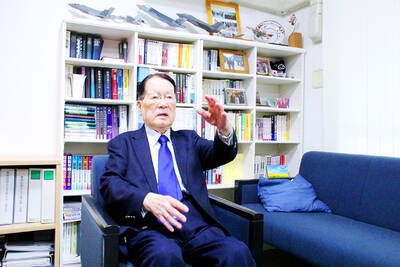
Whether Japan would help defend Taiwan in case of a cross-strait conflict would depend on the US and the extent to which Japan would be allowed to act under the US-Japan Security Treaty, former Japanese minister of defense Satoshi Morimoto said. As China has not given up on the idea of invading Taiwan by force, to what extent Japan could support US military action would hinge on Washington’s intention and its negotiation with Tokyo, Morimoto said in an interview with the Liberty Times (sister paper of the Taipei Times) yesterday. There has to be sufficient mutual recognition of how Japan could provide
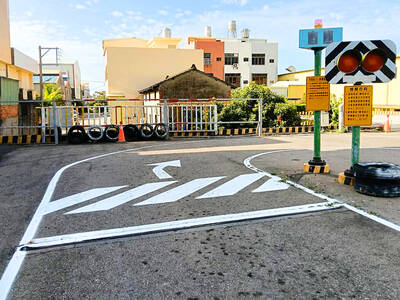
UPDATED TEST: The new rules aim to assess drivers’ awareness of risky behaviors and how they respond under certain circumstances, the Highway Bureau said Driver’s license applicants who fail to yield to pedestrians at intersections or to check blind spots, or omit pointing-and-calling procedures would fail the driving test, the Highway Bureau said yesterday. The change is set to be implemented at the end of the month, and is part of the bureau’s reform of the driving portion of the test, which has been criticized for failing to assess whether drivers can operate vehicles safely. Sedan drivers would be tested regarding yielding to pedestrians and turning their heads to check blind spots, while drivers of large vehicles would be tested on their familiarity with pointing-and-calling


 RSS
RSS