


Cars lined up for about 20km near the southbound lanes of Hsuehshan Tunnel yesterday as the nation entered the second day of the four-day Dragon Boat Festival holiday.
The Taiwan Area National Freeway Bureau said that traffic started to form inside the Hsuehshan Tunnel at about 7:30am, which in turn slowed down traffic outside the tunnel.
From the monitors of the Pinglin Traffic Control Center, cars could be seen lined up all the way from the entrance of the Hsuehshan Tunnel to the Muzha Interchange (木柵) on Freeway No. 3.
The bureau said traffic on other freeways also gradually appeared at around 9am. By noon, slow traffic was reported on the southbound lanes between Taoyuan and Jhongli (中壢) on Freeway No. 1, between Tucheng (土城) and Dasi (大溪) on Freeway No. 3 as well as northbound lanes from Kuaiguang (快官) and Wufeng (霧峰) on Freeway No. 3. On average, the average driving speed was between 30kph and 50kph.
Traffic reemerged on the northbound lanes of Hsuehshan Tunnel, as well as those on the Freeway No. 6 at around 4pm, forming 2km and 5km-long lines on both freeways respectively, the bureau said.
The bureau said some motorists might decide to head home early this afternoon and that traffic may again appear on the northbound lanes of the Hsuehshan Tunnel between 3pm and 8pm.
It advised motorists who don't want to be stuck in traffic to leave early or take Provincial highways No. 2 or No. 9.
Statistics from the bureau showed that the traffic volume on all the national freeways topped 2.17 million vehicles, which was about 1.25 times the average traffic volume on weekends.
To ease traffic on the freeway tomorrow, the bureau will again implement toll-free hours from 12am to 7am.
With the sunny weather encouraging many to travel during the four-day holiday break, several well-known scenic spots, including Sun Moon Lake and Alishan, were crowdeds.
A four-year-old boy was injured by falling rocks while traveling with his parents at the Taroko Gorge National Park yesterday morning. A Central News Agency report quoted a hospital staffer at the Hualien Tzu Chi Hospital as saying that the boy suffered a deep cut in the head but that it did not cause cerebral hemorrhage. The boy was asked to stay in the hospital for further observation.
The park has reported two injuries caused by falling rocks this year. Last month, two Chinese tourists were hit by falling rocks while traveling in Jiucyudong (九曲洞).

LOUD AND PROUD Taiwan might have taken a drubbing against Australia and Japan, but you might not know it from the enthusiasm and numbers of the fans Taiwan might not be expected to win the World Baseball Classic (WBC) but their fans are making their presence felt in Tokyo, with tens of thousands decked out in the team’s blue, blowing horns and singing songs. Taiwanese fans have packed out the Tokyo Dome for all three of their games so far and even threatened to drown out home team supporters when their team played Japan on Friday. They blew trumpets, chanted for their favorite players and had their own cheerleading squad who dance on a stage during the game. The team struggled to match that exuberance on the field, with
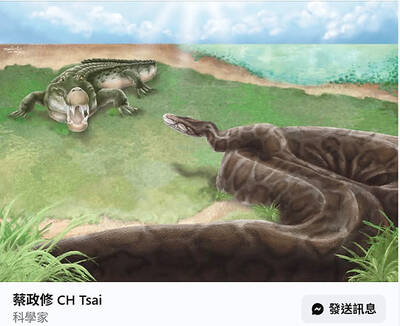
Taiwanese paleontologists have discovered fossil evidence that pythons up to 4m long inhabited Taiwan during the Pleistocene epoch, reporting their findings in the international scientific journal Historical Biology. National Taiwan University (NTU) Institute of Ecology and Evolutionary Biology associate professor Tsai Cheng-hsiu (蔡政修) led the team that discovered the largest snake fossil ever found in Taiwan. The single trunk vertebra was discovered in Tainan at the Chiting Formation, dated to between 400,000 and 800,000 years ago in the Middle Pleistocene, the paper said. The area also produced Taiwan’s first avian fossil, as well as crocodile, mammoth, saber-toothed cat and rhinoceros fossils, it said. Discoveries

Taiwanese paleontologists have discovered fossil evidence that pythons up to 4m long inhabited Taiwan during the Pleistocene epoch, reporting their findings in the international scientific journal Historical Biology. National Taiwan University (NTU) Institute of Ecology and Evolutionary Biology associate professor Tsai Cheng-hsiu (蔡政修) led the team that discovered the largest snake fossil ever found in Taiwan. A single trunk vertebra was discovered in Tainan at the Chiting Formation, dated to between 800,000 to 400,000 years ago in the Middle Pleistocene, the paper said. The area also produced Taiwan’s first avian fossil, as well as crocodile, mammoth, sabre-toothed cat and rhinoceros fossils, it said. Discoveries

Whether Japan would help defend Taiwan in case of a cross-strait conflict would depend on the US and the extent to which Japan would be allowed to act under the US-Japan Security Treaty, former Japanese minister of defense Satoshi Morimoto said. As China has not given up on the idea of invading Taiwan by force, to what extent Japan could support US military action would hinge on Washington’s intention and its negotiation with Tokyo, Morimoto said in an interview with the Liberty Times (sister paper of the Taipei Times) yesterday. There has to be sufficient mutual recognition of how Japan could provide


 RSS
RSS