


With President Ma Ying-jeou (馬英九) out of the country and Vice President Vincent Siew (蕭萬長) seriously ill, some analysts say there is a constitutional crisis in the making. And while others were less alarmed, all urged the legislature to clarify the law that selects a new vice president.
Ma began a 10-day visit to Central America on Tuesday to attend the inauguration of El Salvadoran president-elect Mauricio Funes. He is not due back until June 4. With many top officials accompanying the president, the Presidential Office is like a “ghost town.”
Siew, meanwhile, is recuperating from surgery for lung cancer. The Presidential Office said that he would remain hospitalized for one to two weeks.
This has caused some, such as National Central University associate professor of law Chen In-chin (陳英鈐), to talk of a constitutional meltdown.
Chen said there could be real trouble if someone wanted to cause havoc while the president was abroad. Although the Constitution stipulates that the vice president is the person next in line for the presidency, the problem now is whether Siew is fit for the job.
“It will be a big problem if the vice president cannot perform his duties,” he said.
In the worst-case scenario — with Ma and the vice president incapacitated — the premier is next in line, but the Constitution stipulates that a new election must be held within three months, Chen said.
Judging from cross-strait relations and the international situation, Chen said he wondered how appropriate it would be for the premier, who is not popularly elected, to govern the country and set national policies.
Even if the worst-case scenario occurred, with the death of the vice president, Chen said there was no law in place for the legislature to elect a new vice president despite the fact that it had constitutional authority.
It remained to be seen how Siew’s health would affect his ability to do the job, Chen said, but he urged the ruling and opposition parties to take the matter seriously, “because one should always prepare for the worst.”
Lin Cheng-yi (林正義), a researcher at the Institute of European and American Studies at Academia Sinica, agreed.
He said it was necessary to amend the Act Governing the Legislature’s Power (立法院職權行使法) so lawmakers could elect a new vice president. He said it was equally important to revise the Constitution so more candidates could be lined up to take over the presidency and ensure the smooth operation of government.
Lin said he believed the mechanisms in place would be able to respond to the worst-case scenario. He also said that the premier might play a more significant role as Siew is likely to reduce his workload because of his health.
Yosoh Kure (吳煜宗), a law professor at Shih Hsin University, said he did not think it was that big a deal for the president to be out of country and the vice president sick, because the Constitution clearly stipulates the line of succession. It would cause trouble, however, if the premier could not take over the job from the vice president, he said, because the Constitution does not state who should take over if the premier is incapacitated.
Kure said Ma should not have traveled abroad if the domestic situation was bad, but apparently his assessment did not come to that conclusion.
Huang Chii-chen (黃啟禎), a law professor at Tunghai University, agreed with Kure that there was nothing to worry about because the Constitution clearly designated the line of succession.
It would be a different story, however, if accidents occurred involving the president, vice president and premier at the same time.
“The president and vice president would be safer if they were apart,” he said. “Now they are half a world apart, I think they are pretty safe.”
Huang, however, urged the legislature to amend the Act Governing the Legislature’s Power so lawmakers could exercise their constitutional power to elect a new vice president.
“Legislation is an act of political will,” Huang said. “If the administration wants it, legislation is just a technical problem for the Chinese Nationalist Party [KMT], which enjoys a legislative majority.”
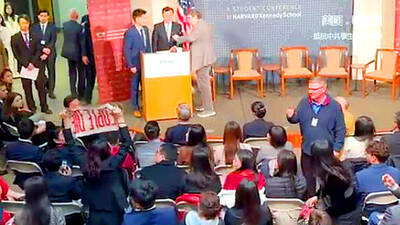
A group of Taiwanese-American and Tibetan-American students at Harvard University on Saturday disrupted Chinese Ambassador to the US Xie Feng’s (謝鋒) speech at the school, accusing him of being responsible for numerous human rights violations. Four students — two Taiwanese Americans and two from Tibet — held up banners inside a conference hall where Xie was delivering a speech at the opening ceremony of the Harvard Kennedy School China Conference 2024. In a video clip provided by the Coalition of Students Resisting the CCP (Chinese Communist Party), Taiwanese-American Cosette Wu (吳亭樺) and Tibetan-American Tsering Yangchen are seen holding banners that together read:

UNAWARE: Many people sit for long hours every day and eat unhealthy foods, putting them at greater risk of developing one of the ‘three highs,’ an expert said More than 30 percent of adults aged 40 or older who underwent a government-funded health exam were unaware they had at least one of the “three highs” — high blood pressure, high blood lipids or high blood sugar, the Health Promotion Administration (HPA) said yesterday. Among adults aged 40 or older who said they did not have any of the “three highs” before taking the health exam, more than 30 percent were found to have at least one of them, Adult Preventive Health Examination Service data from 2022 showed. People with long-term medical conditions such as hypertension or diabetes usually do not
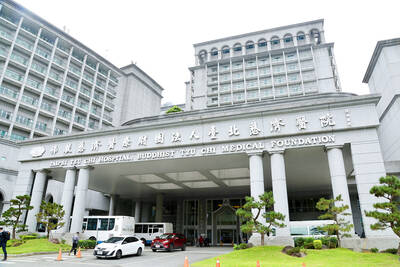
POLICE INVESTIGATING: A man said he quit his job as a nurse at Taipei Tzu Chi Hospital as he had been ‘disgusted’ by the behavior of his colleagues A man yesterday morning wrote online that he had witnessed nurses taking photographs and touching anesthetized patients inappropriately in Taipei Tzu Chi Hospital’s operating theaters. The man surnamed Huang (黃) wrote on the Professional Technology Temple bulletin board that during his six-month stint as a nurse at the hospital, he had seen nurses taking pictures of patients, including of their private parts, after they were anesthetized. Some nurses had also touched patients inappropriately and children were among those photographed, he said. Huang said this “disgusted” him “so much” that “he felt the need to reveal these unethical acts in the operating theater
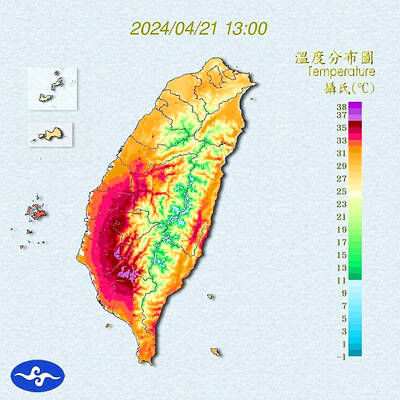
Heat advisories were in effect for nine administrative regions yesterday afternoon as warm southwesterly winds pushed temperatures above 38°C in parts of southern Taiwan, the Central Weather Administration (CWA) said. As of 3:30pm yesterday, Tainan’s Yujing District (玉井) had recorded the day’s highest temperature of 39.7°C, though the measurement will not be included in Taiwan’s official heat records since Yujing is an automatic rather than manually operated weather station, the CWA said. Highs recorded in other areas were 38.7°C in Kaohsiung’s Neimen District (內門), 38.2°C in Chiayi City and 38.1°C in Pingtung’s Sandimen Township (三地門), CWA data showed. The spell of scorching


 RSS
RSS