


Dozens of sex workers and their supporters demonstrated outside the Ministry of the Interior (MOI) yesterday, urging it to declare its stance on the decriminalization of the sex industry.
A citizens’ conference organized by the Executive Yuan in November recommended that the sex industry be decriminalized and that penalties for both sex workers and their customers be lifted.
Although President Ma Ying-jeou (馬英九) promised during the presidential campaign that the legalization of the sex industry would be based on the conclusion of the conference, the MOI did not declare its stance on the issue, saying that more discussion was needed.
“So another forum was held by the MOI itself in January, and most of the participants also supported legalizing the sex industry,” Collective of Sex Workers and Supporters director Chien Chia-ying (簡嘉瑩) said. “Yet the MOI still said that it needed more time to look into it.”
“We repeatedly asked the MOI whether they had reached any conclusions during the past four months, but the answer has always been ‘we’re looking into it.’ when will we ever see the final outcome?” Chien asked.
As the government continues to “look into the issue,” prostitutes continue to get arrested.
“In the 17 years after the sex industry was completely outlawed, more than 70,000 sex workers have been arrested and the total amount of fines they have paid adds up to between NT$70 million and NT$100 million,” she said. “This is the hard-earned money of people who live in poverty.”
A sex worker in her 40s who wished to be known only as Miko said that, unable to find a job, prostitution was the only thing she could do to raise her children.
“I was treated just like any other worker when I worked as a sex worker in countries where prostitution was legal — it’s ironic that I am treated as a criminal in my own country,” Miko said. “I’m not a criminal — I don’t rob, I don’t steal, I work hard to make a living and it’s the government that’s making me suffer.”
After protesters shouted for about 30 minutes, MOI Social Affairs Department specialist Chiang Kuo-jen (江國仁) came out to meet them.
“We already have a conclusion, but I can’t give it to you now because it still needs approval from the minister. But we will submit it to the Cabinet as a recommendation soon,” Chiang told the demonstrators.
However, Chiang’s response drew more protests from the demonstrators, who dismissed it as just another excuse to postpone the decision.
After verbal disputes, Chiang finally promised that the MOI would announce its decision on May 18.
“If we still don’t get a positive response by that day, we will come back and we may force our way into [the MOI],” Chien said.
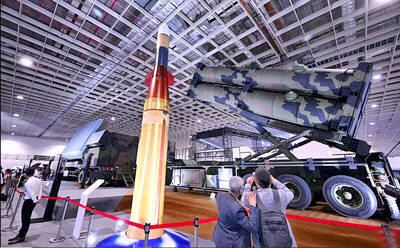
Taiwan is to commence mass production of the Tien Kung (天弓, “Sky Bow”) III, IV and V missiles by the second quarter of this year if the legislature approves the government’s NT$1.25 trillion (US$39.78 billion) special defense budget, an official said yesterday. Commenting on condition of anonymity, a defense official with knowledge of the matter said that the advanced systems are expected to provide crucial capabilities against ballistic and cruise missiles for the proposed “T-Dome,” an advanced, multi-layered air defense network. The Tien Kung III is an air defense missile with a maximum interception altitude of 35km. The Tien Kung IV and V
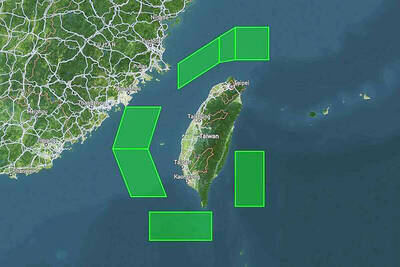
The disruption of 941 flights in and out of Taiwan due to China’s large-scale military exercises was no accident, but rather the result of a “quasi-blockade” used to simulate creating the air and sea routes needed for an amphibious landing, a military expert said. The disruptions occurred on Tuesday and lasted about 10 hours as China conducted live-fire drills in the Taiwan Strait. The Civil Aviation Administration (CAA) said the exercises affected 857 international flights and 84 domestic flights, affecting more than 100,000 travelers. Su Tzu-yun (蘇紫雲), a research fellow at the government-sponsored Institute for National Defense and Security Research, said the air
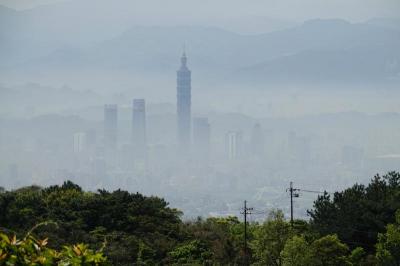
A strong continental cold air mass is to bring pollutants to Taiwan from tomorrow, the Ministry of Environment said today, as it issued an “orange” air quality alert for most of the country. All of Taiwan except for Hualien and Taitung counties is to be under an “orange” air quality alert tomorrow, indicating air quality that is unhealthy for sensitive groups. In China, areas from Shandong to Shanghai have been enveloped in haze since Saturday, the ministry said in a news release. Yesterday, hourly concentrations of PM2.5 in these areas ranged from 65 to 160 micrograms per cubic meter (mg/m³), and pollutants were
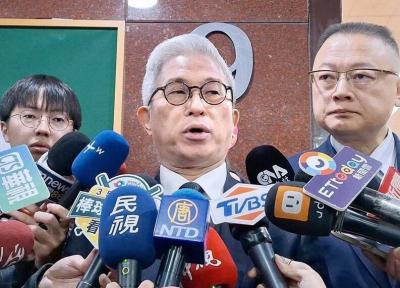
Taiwan’s armed forces have established response protocols for a wide range of sudden contingencies, including the “Wan Chun Plan” to protect the head of state, the Ministry of Defense (MND) said today. After US President Donald Trump on Saturday launched a series of airstrikes in Venezuela and kidnapped Venezuelan President Nicolas Maduro, concerns have been raised as to whether China would launch a similar “decapitation strike” on Taiwan. The armed forces regularly coordinate with relevant agencies and practice drills to ensure preparedness for a wide range of scenarios, Vice Minister of National Defense Hsu Szu-chien (徐斯儉) told reporters before a


 RSS
RSS