


Minister of Foreign Affairs Francisco Ou (歐鴻鍊) yesterday said that Japanese Representative to Taiwan Masaki Saito's behavior was not fitting of a diplomat, joining a growing chorus of criticism over the envoy's remark about Taiwan's “unresolved” status.
Speaking at a luncheon in Taipei, Ou said because Saito is a government representative, he could not claim he was only expressing his personal views.
“As a career diplomat, I thought his speech and conduct were inappropriate for a public servant. As a representative of a government, he has no room to make any personal statements. Everything he says represents his government. We believe he will deal with the mistakes he has committed,” Ou said.
Saito has been the subject of scorn of Beijing and the Taiwanese government since he told an academic forum in Chiayi County on Friday that Taiwan's status had “not been determined.”
Saito's comments, however, have won plaudits from independence activists who support his view.
Yesterday's luncheon, in which Ou was the only invited speaker on the subject of flexible diplomacy, was jointly held by the Ministry of Foreign Affairs and Global Views monthly magazine.
Ou said one of the tenets of President Ma Ying-jeou's (馬英九) flexible diplomacy was to engage in a diplomatic truce with Beijing.
The truce, he said, benefits Taiwan, China and the international community.
During the six-decade-long period of cross-strait hostilities, he said, both Taiwan and China engaged in nasty tug-of-wars to lure away each other's allies, which produced negative results for Taipei, Beijing and the international community.
“Although China successfully blocked Taiwan's international participation, it also ignited anti-China sentiment among the Taiwanese public,” he said.
“Taiwan's struggle for independence never came to fruition during the eight years of Democratic Progressive Party rule. Taiwan lost nine allies but only gained three,” he said.
“Mutual trust with non-ally countries, such as the US, Japan and European nations, also deteriorated,” he said.
Ou said the US “appreciated” Ma's decision to maintain a low profile when he transited through the US on his way to and back from Latin America in August.
“Foreign relations must be constantly cultivated by our representatives and ambassadors. It is not something a transit stop by a high-ranking official can do,” he said.
He added that the Ma administration would not engage in “transit diplomacy,” “vacation diplomacy,” or “mystery destination diplomacy,” referring to 2006 when former president Chen Shui-bian (陳水扁) deviated from his publicized itinerary by making stops at several non-ally nations on a visit to Paraguay.
Ou assured the audience that despite the current detente on the diplomatic front, Taiwan retains its diplomatic muscle and would be ready to compete against China if Beijing ever pulls out of the truce.
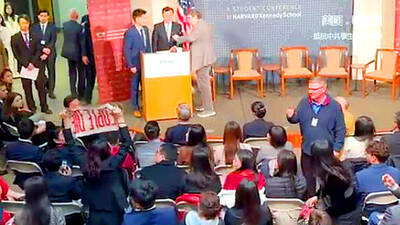
A group of Taiwanese-American and Tibetan-American students at Harvard University on Saturday disrupted Chinese Ambassador to the US Xie Feng’s (謝鋒) speech at the school, accusing him of being responsible for numerous human rights violations. Four students — two Taiwanese Americans and two from Tibet — held up banners inside a conference hall where Xie was delivering a speech at the opening ceremony of the Harvard Kennedy School China Conference 2024. In a video clip provided by the Coalition of Students Resisting the CCP (Chinese Communist Party), Taiwanese-American Cosette Wu (吳亭樺) and Tibetan-American Tsering Yangchen are seen holding banners that together read:

UNAWARE: Many people sit for long hours every day and eat unhealthy foods, putting them at greater risk of developing one of the ‘three highs,’ an expert said More than 30 percent of adults aged 40 or older who underwent a government-funded health exam were unaware they had at least one of the “three highs” — high blood pressure, high blood lipids or high blood sugar, the Health Promotion Administration (HPA) said yesterday. Among adults aged 40 or older who said they did not have any of the “three highs” before taking the health exam, more than 30 percent were found to have at least one of them, Adult Preventive Health Examination Service data from 2022 showed. People with long-term medical conditions such as hypertension or diabetes usually do not
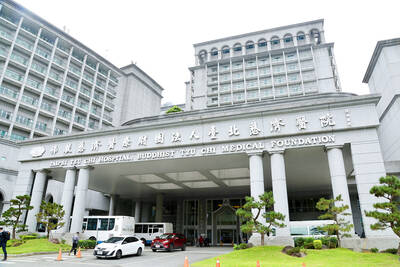
POLICE INVESTIGATING: A man said he quit his job as a nurse at Taipei Tzu Chi Hospital as he had been ‘disgusted’ by the behavior of his colleagues A man yesterday morning wrote online that he had witnessed nurses taking photographs and touching anesthetized patients inappropriately in Taipei Tzu Chi Hospital’s operating theaters. The man surnamed Huang (黃) wrote on the Professional Technology Temple bulletin board that during his six-month stint as a nurse at the hospital, he had seen nurses taking pictures of patients, including of their private parts, after they were anesthetized. Some nurses had also touched patients inappropriately and children were among those photographed, he said. Huang said this “disgusted” him “so much” that “he felt the need to reveal these unethical acts in the operating theater
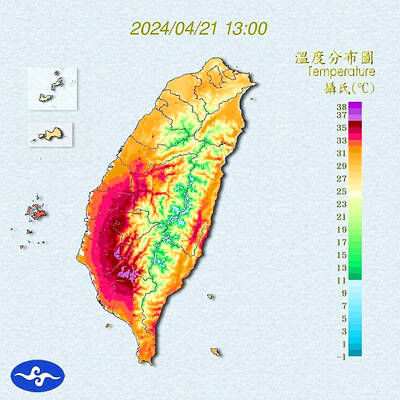
Heat advisories were in effect for nine administrative regions yesterday afternoon as warm southwesterly winds pushed temperatures above 38°C in parts of southern Taiwan, the Central Weather Administration (CWA) said. As of 3:30pm yesterday, Tainan’s Yujing District (玉井) had recorded the day’s highest temperature of 39.7°C, though the measurement will not be included in Taiwan’s official heat records since Yujing is an automatic rather than manually operated weather station, the CWA said. Highs recorded in other areas were 38.7°C in Kaohsiung’s Neimen District (內門), 38.2°C in Chiayi City and 38.1°C in Pingtung’s Sandimen Township (三地門), CWA data showed. The spell of scorching


 RSS
RSS