

Here are some numbers to crunch: Ministry of the Interior (MOI) data show that the population of Taiwan is just above 23 million people, with 190,000 births and 140,000 deaths a year.
About 10 percent of the population — (2.3 million people) — is 65 years old or older. In 10 years, that number will increase to 22 percent — 5.6 million people.
In 2000, there were 40.9 people aged 65 and above for every 100 people aged under 15. In 2005, the number increased to 52.1, and last year, it was 61.5.
The graying of the country’s population has increased the demand for long-term care and nursing institutions for the elderly, a recent MOI report said.
To cope with the rapidly aging population, the Executive Yuan has commissioned the Council of Economic Planning and Development and related agencies to draw up a plan for a long-term care insurance system that would be set up by 2011.
Department of Health Minister Yeh Ching-chuan (葉金川) has said that the system would be implemented by the Bureau of National Health Insurance. The benefits to insured citizens would mainly be the provision and insured coverage of services such as home, community and institutionalized care. In addition, cash payouts would be made to insured persons with some type of disability based on their degree of disability, he said.
Although the concept originated from concern for the elderly, critics doubt whether cash payouts will solve the problem of an increasing number of senior citizens or people with chronic diseases needing long-term care.
Wang Yu-ling (王幼玲), secretary-general of the League of Welfare Organizations for the Disabled, criticized reimbursements for the costs of hiring foreign caregivers.
She said that using cash payouts for those needing long-term care and listing it as one of the items for the long-term care coverage plan was like “using petty cash to dismiss disabled people’s problems.”
“The [government] thrusts the responsibility of ensuring the quality of caregivers on the family,” she said. “Those needing long-term care are unprotected against the risks of foreign caregivers not being able to perform their jobs well.”
“As employers, the families are burdened with the responsibility of caregivers’ working conditions and occupational safety,” she said.
Unequal pay has not only caused dissenting voices in the issue of long-term care insurance, but in all areas of labor, including manufacturing and construction. Some labor associations have urged government officials to cut the number of foreign workers allowed into the country to reserve jobs for domestic workers.
Lorna Kung (龔尤倩), executive director of the Scalabrini International Migration Network in Taiwan, said the problem stemmed from pay differential between foreign and domestic caregivers.
Government officials said insurance payouts for people hiring foreign caregivers may be less than the payout given to those who hire domestic caregivers. The reasoning behind the difference in salaries is to protect the jobs of domestic workers.
Kung said, however, that she believed in the concept of “equal work, equal pay” because “as long as unequal pay exists between different groups, there will exist prejudice and a divide between different groups.”
Because families may receive more cash if they hire a domestic caregiver instead of a foreign one, many people currently employing foreign caregivers may want to make the switch to hiring domestic workers once the plan is introduced. However, the transition should be facilitated by the government instead of having individual families pay the transition fees, she said.
Even if the problem of who pays the transition fees were solved, would there be enough qualified domestic workers to meet increasing demand?
The Council of Labor Affairs (CLA) recently reported that as of this year, Taiwan had 44,346 people trained as caregivers. More than 4,100 are employed at government institutions and with civil groups that offer home care services, and 9,926 are employed at homes for the elderly, it said.
To ensure an adequate number of caregivers in the proposed long-term care system, the council has budgeted NT$173 million (US$5.1 million) to train another 32,000 caregivers from last year to 2011, the CLA report said.
Tseng Min-chieh (曾敏傑), vice president of the Taiwan Foundation for Rare Disorders and an associate professor at National Taipei University’s Department of Social Work, is concerned that the training may not go as smoothly as officials expect.
About a decade ago, Taiwan was faced with widespread unemployment among blue-collar workers because many businesses shifted their production to countries with cheaper labor such as China, Tseng said. Back then, the government had also planned to train the unemployed to help them become caregivers.
However, training unemployed blue-collar workers was not as easy as government officials hoped. Many workers had a hard time adjusting to their new jobs after working in factories or construction sites for half a lifetime.
“Now, with so many white-collar workers thrown out of work, it may be even harder for them to adjust to a new job as a caregiver,” he said.
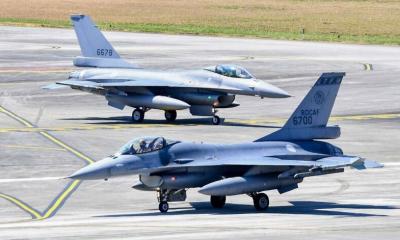
The first two F-16V Block 70 jets Taiwan purchased from the US were spotted unexpectedly turning back after departing from Hawaii yesterday, potentially further delaying delivery of the aircraft. Taiwan has purchased 66 of the F-16 C/D Block 70 jets to be deployed at Chihhang Air Base (志航基地) in Taitung County and operated by the air force's 7th Tactical Fighter Wing to defend Taiwan’s eastern region. Two single-seat jets, bearing serial No. 6727 and 6728, were spotted taking off from Hickam Field in Hawaii yesterday, observers said. Based on the precedent set during the delivery of Taiwan's older F-16 Block 20s, the new

Taiwan’s growing defense preparations might be sending a stronger signal to the US than to Beijing, highlighting the need for Taipei to tailor its deterrence efforts to different audiences, a US security academic said yesterday. Stanford University Freeman Spogli Institute for International Studies fellow Oriana Skylar Mastro made the comment during a Taipei Security Dialogue panel examining lessons Taiwan could draw from the wars in Ukraine and the Middle East. Mastro said she was impressed by Taiwan’s increased defense spending, emphasis on asymmetric capabilities and efforts to prepare society for conflict, but questioned whom those initiatives were influencing. She said when she asked
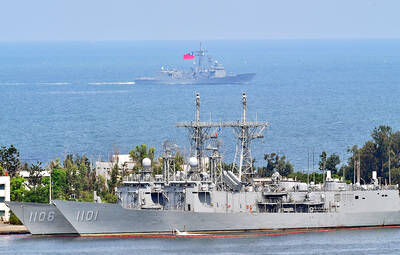
SIZE MATTERS: Large ships are politically attractive as visible symbols of national defense, but small surface combatants are more likely to survive an initial strike Taiwan needs to restructure its naval fleet from focusing on large warships, which are “sitting ducks” for China’s advanced tracking technology, to smaller, stealthy corvettes that are harder to detect but retain sufficient firepower to deter a Chinese invasion, a Taiwanese academic and a former US military commander said in an article published on Friday in the journal Foreign Affairs. Taiwan does not need a fleet capable of competing with the Chinese navy for traditional control of the Taiwan Strait, but rather “sea denial” capabilities that would prevent China from freely using the waterway, Taiwanese aerospace and security expert Holmes Liao
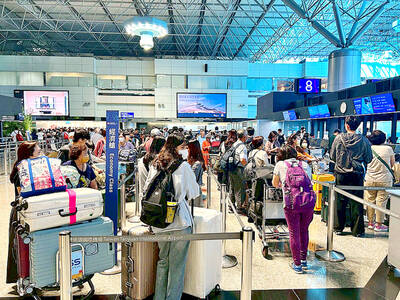
EVA Airways Corp is to raise excess baggage fees and revise other international baggage charges beginning on Sept. 29, citing higher fuel prices and rising global operating costs amid economic and geopolitical pressures. The changes would apply to international flights with travel dates on or after Sept. 29, the Taiwanese carrier said in a statement on its Web site. The revised baggage policy covers excess baggage, prepaid excess baggage, overweight and oversized baggage fees. It also covers updated pricing rules, and fees for transporting pets and sports equipment. Under the new rates, excess baggage fees would increase by between US$20 and US$90 per


 RSS
RSS