


The Democratic Progressive Party (DPP) caucus said yesterday it was ready to go head-to-head with the Chinese Nationalist Party (KMT) caucus and would make every effort to block several bills lined up for this week’s legislative agenda.
A proposed amendment to the Act Governing the Relations between Peoples of the Taiwan Area and the Mainland Area (兩岸人民關係條例) is scheduled for review in today’s Internal Administration Committee meeting, as well as a proposed amendment to the University Act (大學法), which will be reviewed at the Education and Culture Committee meeting.
If the proposals pass, universities in Taiwan could begin recruiting graduate students from China.
Voicing the caucus’ opposition to allowing Chinese students to study in Taiwan, DPP caucus whip Ker Chien-ming (柯建銘) said it was obvious the KMT caucus scheduled the review of the two bills at the same time to restrict DPP legislators from voicing their opinions.
Ker said he had instructed all DPP legislators in the two meetings to make their stance known.
A controversial amendment to the Assembly and Parade Act (集會遊行法) is scheduled for tomorrow’s legislative plenary session.
The DPP described the proposal as a prelude to martial law, saying that it would hand full power over protests to an authoritarian government.
The amendment proposed by the Cabinet requires protest organizers to notify police of a protest’s time, location and parade route five days in advance and stipulates that violators could be fined up to NT$50,000 (US$1,500). Police would have the right to ban a rally or change its route if they believed it would jeopardize national security, social order or the public interest, the proposed amendment said. The amendment would also give police the right to break up any rally that blocked traffic.
Meanwhile, Straits Exchange Foundation Chairman Chiang Pin-kung (江丙坤) and Mainland Affairs Council Chairwoman Lai Shin-yuan (賴幸媛) will brief the legislature’s Internal Administration Committee on the third round of cross-strait talks on Wednesday and Thursday.
The administration of President Ma Ying-jeou (馬英九) has said there is no need for National Security Council Secretary-General Su Chi (蘇起) to attend the meetings because Su is an aide, not a decision-maker.
Ker said that the DPP caucus had asked Su to brief the legislature on Wednesday and Thursday and that if Su failed to appear on the floor, he and the government would be in contempt of the Constitution.
“Chiang skipped a briefing to the legislature before he went to China for the cross-strait talks [late last month] and after the talks Su is refusing to present the government’s stance on cross-strait polices,” Ker said. “The government has totally neglected the legislature’s power to monitor significant cross-strait policies.”
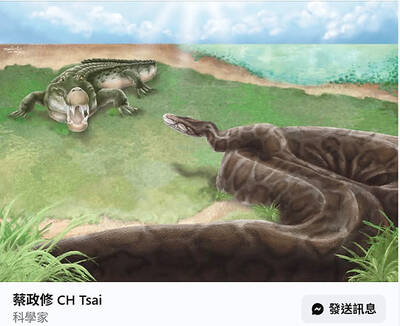
Taiwanese paleontologists have discovered fossil evidence that pythons up to 4m long inhabited Taiwan during the Pleistocene epoch, reporting their findings in the international scientific journal Historical Biology. National Taiwan University (NTU) Institute of Ecology and Evolutionary Biology associate professor Tsai Cheng-hsiu (蔡政修) led the team that discovered the largest snake fossil ever found in Taiwan. The single trunk vertebra was discovered in Tainan at the Chiting Formation, dated to between 400,000 and 800,000 years ago in the Middle Pleistocene, the paper said. The area also produced Taiwan’s first avian fossil, as well as crocodile, mammoth, saber-toothed cat and rhinoceros fossils, it said. Discoveries

Taiwanese paleontologists have discovered fossil evidence that pythons up to 4m long inhabited Taiwan during the Pleistocene epoch, reporting their findings in the international scientific journal Historical Biology. National Taiwan University (NTU) Institute of Ecology and Evolutionary Biology associate professor Tsai Cheng-hsiu (蔡政修) led the team that discovered the largest snake fossil ever found in Taiwan. A single trunk vertebra was discovered in Tainan at the Chiting Formation, dated to between 800,000 to 400,000 years ago in the Middle Pleistocene, the paper said. The area also produced Taiwan’s first avian fossil, as well as crocodile, mammoth, sabre-toothed cat and rhinoceros fossils, it said. Discoveries
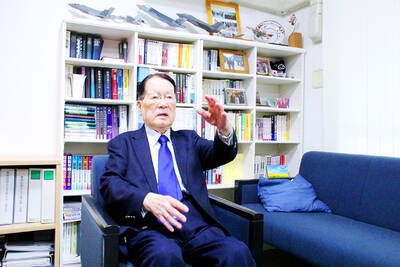
Whether Japan would help defend Taiwan in case of a cross-strait conflict would depend on the US and the extent to which Japan would be allowed to act under the US-Japan Security Treaty, former Japanese minister of defense Satoshi Morimoto said. As China has not given up on the idea of invading Taiwan by force, to what extent Japan could support US military action would hinge on Washington’s intention and its negotiation with Tokyo, Morimoto said in an interview with the Liberty Times (sister paper of the Taipei Times) yesterday. There has to be sufficient mutual recognition of how Japan could provide
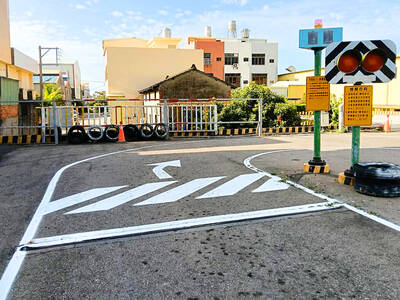
UPDATED TEST: The new rules aim to assess drivers’ awareness of risky behaviors and how they respond under certain circumstances, the Highway Bureau said Driver’s license applicants who fail to yield to pedestrians at intersections or to check blind spots, or omit pointing-and-calling procedures would fail the driving test, the Highway Bureau said yesterday. The change is set to be implemented at the end of the month, and is part of the bureau’s reform of the driving portion of the test, which has been criticized for failing to assess whether drivers can operate vehicles safely. Sedan drivers would be tested regarding yielding to pedestrians and turning their heads to check blind spots, while drivers of large vehicles would be tested on their familiarity with pointing-and-calling


 RSS
RSS