


Once a training site for Japan’s kamikaze attack pilots during World War II, Dapeng Bay (大鵬灣) has been transformed into a tourist attraction. A lagoon located between Donggang (東港) and Linbien (林邊) in Pingtung County, Dapeng Bay was known by locals as the “Big Lake” and was used as an airport for seaplanes during the Japanese colonial era.
One underground tunnel used to hide seaplanes operated by kamikaze pilots still exists. Other underground tunnels were bombed and destroyed by the Japanese Air Force when they left the bay, burying several military aircraft.
In 1949, the Chinese Nationalist Party (KMT) government reclaimed the bay and built Dapeng Air Force Base (大鵬營區). A portion of the lagoon was also opened for oyster farming.
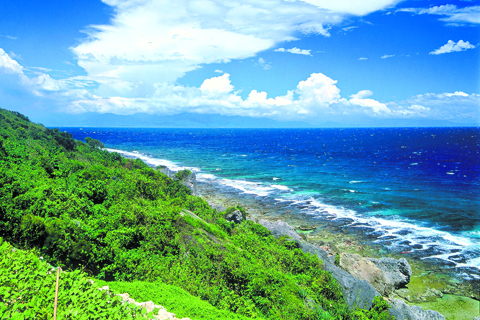
PHOTO COURTESY OF THE DAPENG BAY NATIONAL SCENIC ADMINISTRATION
Eleven years ago, the government relocated the oyster farms and the air force base and established the Dapeng Bay National Scenic Administration.
Today, the bay has gained a reputation as a haven for water sports enthusiasts and is home to the annual Dapeng Cup National Windsurfing Championship. This year, the race will be held on Sunday.
Yang Jui-chi (楊瑞吉), general secretary of the Pingtung County Sailing Association, said the water in Dapeng Bay is around 4m deep, allowing sailboats of various sizes to operate their.
Because the lagoon is free from the influence of the northeast seasonal wind, the wind speed in the bay maintains an average of around level 4 on the Beaufort scale, ideal conditions for sailing, Yang said.
To match the bay’s reputation as a water sports paradise, the Taiwan Area National Expressway Engineering Bureau designed the soon-to-be-completed Dapeng Bridge (大鵬橋) in the shape of a sail. A section of bridge can be opened whenever a large sailboat needs to pass through.
Former Tourism Bureau deputy director general Hsieh Wei-chun (謝謂君) said that once completed, Dapeng Bridge would make it possible for boats to sail from the bay to Liouciou Island (小琉球).
Aside from water sports, Oyster Shell Island (蚵殼島), formed by oyster shells discarded by farmers over the years, is another noteworthy attraction. Visitors can stop by the isle and enjoy fried oysters on the dock.
Cyclists can ride along the bay on a bicycle path.
Hsieh said that the contractor in charge of development of Dapeng Bay — a build-operate-transfer (BOT) project — aims to begin construction of an F-2 racetrack this year.
“So far, they [the contractor] have passed the Federacion Internacional de Automobile evaluation. They need to secure bank loans of approximately NT$400 million [US$13 million] to start building the racetrack and the relevant infrastructure,” Hsieh said.
Meanwhile, the contractor is also applying for licenses from the Civil Aeronautics Administration (CAA) to rent out light aircraft to visitors, Hsieh said.
Visitors to the bay can now watch light aircraft from a seaplane-shaped deck, another of the bay’s landmarks.
Hsieh said that adding Liouciou Island to the Dapeng Bay National Scenic Area had helped add some diversity to the bay’s somewhat monotonous natural scenery. Also known as Samagi (沙瑪基), Liouciou is a small island located off the west coast of Pingtung.
According to the administration’s Web site, the island was first discovered in the Qing Dynasty by Kaohsiung resident Lee Yue (李月). Amazed at its rich fishery resources, Lee called on about 20 families to migrate to the island and named it Liouciou, which means “a ball drifting in the sea.”
To differentiate it from Okinawa, Japan, which has the same pronunciation as the island in Chinese, the island is also called Little Liouciou.
Chien Ching-fa (簡慶發), chief of the Dapeng Bay National Scenic Area Administration’s Liouciou Administration Center, said that most young people move to Taiwan proper after they graduate from junior high school as there is no high school in Liouciou.
In the past, after graduation they were unlikely to return to find jobs, he said. Those who remain in Liouciou, however, relied mainly on fishing.
In recent years, however, more young people have chosen to return and become involved in the tourism industry, Chien said.
Liouciou is famous for natural formations around its coastline, including Black Ghost Cave, Venice Beach, Shanfu Inter-tidal Zone and White Light Tower, which have also made Liouciou a popular place for couples to take wedding portraits.
The island is known for its fresh seafood, including mussels, swordfish and sea lettuce.
Meanwhile, big squid balls and “Cheng’s sausages” are rated by visitors as the two best dishes on the island.
Last year, about 540,000 tourists visited Dapeng Bay and Liouciou, administration director Johnson Sheu said.
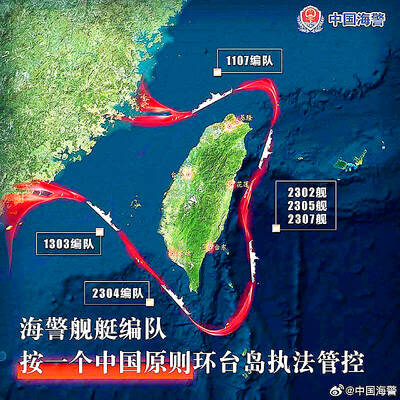
Taiwan would benefit from more integrated military strategies and deployments if the US and its allies treat the East China Sea, the Taiwan Strait and the South China Sea as a “single theater of operations,” a Taiwanese military expert said yesterday. Shen Ming-shih (沈明室), a researcher at the Institute for National Defense and Security Research, said he made the assessment after two Japanese military experts warned of emerging threats from China based on a drill conducted this month by the Chinese People’s Liberation Army’s (PLA) Eastern Theater Command. Japan Institute for National Fundamentals researcher Maki Nakagawa said the drill differed from the

‘WORSE THAN COMMUNISTS’: President William Lai has cracked down on his political enemies and has attempted to exterminate all opposition forces, the chairman said The legislature would motion for a presidential recall after May 20, Chinese Nationalist Party (KMT) Chairman Eric Chu (朱立倫) said yesterday at a protest themed “against green communists and dictatorship” in Taipei. Taiwan is supposed to be a peaceful homeland where people are united, but President William Lai (賴清德) has been polarizing and tearing apart society since his inauguration, Chu said. Lai must show his commitment to his job, otherwise a referendum could be initiated to recall him, he said. Democracy means the rule of the people, not the rule of the Democratic Progressive Party (DPP), but Lai has failed to fulfill his

A rally held by opposition parties yesterday demonstrates that Taiwan is a democratic country, President William Lai (賴清德) said yesterday, adding that if opposition parties really want to fight dictatorship, they should fight it on Tiananmen Square in Beijing. The Chinese Nationalist Party (KMT) held a protest with the theme “against green communists and dictatorship,” and was joined by the Taiwan People’s Party. Lai said the opposition parties are against what they called the “green communists,” but do not fight against the “Chinese communists,” adding that if they really want to fight dictatorship, they should go to the right place and face
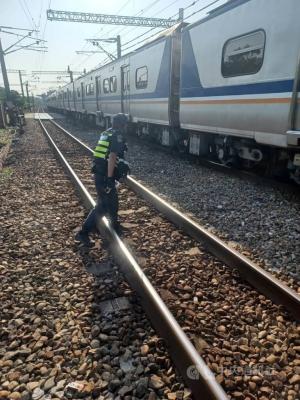
A 79-year-old woman died today after being struck by a train at a level crossing in Taoyuan, police said. The woman, identified by her surname Wang (王), crossed the tracks even though the barriers were down in Jhongli District’s (中壢) Neili (內壢) area, the Taoyuan Branch of the Railway Police Bureau said. Surveillance footage showed that the railway barriers were lowered when Wang entered the crossing, but why she ventured onto the track remains under investigation, the police said. Police said they received a report of an incident at 6:41am involving local train No. 2133 that was heading from Keelung to Chiayi City. Investigators


 RSS
RSS