


A computer program that lets office workers chat on MSN messenger while giving the appearance that one is working has recently become extremely popular.
The program, JustChat, allows messaging content to appear in the windows of various software programs that office workers use, such as Microsoft Word or Excel. Users who are actually chatting online appear hard at work as they type away in what looks like a Word document.
Office workers who see or hear their boss nearing their workstation can close JustChat at the touch of a button. The program also allows users to switch between different chat windows by clicking on the tabs that are discreetly placed at the top of each dialogue box.
“This thing is too wonderful,” an Internet user called “QQ” said.
Another user, with the online name “Ausir,” said: “How terrible for bosses.”
JustChat, developed by a Taiwanese programmer, has been spreading like wildfire as office workers who chat during work hours pass on the news to each other.
However, IT specialists warn that JustChat is only useful in fooling those who happen to walk by your computer, but not your company’s internal IT department.
“Most companies have a monitoring system that track employees’ actions online, such as which Web sites they are visiting, who they are talking to using instant messaging software, what files they are transferring using FTP [File Transfer Protocol] and what they are writing in their e-mails,” said Roger Huang (黃志成), an IT consultant at IBM Taiwan.
The system is designed not only to keep bored workers from misusing their office hours, but also to act as a gatekeeper in preventing confidential corporate data from being leaked into the wrong hands, he said.
Or, as Internet user “Small Role” put it, “MSN monitoring systems have full records of all your conversations. Better to just spend working hours working.”

LOUD AND PROUD Taiwan might have taken a drubbing against Australia and Japan, but you might not know it from the enthusiasm and numbers of the fans Taiwan might not be expected to win the World Baseball Classic (WBC) but their fans are making their presence felt in Tokyo, with tens of thousands decked out in the team’s blue, blowing horns and singing songs. Taiwanese fans have packed out the Tokyo Dome for all three of their games so far and even threatened to drown out home team supporters when their team played Japan on Friday. They blew trumpets, chanted for their favorite players and had their own cheerleading squad who dance on a stage during the game. The team struggled to match that exuberance on the field, with
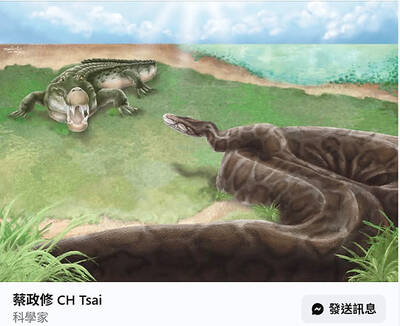
Taiwanese paleontologists have discovered fossil evidence that pythons up to 4m long inhabited Taiwan during the Pleistocene epoch, reporting their findings in the international scientific journal Historical Biology. National Taiwan University (NTU) Institute of Ecology and Evolutionary Biology associate professor Tsai Cheng-hsiu (蔡政修) led the team that discovered the largest snake fossil ever found in Taiwan. The single trunk vertebra was discovered in Tainan at the Chiting Formation, dated to between 400,000 and 800,000 years ago in the Middle Pleistocene, the paper said. The area also produced Taiwan’s first avian fossil, as well as crocodile, mammoth, saber-toothed cat and rhinoceros fossils, it said. Discoveries

Taiwanese paleontologists have discovered fossil evidence that pythons up to 4m long inhabited Taiwan during the Pleistocene epoch, reporting their findings in the international scientific journal Historical Biology. National Taiwan University (NTU) Institute of Ecology and Evolutionary Biology associate professor Tsai Cheng-hsiu (蔡政修) led the team that discovered the largest snake fossil ever found in Taiwan. A single trunk vertebra was discovered in Tainan at the Chiting Formation, dated to between 800,000 to 400,000 years ago in the Middle Pleistocene, the paper said. The area also produced Taiwan’s first avian fossil, as well as crocodile, mammoth, sabre-toothed cat and rhinoceros fossils, it said. Discoveries

Whether Japan would help defend Taiwan in case of a cross-strait conflict would depend on the US and the extent to which Japan would be allowed to act under the US-Japan Security Treaty, former Japanese minister of defense Satoshi Morimoto said. As China has not given up on the idea of invading Taiwan by force, to what extent Japan could support US military action would hinge on Washington’s intention and its negotiation with Tokyo, Morimoto said in an interview with the Liberty Times (sister paper of the Taipei Times) yesterday. There has to be sufficient mutual recognition of how Japan could provide


 RSS
RSS